
We read your photo as:
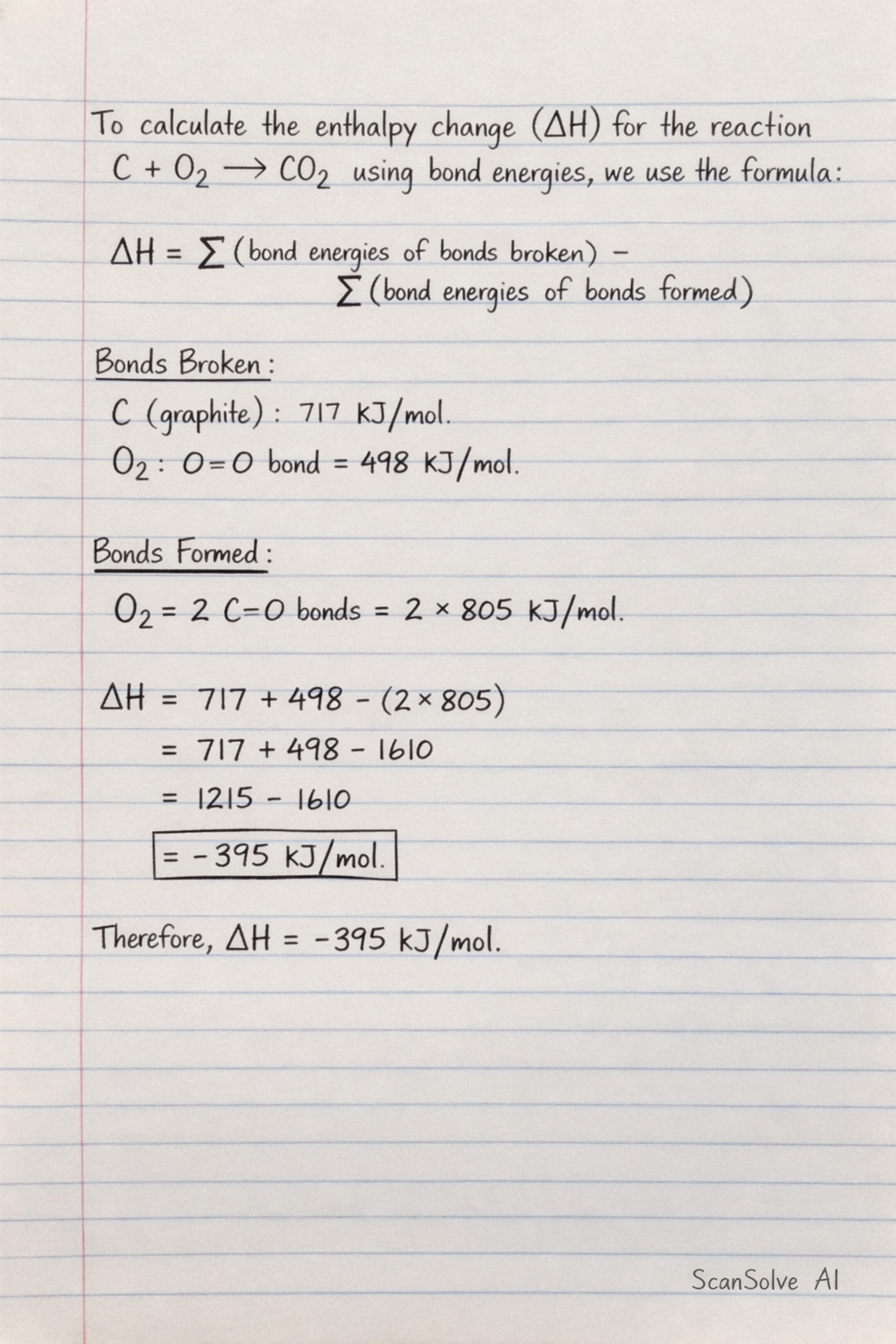
To calculate the enthalpy change ( H) for the reaction C + O2 -> CO2 using bond energies, we use the formula:
Geography
ScanSolve AI Answer
Answer
Step-by-step solution
3 stepsTo calculate the enthalpy change () for the reaction using bond energies, we use the formula:
Let's identify the bonds broken in the reactants and bonds formed in the products.
-
Reactants:
- (graphite): The energy given for C(graphite) (717 kJ/mol) represents the energy required to atomize one mole of solid carbon into gaseous carbon atoms. This is an energy input, similar to breaking bonds.
- : This molecule contains one double bond. The energy required to break this bond is 498 kJ/mol.
-
Products:
- : This molecule has a linear structure with two double bonds. The energy released when these bonds are formed is .
Calculate the total energy required to break bonds (reactants).
Energy to atomize C(graphite) =
Energy to break 1 mole of bonds =
Total energy for bond breaking =Calculate the total energy released when bonds are formed (products).
Energy released from forming 2 moles of bonds =
Calculate the enthalpy change ().
Comparing this value to the given options, -394 kJ/mol is the closest.
The final answer is .
Was this helpful?
Try one yourself
A new problem that tests the same skill.
Still stuck on this one?
Ask a follow-up, and the answer starts from this question.
Got a different question?Ask your own question
More Geography Questions
QTo determine the enthalpy change for the reaction using bond energies, we use the formula:QCalculate the enthalpy change for the reaction C2H4 + H2 -> C2H6 using the provided bond energies.QCalculate the enthalpy change of the reaction C3H8(g) + 5O2(g) -> 3CO2(g) + 4H2O(l) using the given…QCalculate the enthalpy change for the combustion of ethane (C2H6) using bond enthalpy data.QCalculate the enthalpy change for the following reaction: C2H4(g) + Br2(g) -> C2H4Br2(g)
Handwritten Step-by-Step Solution
Get this as a handwritten image on WhatsApp — like a tutor wrote it for you.
Try on WhatsApp