

This geography problem is solved step by step below, with detailed explanations to help you understand the method and arrive at the correct answer.
ScanSolve AI Answer
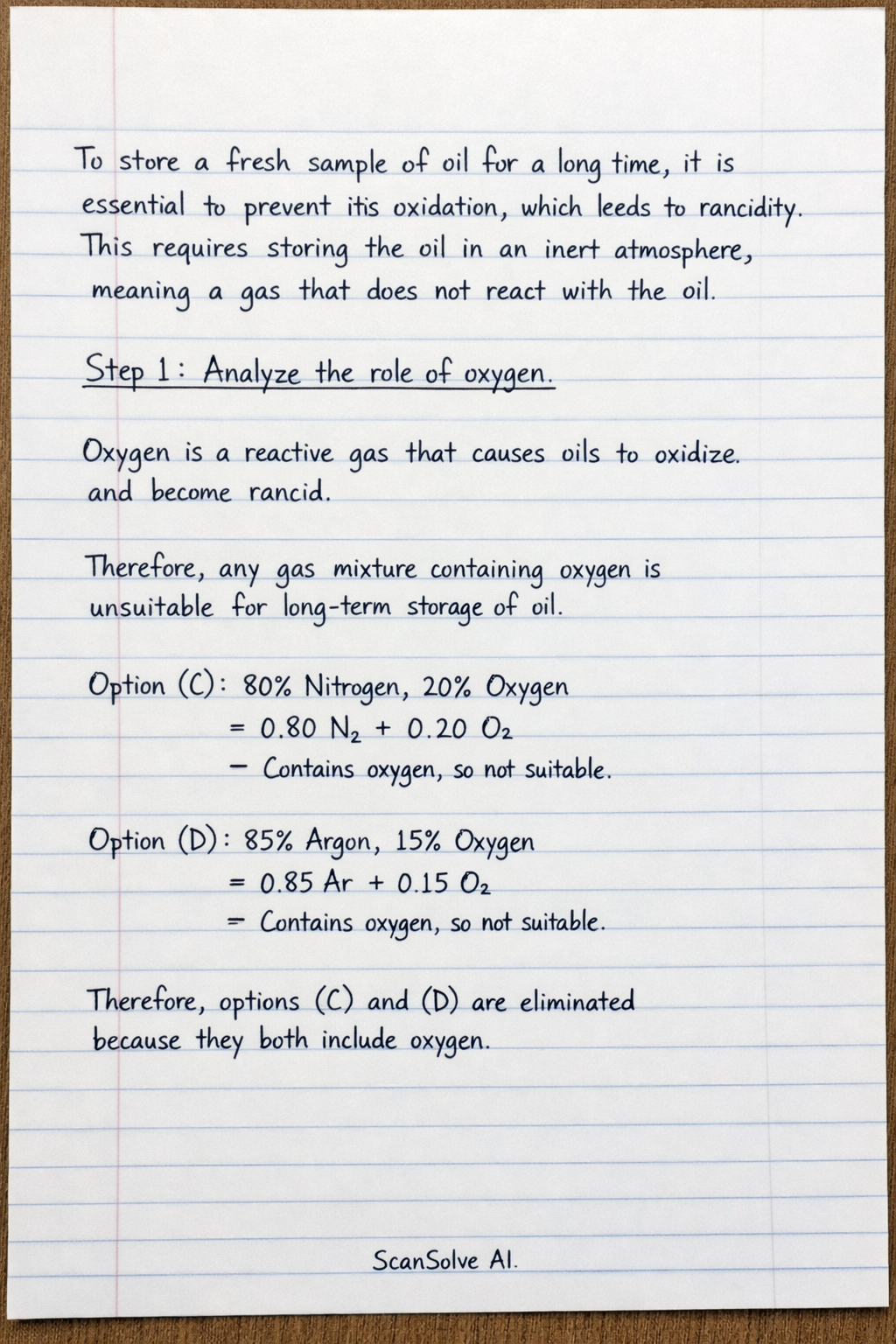
To store a fresh sample of oil for a long time, it is essential to prevent its oxidation, which leads to rancidity. This requires storing the oil in an inert atmosphere, meaning a gas that does not react with the oil. Step 1: Analyze the role of oxygen. Oxygen is a reactive gas that causes oils to oxidize and become rancid. Therefore, any gas mixture containing oxygen is unsuitable for long-term storage of oil. This eliminates options (C) and (D) because they both include oxygen. Step 2: Evaluate the remaining inert gases. We are left with options (A) and (B): (A) Carbon dioxide or helium: Helium* (He) is a noble gas and is chemically inert, meaning it does not react with other substances under normal conditions. It is an excellent choice for creating an inert atmosphere. Carbon dioxide* (CO_2) is generally unreactive with oils and can displace oxygen, making it suitable for preventing oxidation. It is often used in modified atmosphere packaging. (B) Helium or nitrogen: Helium* (He) is, as mentioned, an inert noble gas. Nitrogen* (N_2) is a diatomic molecule with a very strong triple bond, making it largely unreactive under normal conditions. It is widely used in food packaging to create an inert atmosphere and prevent oxidation. Step 3: Select the best option. Both helium and nitrogen are highly effective and commonly used inert gases for preventing the oxidation of oils and fats. Carbon dioxide is also effective. However, nitrogen and helium are quintessential inert gases. Option (B) pairs two of the most universally recognized and chemically inert gases for this purpose. The correct option is (B). The gases that can be used for storage of a fresh sample of an oil for a long time are Helium or nitrogen. Last free one today — make it count tomorrow, or type /upgrade for unlimited.