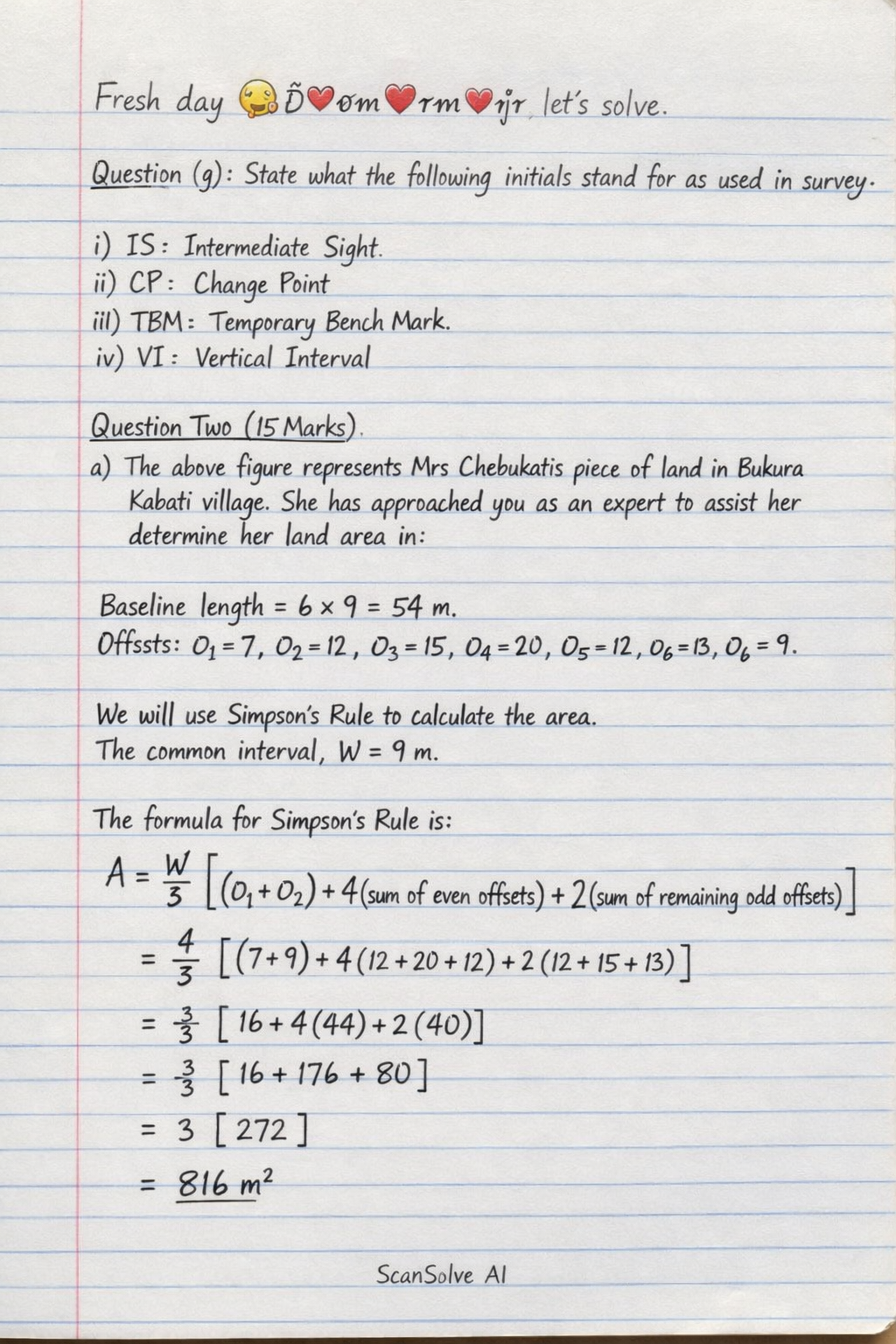
We read your photo as:

State what the following initials stand for as used in survey: i) IS: ii) CP: iii) TBM: iv) VI:

Geography

ScanSolve AI Answer

Answers

2 parts
b(i)

334.33 m334.33 \text{ m}

b(ii)

1.76 hectares1.76 \text{ hectares}

Step-by-step solution

12 steps

Part g(i)

IS: **Intermediate Sight

State what the following initials stand for as used in survey

Part g(ii)

CP: **Change Point

Part g(iii)

TBM: **Temporary Bench Mark

Part g(iv)

VI: **Vertical Interval

Question Two (15 Marks)

Part a· 5 steps

The above figure represents Mrs Chebukatis piece of land in Bukura Kabati village. She has approached you as an expert to assist her determine her land area in

The figure shows a baseline divided into 6 equal intervals of 9 m each, making the total baseline length 6×9=546 \times 9 = 54 m. There are 7 offsets given: O1=7,O2=12,O3=15,O4=20,O5=12,O6=13,O7=9O_1=7, O_2=12, O_3=15, O_4=20, O_5=12, O_6=13, O_7=9.
We will use Simpson's Rule to calculate the area. The common interval W=9W = 9 m.

The formula for Simpson's Rule is:

A=W3[(O1+On)+4(sum of even offsets)+2(sum of remaining odd offsets)]A = \frac{W}{3} [ (O_1 + O_n) + 4(\text{sum of even offsets}) + 2(\text{sum of remaining odd offsets}) ]
  1. Identify the offsets and common interval.

    W=9 mW = 9 \text{ m}
    O1=7 mO_1 = 7 \text{ m}
    O2=12 mO_2 = 12 \text{ m}
    O3=15 mO_3 = 15 \text{ m}
    O4=20 mO_4 = 20 \text{ m}
    O5=12 mO_5 = 12 \text{ m}
    O6=13 mO_6 = 13 \text{ m}
    O7=9 mO_7 = 9 \text{ m}

  2. Calculate the sum of the first and last offsets.

    O1+O7=7+9=16 mO_1 + O_7 = 7 + 9 = 16 \text{ m}
  3. Calculate the sum of the even offsets.

    O2+O4+O6=12+20+13=45 mO_2 + O_4 + O_6 = 12 + 20 + 13 = 45 \text{ m}
  4. Calculate the sum of the remaining odd offsets (excluding the first and last).

    O3+O5=15+12=27 mO_3 + O_5 = 15 + 12 = 27 \text{ m}
  5. Apply Simpson's Rule to find the area in M2M^2.

    A=93[(16)+4(45)+2(27)]A = \frac{9}{3} [ (16) + 4(45) + 2(27) ] A=3[16+180+54]A = 3 [ 16 + 180 + 54 ] A=3[250]A = 3 [ 250 ] A=750 m2A = 750 \text{ m}^2

Part a(i)· 1 step

Area in M2M^2: 750 m2\boxed{750 \text{ m}^2}

  1. Convert the area to Acres.

    Given that 1 acre=4046.86 m21 \text{ acre} = 4046.86 \text{ m}^2.

    Area in Acres=750 m24046.86 m2/acre\text{Area in Acres} = \frac{750 \text{ m}^2}{4046.86 \text{ m}^2/\text{acre}} Area in Acres≈0.1853 acres\text{Area in Acres} \approx 0.1853 \text{ acres}

Part a(ii)· 1 step

Area in Acres: 0.1853 acres\boxed{0.1853 \text{ acres}}

  1. Convert the area to Hectares.

    Given that 1 hectare=10000 m21 \text{ hectare} = 10000 \text{ m}^2.

    Area in Hectares=750 m210000 m2/hectare\text{Area in Hectares} = \frac{750 \text{ m}^2}{10000 \text{ m}^2/\text{hectare}} Area in Hectares=0.075 hectares\text{Area in Hectares} = 0.075 \text{ hectares}

Part a(iii)

Area in Hectares: 0.075 hectares\boxed{0.075 \text{ hectares}}

Part b(i)

334.33 m334.33 \text{ m}

The correct distance in Meters

Below is the data collected during chain survey carried out at Bukura Agricultural College main farm by survey students

Area they calculated was 4.5 acres
Distance they recorded using a chain length of 29.5m was 340m
If the length of their standard chain was 30m, calculate;

  1. Use the formula for correct distance.

    Correct Distance=Recorded Distance×Faulty Chain LengthStandard Chain Length\text{Correct Distance} = \text{Recorded Distance} \times \frac{\text{Faulty Chain Length}}{\text{Standard Chain Length}}
  2. Substitute the given values.

    Correct Distance=340 m×29.5 m30 m\text{Correct Distance} = 340 \text{ m} \times \frac{29.5 \text{ m}}{30 \text{ m}} Correct Distance=340×0.98333...\text{Correct Distance} = 340 \times 0.98333... Correct Distance≈334.33 m\text{Correct Distance} \approx 334.33 \text{ m}

    The correct distance in Meters is 334.33 m\boxed{334.33 \text{ m}}.

Part b(ii)

1.76 hectares1.76 \text{ hectares}

The correct area in Hectares

  1. Use the formula for correct area.

    Correct Area=Calculated Area×(Faulty Chain LengthStandard Chain Length)2\text{Correct Area} = \text{Calculated Area} \times \left( \frac{\text{Faulty Chain Length}}{\text{Standard Chain Length}} \right)^2
  2. Substitute the given values.

    Correct Area=4.5 acres×(29.5 m30 m)2\text{Correct Area} = 4.5 \text{ acres} \times \left( \frac{29.5 \text{ m}}{30 \text{ m}} \right)^2 Correct Area=4.5×(0.98333...)2\text{Correct Area} = 4.5 \times (0.98333...)^2 Correct Area=4.5×0.966944...\text{Correct Area} = 4.5 \times 0.966944... Correct Area≈4.35125 acres\text{Correct Area} \approx 4.35125 \text{ acres}
  3. Convert the correct area from acres to hectares.

    Given that 1 acre=0.404686 hectares1 \text{ acre} = 0.404686 \text{ hectares}.

    Correct Area in Hectares=4.35125 acres×0.404686hectaresacre\text{Correct Area in Hectares} = 4.35125 \text{ acres} \times 0.404686 \frac{\text{hectares}}{\text{acre}} Correct Area in Hectares≈1.7616 hectares\text{Correct Area in Hectares} \approx 1.7616 \text{ hectares}

    The correct area in Hectares is 1.76 hectares\boxed{1.76 \text{ hectares}}.

    Question Three (a):
    The question is incomplete as the table of data for the levelling exercise is cut off. Please provide the full table and the specific questions related to it for me to solve.

Was this helpful?

Try one yourself

A new problem that tests the same skill.

Still stuck on this one?

Ask a follow-up, and the answer starts from this question.

Got a different question?Ask your own question
Handwritten step-by-step solution preview

Handwritten Step-by-Step Solution

Get this as a handwritten image on WhatsApp — like a tutor wrote it for you.

Try on WhatsApp