
We read your photo as:
Major educational ideas that emerged during the Renaissance, Reformation, and Counter-Reformation period.
ScanSolve AI Answer
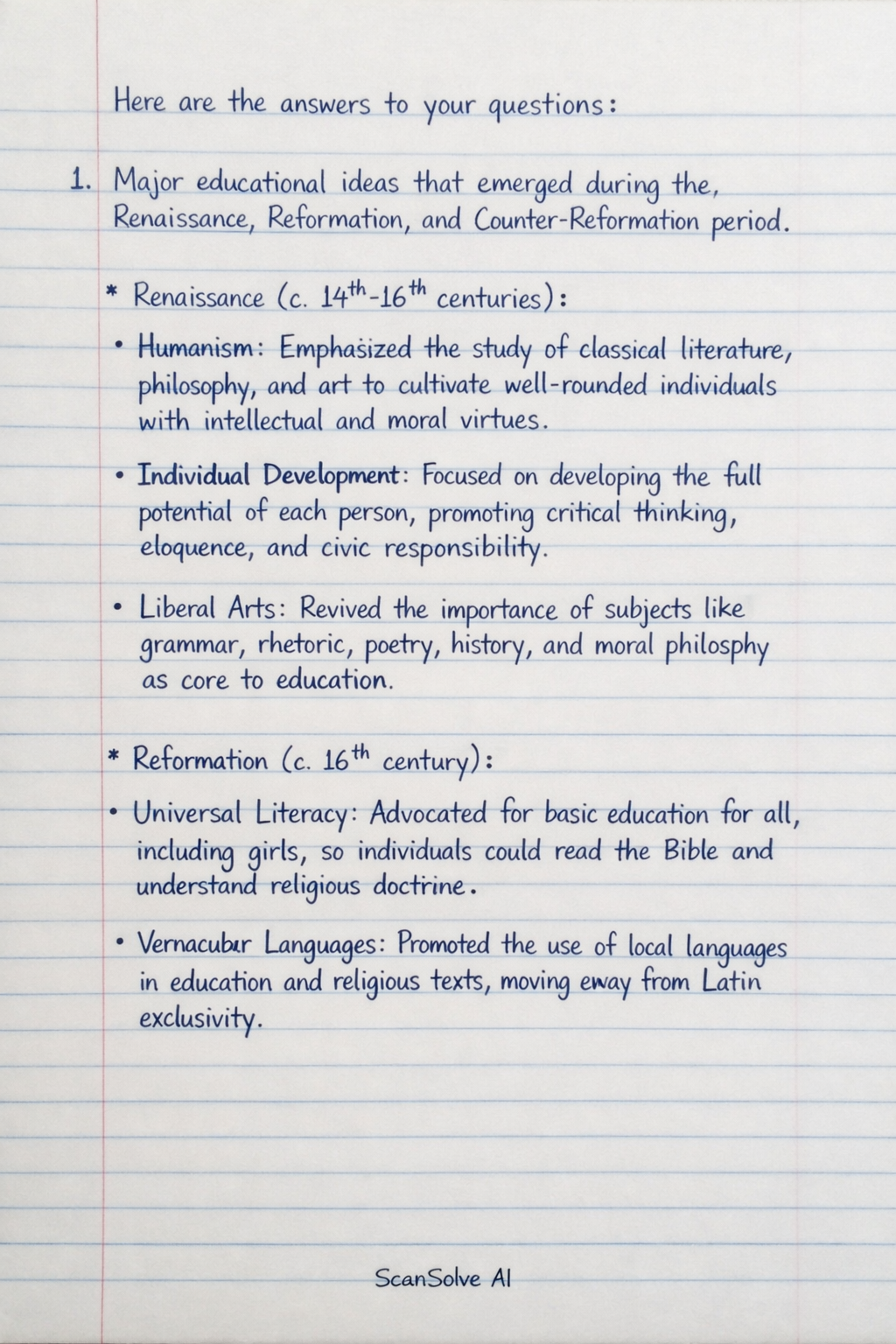
Here are the answers to your questions:
1. Major educational ideas that emerged during the Renaissance, Reformation, and Counter-Reformation period.
- Renaissance (c. 14th-16th centuries):
- Humanism: Emphasized the study of classical literature, philosophy, and art to cultivate well-rounded individuals with intellectual and moral virtues.
- Individual Development: Focused on developing the full potential of each person, promoting critical thinking, eloquence, and civic responsibility.
- Liberal Arts: Revived the importance of subjects like grammar, rhetoric, poetry, history, and moral philosophy as core to education.
- Reformation (c. 16th century):
- Universal Literacy: Advocated for basic education for all, including girls, so individuals could read the Bible and understand religious doctrine.
- Vernacular Languages: Promoted the use of local languages in education and religious texts, moving away from Latin exclusivity.
- State Control of Education: Shifted some educational authority from the Church to the state, leading to the establishment of public schools.
- Moral and Religious Instruction: Maintained a strong emphasis on religious and moral training as central to character development.
- Counter-Reformation (c. 16th-17th centuries):
- Religious Orthodoxy: Reaffirmed Catholic doctrines and sought to combat Protestantism through rigorous religious instruction.
- Jesuit Education: Established highly organized and disciplined schools (e.g., by the Society of Jesus) that offered a comprehensive curriculum, including classical studies, science, and theology, with a focus on intellectual excellence and loyalty to the Church.
- Teacher Training: Emphasized the thorough training of teachers to ensure consistent and effective delivery of Catholic education.
2. Definition of realism and its four features in education during the seventeenth century.
-
Realism: A philosophical approach that asserts that reality exists independently of human consciousness and can be understood through observation, experience, and scientific inquiry. In education, it emphasizes learning about the real world directly rather than through abstract ideas or traditional texts alone.
-
Four Features of Realism in 17th Century Education:
- i) Sense Realism: Advocated for learning through direct sensory experience and observation of nature. Thinkers like John Amos Comenius promoted the use of illustrated textbooks and direct engagement with objects to make learning concrete and understandable.
- ii) Social Realism: Focused on preparing individuals for practical life in society, emphasizing manners, social graces, and the skills needed for specific social roles. Education was seen as a means to navigate and succeed in the social world, often through travel and interaction with different cultures.
- iii) Humanistic Realism: While still valuing classical texts, this approach emphasized studying them for their content and understanding of human nature and society, rather than just for linguistic style or grammar. It sought practical wisdom from the classics.
- iv) Scientific Realism: Stressed the importance of the scientific method, experimentation, and the study of natural sciences. Figures like Francis Bacon and John Locke advocated for empirical observation and rational inquiry as the basis for knowledge, influencing the inclusion of science in the curriculum.
3. Features of colonial education in Kenya between 1926 and 1963.
The period between 1926 and 1963 saw the entrenchment of colonial education policies, heavily influenced by the recommendations of the Phelps-Stokes Commissions. Key features included:
- i) Racial Segregation: Education was strictly segregated along racial lines, with separate and unequal systems for Europeans, Asians, and Africans. European schools received the best funding and resources, followed by Asian schools, while African schools were severely underfunded.
- ii) Vocational and Technical Bias for Africans: African education was primarily designed to provide basic literacy and numeracy, coupled with strong emphasis on practical and vocational skills (e.g., agriculture, carpentry, domestic science). This was intended to produce a semi-skilled labor force for the colonial economy and prevent Africans from pursuing higher academic or professional careers.
- iii) Limited Access and Progression for Africans: Access to education for Africans was severely restricted, especially at secondary and higher levels. The colonial government deliberately limited opportunities to prevent political awakening and maintain social control.
- iv) Missionary Dominance: Christian missionary societies continued to play a dominant role in providing and managing African education. They established most schools, integrated religious instruction into the curriculum, and often acted as agents of cultural assimilation.
- v) Curriculum Irrelevance and Eurocentrism: The curriculum was largely Eurocentric, focusing on British history, geography, and culture, with little relevance to the African context or the aspirations of the local population. This aimed to instill colonial values and loyalty.
Still stuck on this one?
Ask a follow-up, and the answer starts from this question.
More History Questions
Handwritten Step-by-Step Solution
Get this as a handwritten image on WhatsApp — like a tutor wrote it for you.
Try on WhatsApp