

This history question requires analysis of historical events, causes, and consequences. The detailed answer below provides context, evidence, and a well-structured explanation.
ScanSolve AI Answer
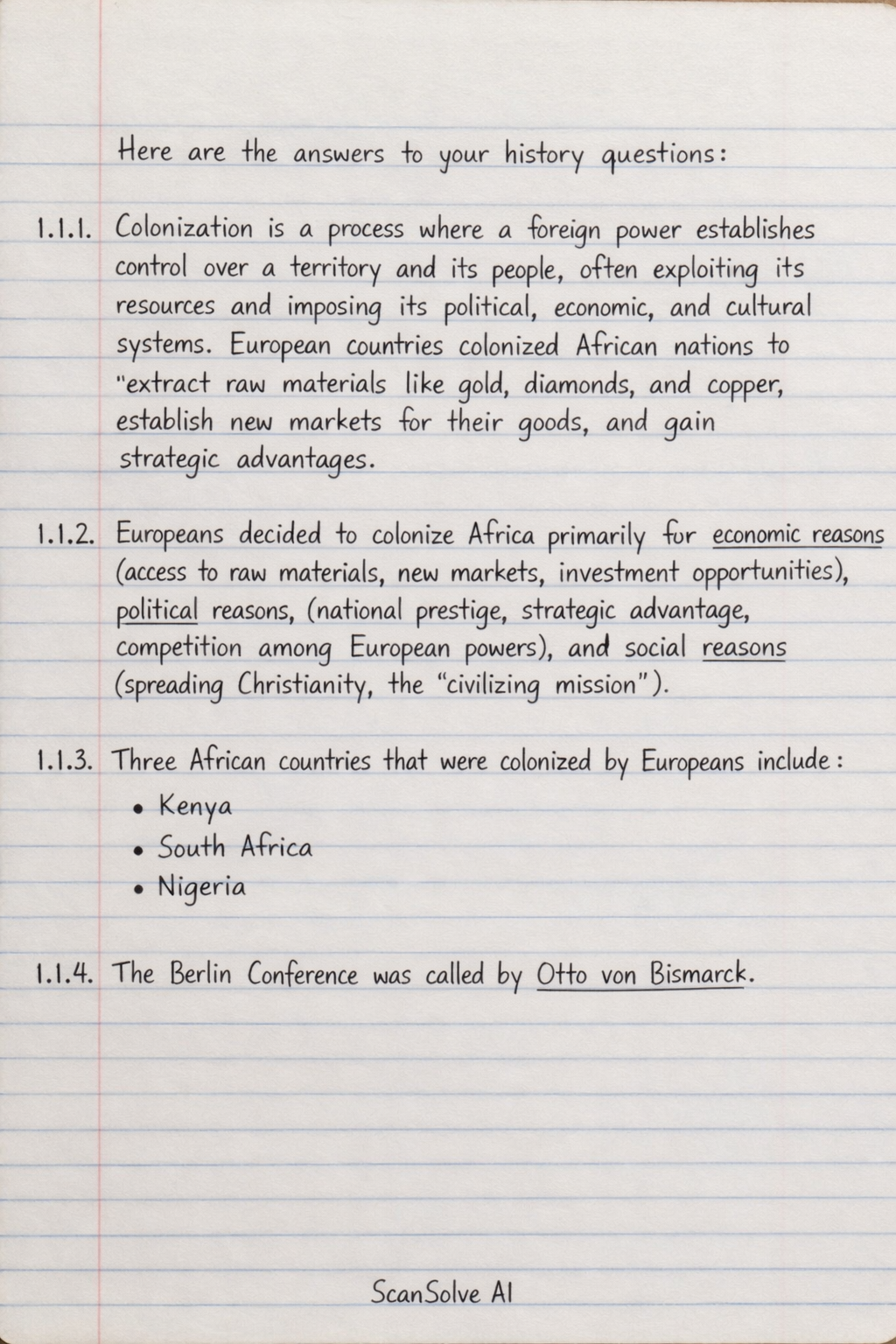
Here are the answers to your history questions: 1.1.1 Colonization is a process where a foreign power establishes control over a territory and its people, often exploiting its resources and imposing its political, economic, and cultural systems. European countries colonized African nations to extract raw materials like gold, diamonds, and copper, establish new markets for their goods, and gain strategic advantages. 1.1.2 Europeans decided to colonize Africa primarily for economic reasons (access to raw materials, new markets, investment opportunities), political reasons (national prestige, strategic advantage, competition among European powers), and social reasons (spreading Christianity, the "civilizing mission"). 1.1.3 Three African countries that were colonized by Europeans include: • Kenya • South Africa • Nigeria 1.1.4 The Berlin Conference was called by Otto von Bismarck. 1.1.5 Otto von Bismarck decided to call the Berlin Conference in Germany to regulate European colonization and trade in Africa and to prevent conflicts among the European powers themselves over the scramble for African territory. He aimed to establish rules for the peaceful division of Africa and solidify Germany's role as a major European power. That's 2 down. 3 left today — send the next one.