
We read your photo as:
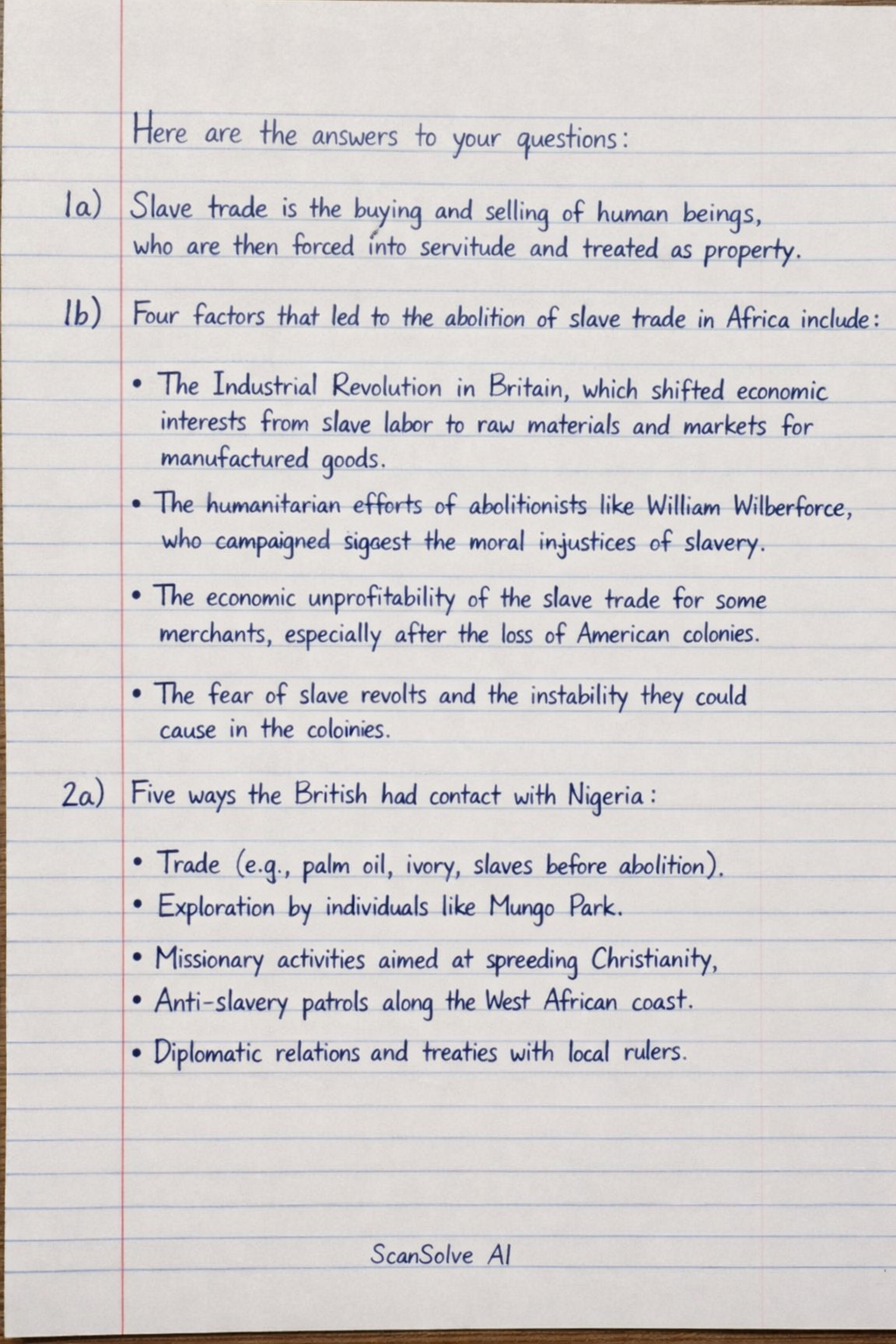
1a) Slave trade is the buying and selling of human beings, who are then forced into servitude and treated as property.
ScanSolve AI Answer
Here are the answers to your questions:
1a) Slave trade is the buying and selling of human beings, who are then forced into servitude and treated as property.
1b) Four factors that led to the abolition of slave trade in Africa include:
- The Industrial Revolution in Britain, which shifted economic interests from slave labor to raw materials and markets for manufactured goods.
- The humanitarian efforts of abolitionists like William Wilberforce, who campaigned against the moral injustices of slavery.
- The economic unprofitability of the slave trade for some merchants, especially after the loss of American colonies.
- The fear of slave revolts and the instability they could cause in the colonies.
2a) Five ways the British had contact with Nigeria:
- Trade (e.g., palm oil, ivory, slaves before abolition).
- Exploration by individuals like Mungo Park.
- Missionary activities aimed at spreading Christianity.
- Anti-slavery patrols along the West African coast.
- Diplomatic relations and treaties with local rulers.
2b) Five methods used by the British government to conquer her territories:
- Military force and expeditions.
- Signing of treaties with local chiefs.
- Economic pressure and trade monopolies.
- Divide and rule tactics among local communities.
- Establishment of protectorates and indirect rule.
3a) Three important things that took place in the Berlin Conference (1884-1885):
- It established the principle of effective occupation, meaning a European power had to demonstrate actual control over a territory to claim it.
- It formally partitioned Africa among European powers, drawing arbitrary borders without regard for existing ethnic or cultural divisions.
- It declared the Congo River basin a free trade zone, open to all European nations.
3b) Two major reasons for the Berlin Conference:
- To regulate European colonization and trade in Africa, preventing conflicts among the competing powers.
- To legitimize the scramble for Africa by establishing rules for claiming and administering African territories.
4a) Amalgamation, in the context of Nigerian history, refers to the unification of the Northern and Southern Protectorates of Nigeria in 1914 by the British colonial government, forming a single colony.
4b) Four reasons for the amalgamation of the Nigerian territories by the British Government:
- Administrative convenience: It was easier and more efficient to administer one large territory than two separate ones.
- Economic reasons: The Northern Protectorate was not financially self-sufficient, and its deficit was covered by the more prosperous Southern Protectorate, particularly through customs revenue from Lagos.
- Strategic reasons: To consolidate British control over the entire region and present a unified front against potential rival European powers.
- Development of infrastructure: A unified administration could better coordinate the development of infrastructure like railways and roads across the entire territory.
Still stuck on this one?
Ask a follow-up, and the answer starts from this question.
More History Questions
Handwritten Step-by-Step Solution
Get this as a handwritten image on WhatsApp — like a tutor wrote it for you.
Try on WhatsApp