

This history question requires analysis of historical events, causes, and consequences. The detailed answer below provides context, evidence, and a well-structured explanation.
ScanSolve AI Answer
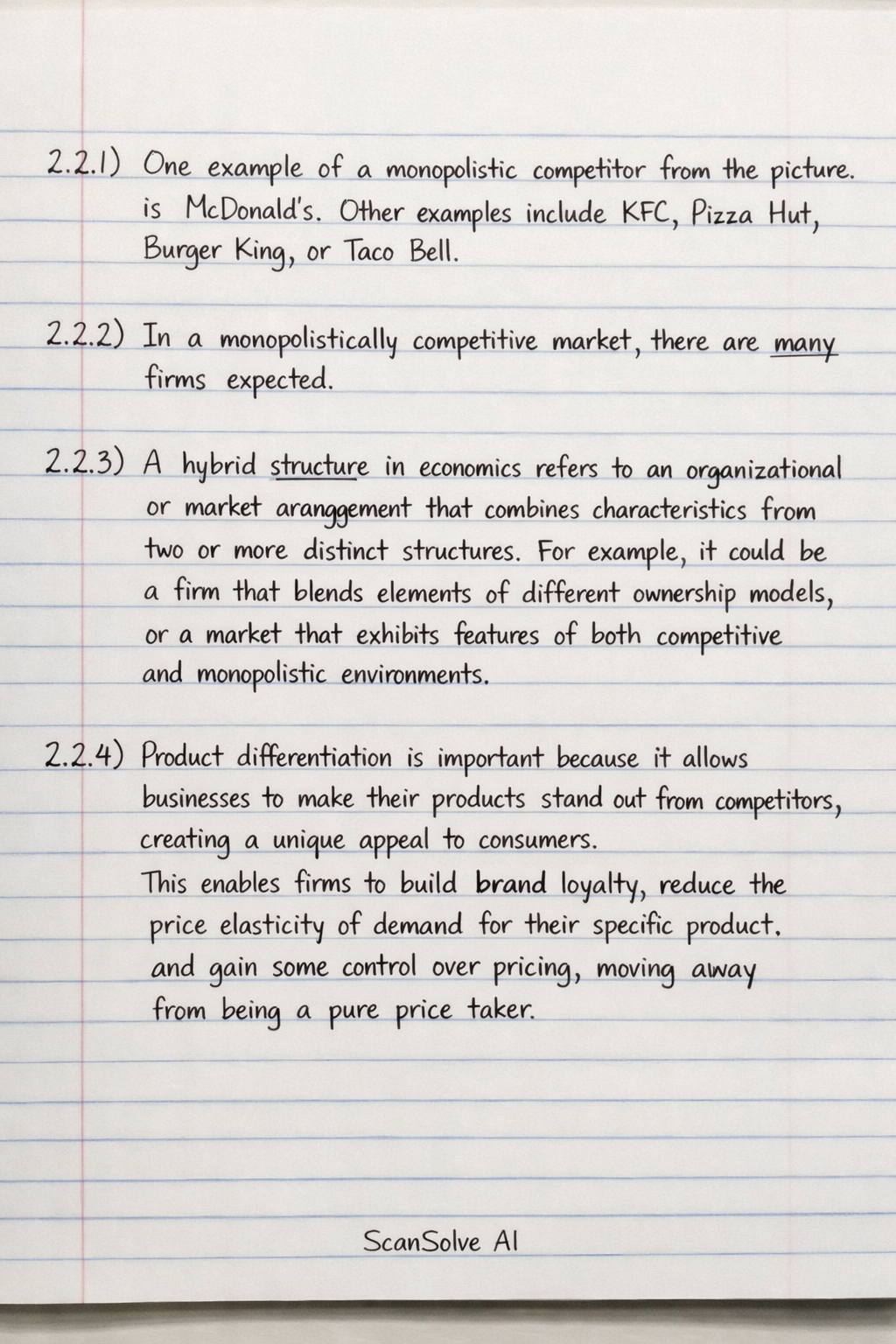
2.2.1) One example of a monopolistic competitor from the picture is McDonald's. Other examples include KFC, Pizza Hut, Burger King, or Taco Bell. 2.2.2) In a monopolistically competitive market, there are many firms expected. 2.2.3) A hybrid structure in economics refers to an organizational or market arrangement that combines characteristics from two or more distinct structures. For example, it could be a firm that blends elements of different ownership models, or a market that exhibits features of both competitive and monopolistic environments. 2.2.4) Product differentiation is important because it allows businesses to make their products stand out from competitors, creating a unique appeal to consumers. This enables firms to build brand loyalty, reduce the price elasticity of demand for their specific product, and gain some control over pricing, moving away from being a pure price taker. 2.2.5) Free entry affects the demand curve of a monopolistically competitive firm in the following way: • If firms in the industry are earning economic profits, new firms will be attracted to enter the market due to the low barriers to entry. • As new firms enter, the number of available substitutes for existing firms' products increases. This causes the demand curve for each existing firm to shift to the left (decrease) and become more elastic. • This process continues until economic profits are eliminated, and firms earn only normal profits in the long run, at which point there is no further incentive for new firms to enter. That's 2 down. 3 left today — send the next one.