
We read your photo as:
Before the Industrial Revolution, light-colored peppered moths (Biston betularia) were common because they were camouflaged against light-colored, lichen-covered tree trunks, making them less visibl
ScanSolve AI Answer
Step-by-step solution
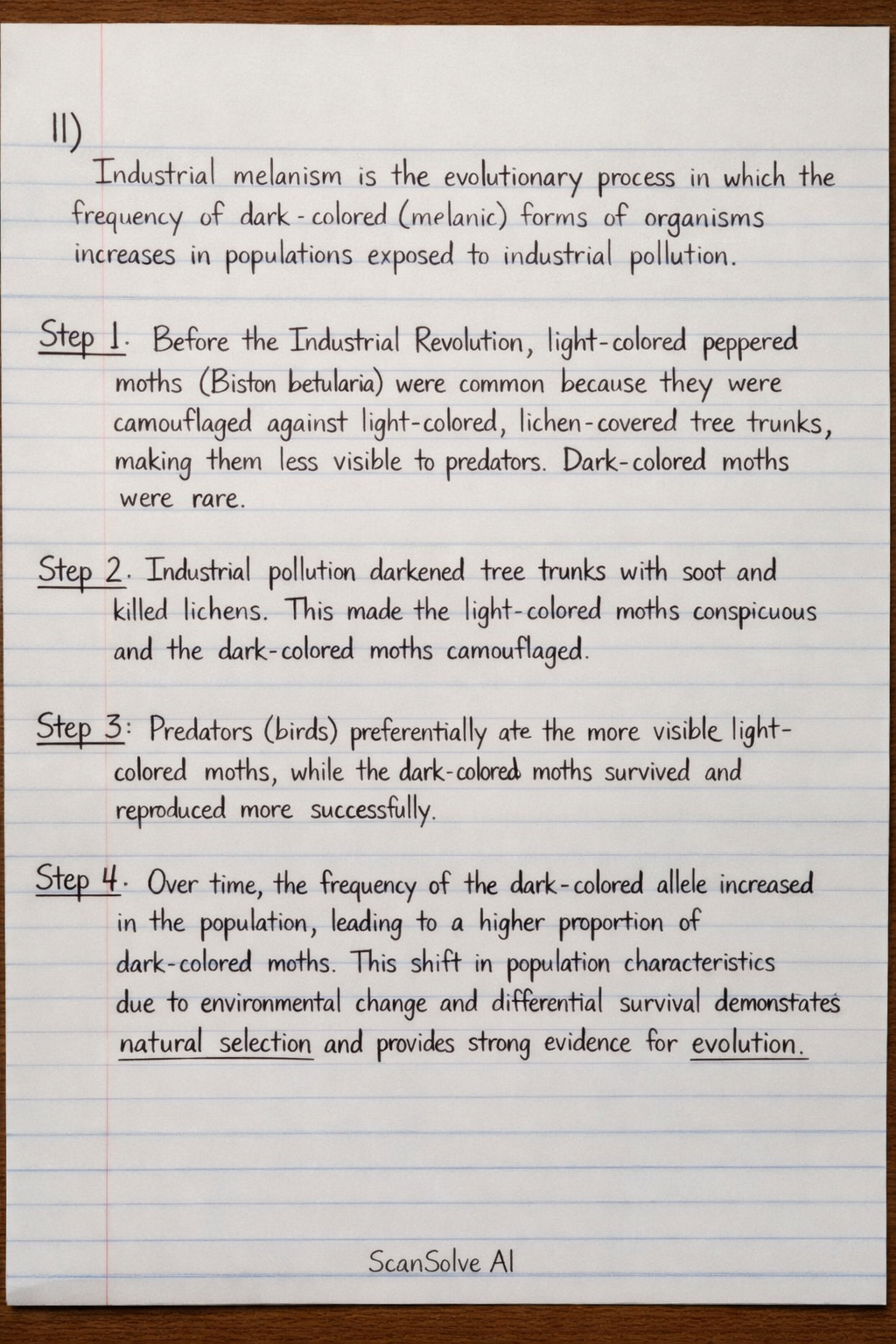
4 steps11) Industrial melanism is the evolutionary process in which the frequency of dark-colored (melanic) forms of organisms increases in populations exposed to industrial pollution.
Before the Industrial Revolution, light-colored peppered moths (Biston betularia) were common because they were camouflaged against light-colored, lichen-covered tree trunks, making them less visible to predators.
Dark-colored moths were rare.
Industrial pollution darkened tree trunks with soot and killed lichens.
This made the light-colored moths conspicuous and the dark-colored moths camouflaged.
Predators (birds) preferentially ate the more visible light-colored moths, while the dark-colored moths survived and reproduced more successfully.
Over time, the frequency of the dark-colored allele increased in the population, leading to a higher proportion of dark-colored moths.
This shift in population characteristics due to environmental change and differential survival demonstrates natural selection and provides strong evidence for evolution.
Still stuck on this one?
Ask a follow-up, and the answer starts from this question.
More History Questions
Handwritten Step-by-Step Solution
Get this as a handwritten image on WhatsApp — like a tutor wrote it for you.
Try on WhatsApp