
We read your photo as:
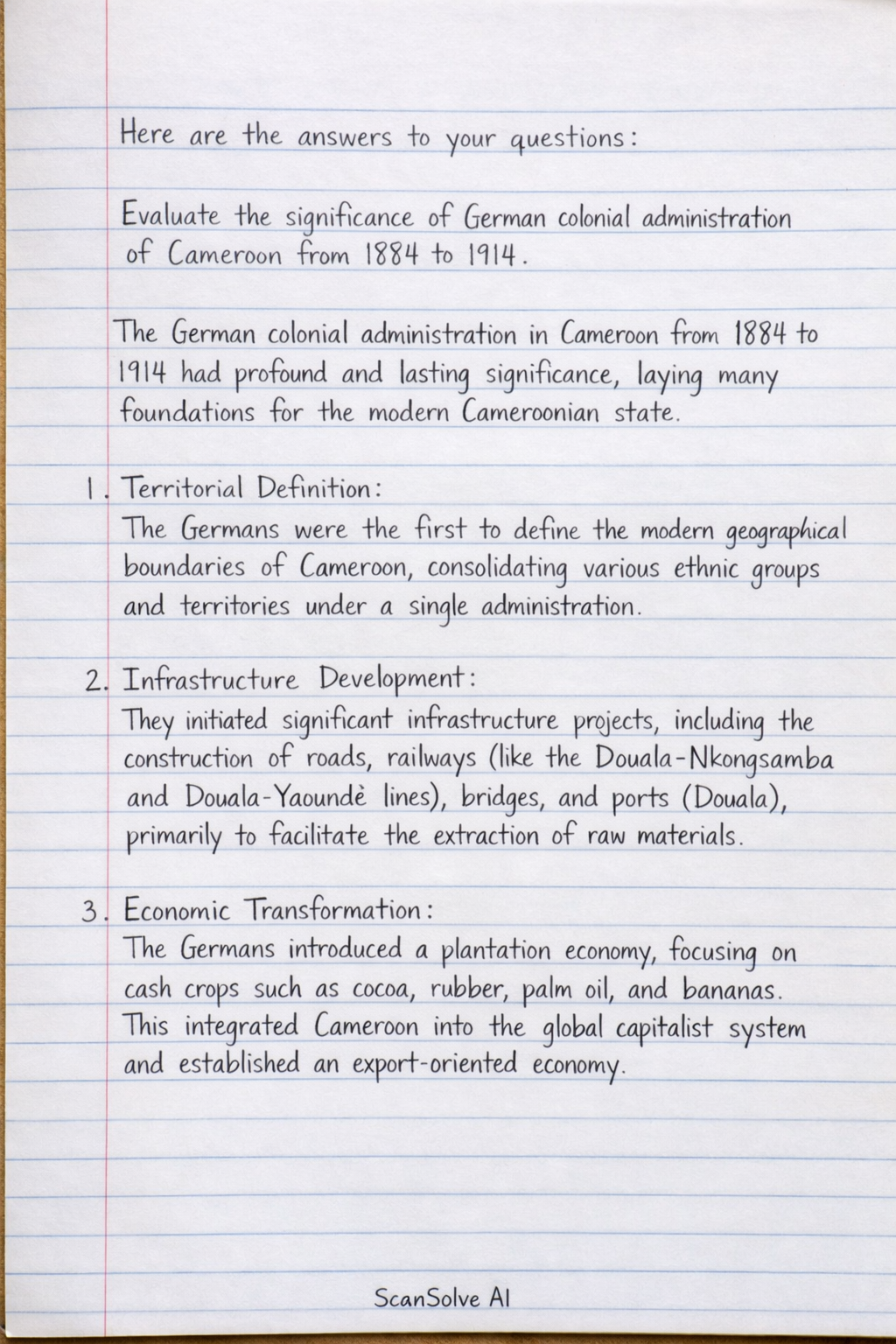
Evaluate the significance of German colonial administration of Cameroon from 1884 to 1914.
ScanSolve AI Answer
Here are the answers to your questions:
Evaluate the significance of German colonial administration of Cameroon from 1884 to 1914.
The German colonial administration in Cameroon from 1884 to 1914 had profound and lasting significance, laying many foundations for the modern Cameroonian state.
- Territorial Definition: The Germans were the first to define the modern geographical boundaries of Cameroon, consolidating various ethnic groups and territories under a single administration.
- Infrastructure Development: They initiated significant infrastructure projects, including the construction of roads, railways (like the Douala-Nkongsamba and Douala-Yaoundé lines), bridges, and ports (Douala), primarily to facilitate the extraction of raw materials.
- Economic Transformation: The Germans introduced a plantation economy, focusing on cash crops such as cocoa, rubber, palm oil, and bananas. This integrated Cameroon into the global capitalist system and established an export-oriented economy.
- Administrative System: They established a centralized and hierarchical administrative system, introducing Western legal frameworks, taxation, and a bureaucracy that replaced or significantly altered traditional governance structures.
- Social and Cultural Impact: While often brutal, German rule introduced Western education and healthcare, albeit limited. It also led to the suppression of local resistance, forced labor, and the imposition of German cultural norms, which sparked early forms of anti-colonial sentiment.
- Legacy: The administrative structures, economic patterns, and infrastructure laid by the Germans continued to influence the subsequent British and French mandate administrations and the independent state of Cameroon.
Why and with what effects did Britain and France partition Cameroon after the First World War?
Britain and France partitioned Cameroon after the First World War primarily due to Germany's defeat and the strategic interests of the Allied powers, leading to significant and lasting effects on the territory.
Why (Reasons for Partition):
- German Defeat: Germany lost all its colonies, including Kamerun, as a consequence of its defeat in World War I.
- Allied Occupation: British and French forces had jointly occupied German Kamerun during the war, effectively dividing it between themselves.
- Strategic Interests: Both Britain and France had strategic and economic ambitions. France aimed to consolidate its vast West and Central African empire, while Britain sought to expand its influence from Nigeria and gain access to resources.
- League of Nations Mandate: The newly formed League of Nations established a mandate system for former German colonies, entrusting their administration to Allied powers rather than returning them to Germany.
- Anglo-French Agreements: Specific agreements, notably the Milner-Simon Agreement of 1919, formalized the division of the territory into British and French spheres of influence.
What Effects (Consequences of Partition):
- Territorial Division: Cameroon was physically divided into two distinct territories: British Cameroons (a smaller western strip, administered as part of Nigeria) and French Cameroons (a larger eastern part, administered directly by France).
- Divergent Administrative Systems:
- British Cameroons: Administered under Indirect Rule, integrating it into the Nigerian administrative structure, which often led to neglect and a sense of marginalization.
- French Cameroons: Administered under Direct Rule, with a policy of assimilation, leading to a more centralized and interventionist approach, greater infrastructure development, but also more direct cultural imposition.
- Linguistic and Cultural Divide: The partition created distinct Anglophone and Francophone identities, languages (English and French), and educational systems within the former German territory, which persists to this day.
- Economic Disparities: Different colonial economic policies led to varied development paths and economic integration with their respective colonial masters, creating regional imbalances.
- Political Fragmentation: The division complicated the path to independence and reunification, leading to the "Anglophone Problem" and ongoing challenges related to national identity and governance in post-colonial Cameroon.
Still stuck on this one?
Ask a follow-up, and the answer starts from this question.
More History Questions
Handwritten Step-by-Step Solution
Get this as a handwritten image on WhatsApp — like a tutor wrote it for you.
Try on WhatsApp