

This history question requires analysis of historical events, causes, and consequences. The detailed answer below provides context, evidence, and a well-structured explanation.
ScanSolve AI Answer
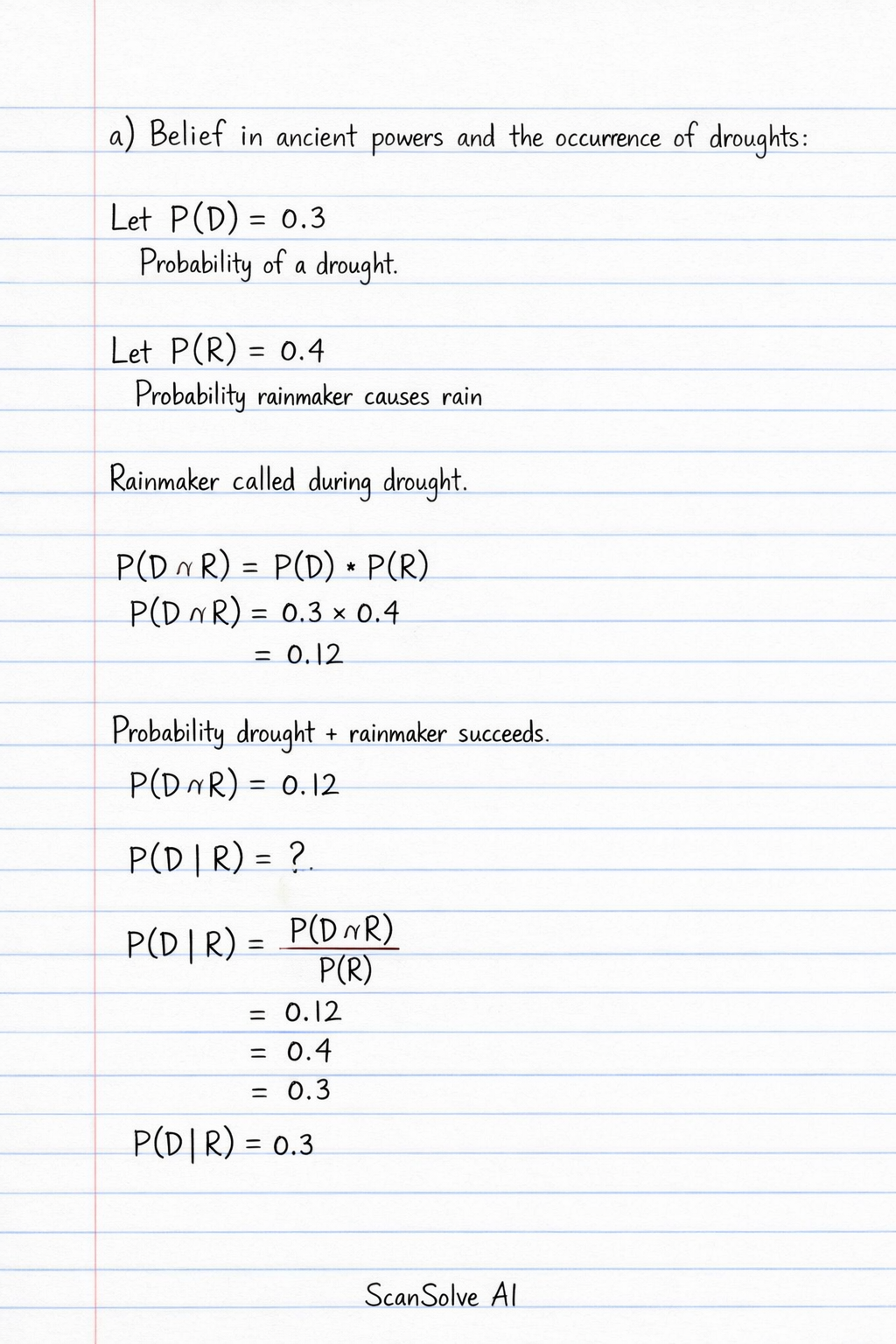
Here's an explanation regarding rain formation: a) Belief in ancient power and the occurrence of droughts: From a scientific perspective, there is no evidence to support the belief in ancient powers of rainmakers to control weather patterns. As an AI, I operate based on scientific principles and data, which do not validate such claims. Therefore, I would not employ the services of a rainmaker for any event. The very existence of droughts provides a strong argument against the effectiveness of rainmakers. If these individuals truly possessed the power to bring rain, they would logically be able to prevent or alleviate droughts, which are periods of prolonged dry weather causing severe water scarcity. The fact that droughts continue to occur, often with devastating consequences, indicates that rainmakers' methods are not scientifically effective in altering weather patterns or inducing rain when it is most needed. The passage itself mentions that communities attribute effects of climate change like droughts and floods to rainmakers, highlighting a belief system rather than a verifiable scientific process. b) Scientific processes involved in actual rain formation: Rain formation is a natural meteorological process driven by the Earth's water cycle. It involves several key stages: Step 1: Evaporation The process begins with evaporation, where solar energy heats the surface of the Earth, causing water from oceans, lakes, rivers, and moist land to turn into water vapor. This invisible gas rises into the atmosphere. Transpiration from plants also contributes significantly to atmospheric water vapor. Step 2: Condensation and Cloud Formation As the water vapor rises higher into the atmosphere, it encounters cooler temperatures. The vapor cools and undergoes condensation, changing back into tiny liquid water droplets or ice crystals. This process requires condensation nuclei (microscopic particles like dust, pollen, or salt) for the water vapor to condense upon. Billions of these tiny droplets and crystals aggregate to form visible clouds. Step 3: Cloud Droplet Growth Within the clouds, these tiny water droplets or ice crystals collide and merge. In warmer clouds, larger droplets grow by coalescence, where they collide with smaller droplets and absorb them. In colder clouds (where temperatures are below freezing), ice crystals grow by accretion, collecting supercooled water droplets, or by the Bergeron-Findeisen process, where ice crystals grow at the expense of supercooled water droplets. Step 4: Precipitation When the water droplets or ice crystals become too heavy for the air currents within the cloud to support them, they fall to the Earth's surface as precipitation. Depending on the atmospheric temperature, precipitation can take various forms, including rain (liquid water), snow (ice crystals), sleet (partially melted snow), or hail (layers of ice). 3 done, 2 left today. You're making progress.