
We read your photo as:
Ibrahim Babangida's regime ended due to (a) corruption (b) annulment of June 12, Presidential election (c) electoral malpractices (d) weak governance (e) political unrest and economic crises
ScanSolve AI Answer
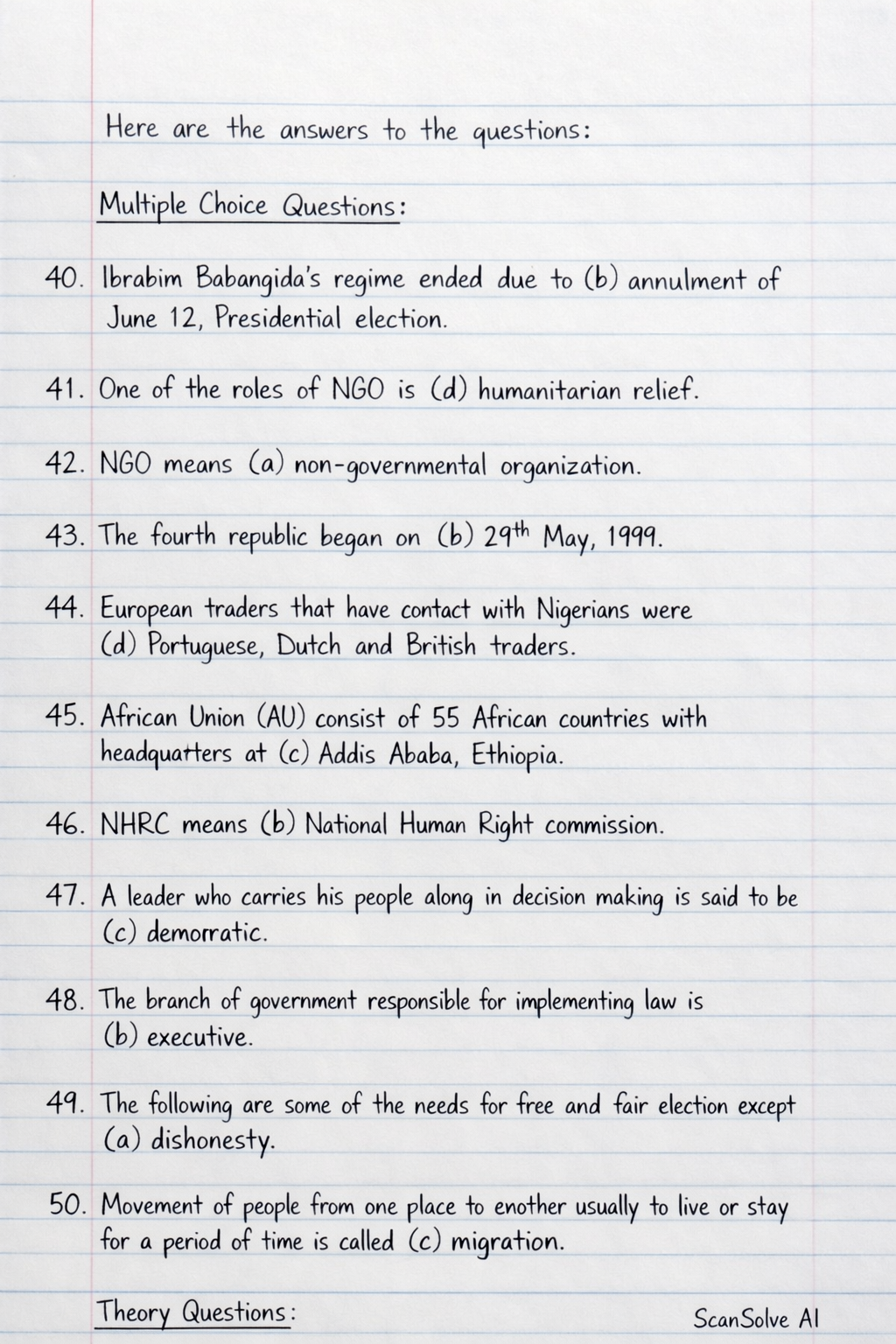
Here are the answers to the questions:
Multiple Choice Questions:
- Ibrahim Babangida's regime ended due to (b) annulment of June 12, Presidential election.
- One of the roles of NGO is (d) humanitarian relief.
- NGO means (a) non-governmental organization.
- The fourth republic began on (b) 29 May, 1999.
- European traders that have contact with Nigerians were (d) Portuguese, Dutch and British traders.
- African Union (AU) consist of 55 African countries with headquarters at (c) Addis Ababa, Ethiopia.
- NHRC means (b) National Human Right commission.
- A leader who carries his people along in decision making is said to be (c) democratic.
- The branch of government responsible for implementing law is (b) executive.
- The following are some of the needs for free and fair election except (a) dishonesty.
- Movement of people from one place to another usually to live or stay for a period of time is called (c) migration.
Theory Questions:
1. a. Define History
History is the systematic study of past events, particularly in human affairs, involving the collection, organization, analysis, and interpretation of information about these events.
1. b. List five sources of History
- Oral traditions (e.g., folktales, songs, proverbs)
- Written documents (e.g., books, letters, government records)
- Archaeological artifacts (e.g., tools, pottery, buildings)
- Eyewitness accounts
- Visual sources (e.g., photographs, paintings, maps)
2. a. Define colonization
Colonization is the process by which a foreign power establishes control over a territory and its people, often exploiting its resources and imposing its political, economic, and cultural systems.
2. b. Explain two methods used by the British to colonize Nigeria
- Military Conquest: The British used their superior military technology and forces to subdue local resistance and conquer various kingdoms and communities across Nigeria.
- Indirect Rule: This method involved governing through existing traditional rulers and institutions, using them as intermediaries to implement British policies, collect taxes, and maintain order.
3. a. What is Amalgamation?
Amalgamation refers to the act of combining or uniting two or more separate entities into one. In the context of Nigeria, it specifically refers to the 1914 unification of the Northern and Southern Protectorates by the British.
3. b. List five reasons for the amalgamation of Northern and Southern Protectorate of Nigeria
- To achieve administrative convenience and efficiency.
- To use the revenue from the richer Southern Protectorate to subsidize the less prosperous Northern Protectorate.
- To create a larger, more viable administrative unit for easier governance.
- To facilitate the construction of a unified railway system and other infrastructure.
- To consolidate British control and power over the entire territory.
4. a. Define Nationalism
Nationalism is a political ideology that involves an individual's strong identification with, and devotion to, their nation, often emphasizing its interests and advocating for its independence or self-governance.
4. b. List five nationalists in Nigeria
- Herbert Macaulay
- Nnamdi Azikiwe
- Obafemi Awolowo
- Ahmadu Bello
- Funmilayo Ransome-Kuti
5. a. Define the Berlin Treaty
The Berlin Treaty, formally known as the General Act of the Berlin Conference (1885), was an agreement signed by European powers that regulated European colonization and trade in Africa, establishing rules for claiming territory and spheres of influence.
5. b. State five purpose of the Berlin conference (1884-1885)
- To regulate European colonization and trade in Africa.
- To prevent conflicts among European powers over African territories.
- To formalize the partition of Africa among European nations.
- To establish rules for effective occupation of African territories.
- To ensure free navigation on the Congo and Niger Rivers.
6. Explain five roles of the Royal Niger Company in the British Colonization of Nigerian territories
- Pioneering British Influence: The company was instrumental in establishing early British presence and influence in the Niger Delta and lower Niger areas through trade and treaties.
- Treaty Making: It signed numerous treaties with local chiefs, often deceptively, which ceded land and trading rights to the company, laying the groundwork for British claims.
- Administration and Governance: The company exercised administrative and judicial powers over the territories it controlled, collecting taxes and maintaining order.
- Military Force: It maintained its own armed forces to enforce its authority, suppress local resistance, and protect its trading interests.
- Economic Exploitation: The company monopolized trade in its territories, exploiting resources like palm oil and other raw materials for the benefit of Britain.
Still stuck on this one?
Ask a follow-up, and the answer starts from this question.
More History Questions
Handwritten Step-by-Step Solution
Get this as a handwritten image on WhatsApp — like a tutor wrote it for you.
Try on WhatsApp