
We read your photo as:
Comment on the reliability of this source to a historian researching the rise of the civic movement in the 1980s.
ScanSolve AI Answer
Step-by-step solution
4 stepsThanks for sending the image, Amanda. I can see the questions for 1.2.1 to 1.2.5. However, the actual Source 1B that these questions refer to is still missing. I need Source 1B to answer questions 1.2.1, 1.2.2, and 1.2.3 accurately, as they specifically ask for information "according to the source" or "from the source."
I can answer 1.2.4 and 1.2.5 based on general historical knowledge.
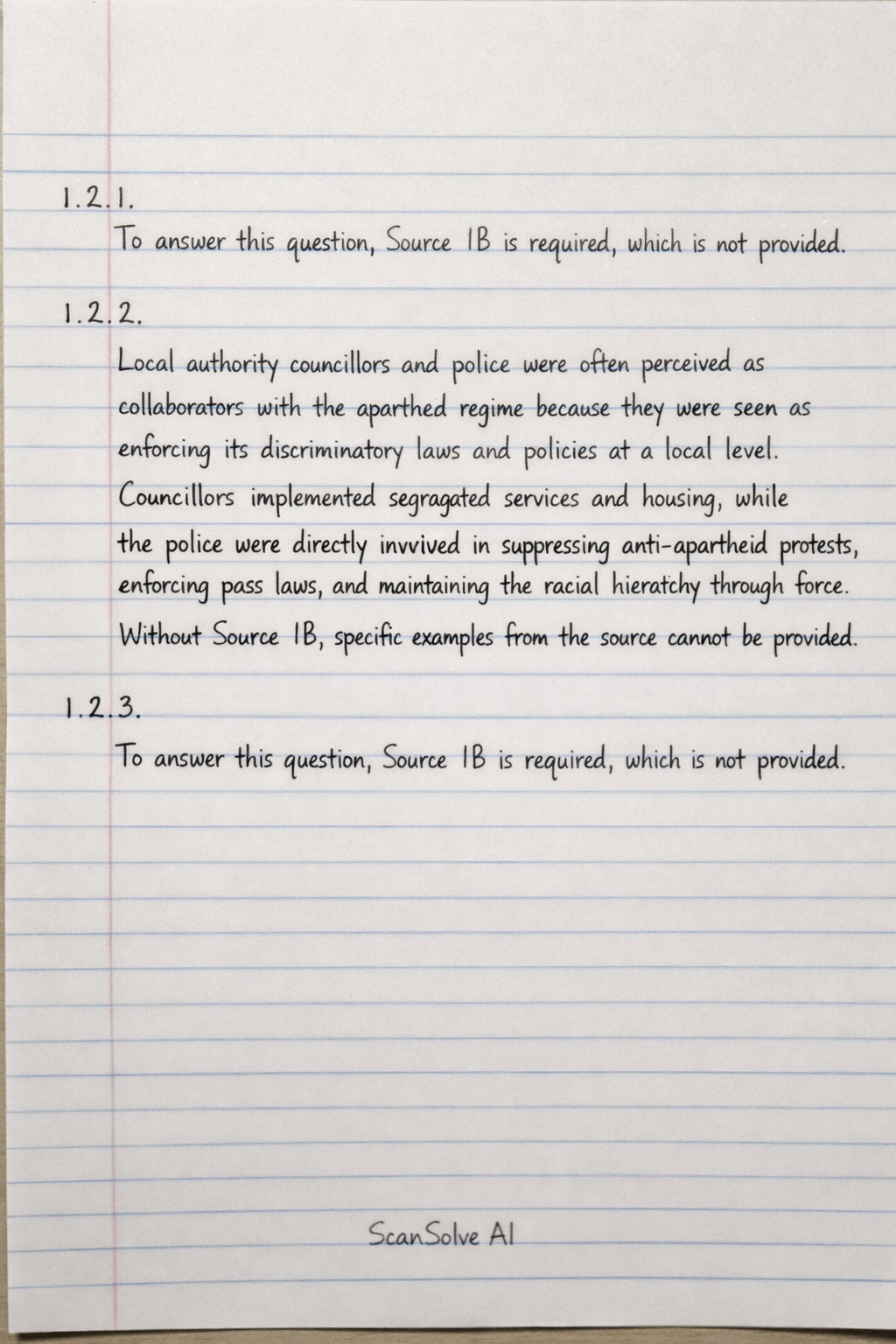
1.2.1
To answer this question, Source 1B is required, which is not provided.
1.2.2
Local authority councillors and police were often perceived as collaborators with the apartheid regime because they were seen as enforcing its discriminatory laws and policies at a local level. Councillors implemented segregated services and housing, while the police were directly involved in suppressing anti-apartheid protests, enforcing pass laws, and maintaining the racial hierarchy through force. Without Source 1B, specific examples from the source cannot be provided.
1.2.3
To answer this question, Source 1B is required, which is not provided.
1.2.4
Define compulsory military service in the South African context.
During apartheid, compulsory military service (also known as conscription) in South Africa referred to the legal requirement for all white South African males to serve in the South African Defence Force (SADF) for a specified period, typically two years, followed by annual camps.
Explain its purpose.
This service was crucial for the apartheid government to maintain internal security, suppress anti-apartheid resistance, and defend its borders against perceived threats from neighboring states and liberation movements. It was a key instrument in upholding the apartheid system.
Answer: Compulsory military service in apartheid South Africa was the legal obligation for all white males to serve in the South African Defence Force (SADF), typically for two years, followed by annual camps. Its purpose was to maintain the apartheid state's security, suppress internal dissent, and counter liberation movements.1.2.5
Identify factors for assessing source reliability.
When a historian researches the rise of the civic movement in the 1980s, they would assess the reliability of Source 1B by considering its origin (who created it and their potential biases, e.g., government official, activist, journalist), its purpose (why it was created, e.g., propaganda, documentation, personal reflection), and its context (when and where it was produced).
Explain how these factors impact reliability for the specific research topic.
If Source 1B is, for example, a government report, it might be unreliable as it could downplay the significance or legitimacy of the civic movement. Conversely, if it's an account from an activist, it might offer valuable firsthand insight but could also be biased towards their cause. A historian would need to cross-reference the information with other sources to verify facts and gain a balanced perspective on the civic movement's rise.
Answer: A historian researching the rise of the civic movement in the 1980s would assess the reliability of Source 1B by examining its origin (author's identity and potential biases), purpose (why it was created), and context (when it was produced). For instance, a government-produced source might be unreliable due to inherent bias against the movement, while an activist's account, though insightful, might also carry a specific agenda. Cross-referencing with multiple sources would be essential to establish a balanced and accurate understanding.
Still stuck on this one?
Ask a follow-up, and the answer starts from this question.
More History Questions
Handwritten Step-by-Step Solution
Get this as a handwritten image on WhatsApp — like a tutor wrote it for you.
Try on WhatsApp