
We read your photo as:
Compare and contrast traditional East African, Biblical, and scientific views on the origin of man.
ScanSolve AI Answer
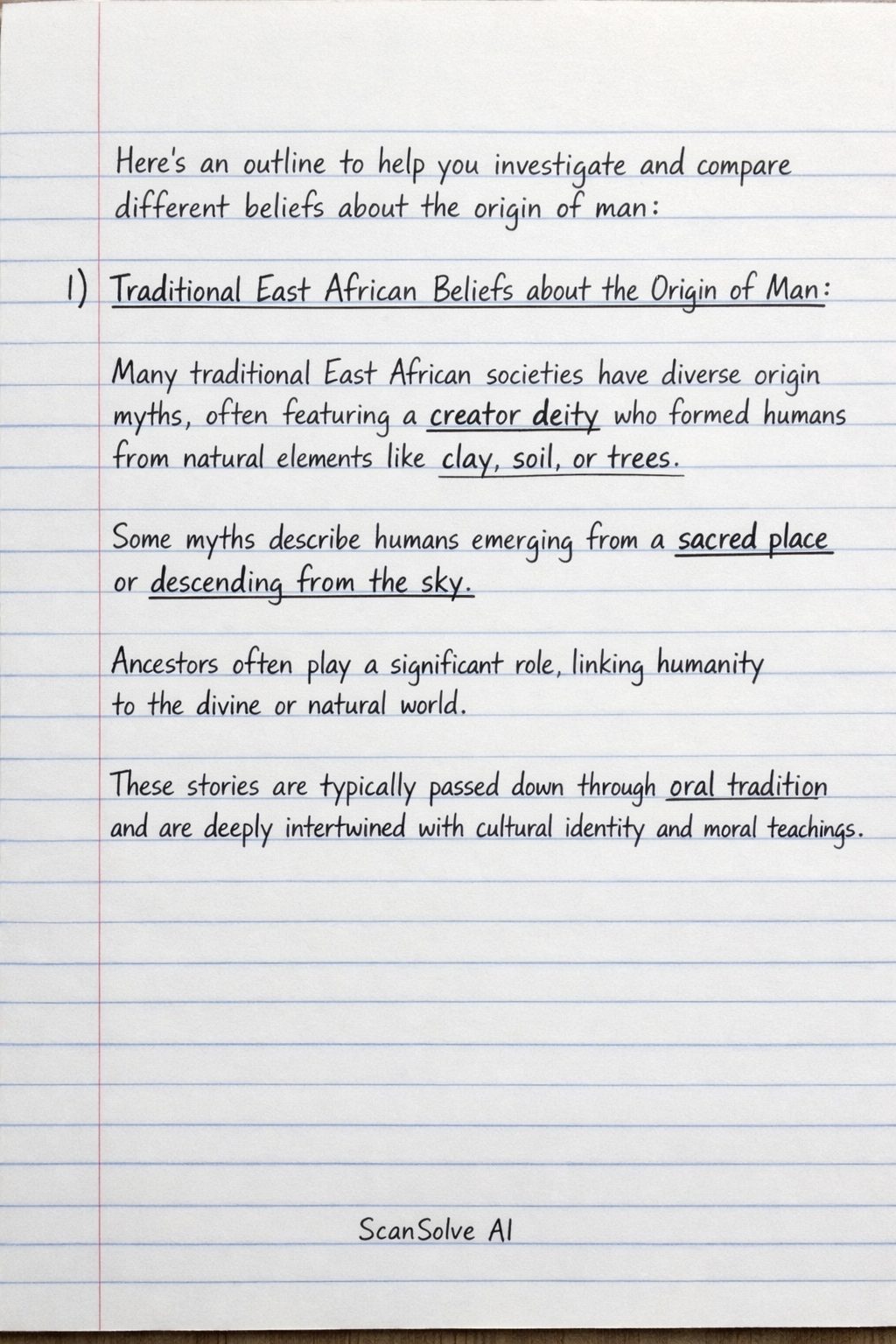
Here's an outline to help you investigate and compare different beliefs about the origin of man:
1) Traditional East African Beliefs about the Origin of Man:
Many traditional East African societies have diverse origin myths, often featuring a creator deity who formed humans from natural elements like clay, soil, or trees. Some myths describe humans emerging from a sacred place or descending from the sky. Ancestors often play a significant role, linking humanity to the divine or natural world. These stories are typically passed down through oral tradition and are deeply intertwined with cultural identity and moral teachings.
2) The Biblical Creation Story (Genesis 1-2):
The Bible describes God creating the universe and all life in six days. In Genesis 1, God speaks creation into existence, culminating in the creation of humanity in His own image on the sixth day. Genesis 2 provides a more detailed account of human creation, where God forms Adam from the dust of the ground and breathes life into him. He then creates Eve from Adam's rib to be his companion. This narrative emphasizes God's omnipotence and humanity's unique relationship with the Creator.
3) Scientific Views about the Origin of Man:
The prevailing scientific view is the theory of evolution by natural selection. This theory proposes that all life on Earth shares a common ancestor and has diversified over millions of years through a process of gradual change. Regarding human origins, scientific evidence from paleontology, genetics, and archaeology suggests that modern humans (Homo sapiens) evolved in Africa from earlier hominid species over a period of several million years. Key aspects include bipedalism, increasing brain size, and the development of tools and language.
4) Comparison of the Three Explanations:
-
Similarities:
- All three views attempt to explain the origin of humanity and our place in the world.
- They often imply a beginning point for human existence.
- Humans are generally presented as distinct or special in some way compared to other life forms.
-
Differences:
- Mechanism: Traditional and religious views typically involve divine intervention or supernatural forces, while scientific views rely on natural processes (evolution).
- Timeline: Religious creation stories often imply a relatively short timeline for human existence, whereas scientific evolution proposes a much longer, gradual process over millions of years.
- Source of Knowledge: Traditional and religious beliefs are based on faith, sacred texts, and oral traditions, while scientific views are based on empirical evidence, observation, and testable hypotheses.
-
Strengths and Limitations of Each View:
- Traditional/Religious:
- Strengths: Provides meaning, purpose, and moral frameworks; fosters cultural identity and community; offers comfort and answers to existential questions.
- Limitations: Often not empirically testable; can lead to conflicts with scientific findings if interpreted literally; diversity of beliefs can lead to disagreement.
- Scientific:
- Strengths: Based on empirical evidence and testable hypotheses; constantly refined with new discoveries; provides a unified framework for understanding biological diversity.
- Limitations: Does not address existential or moral questions; can be complex and challenging to understand for non-experts; subject to revision as new evidence emerges.
- Traditional/Religious:
Still stuck on this one?
Ask a follow-up, and the answer starts from this question.
More History Questions
Handwritten Step-by-Step Solution
Get this as a handwritten image on WhatsApp — like a tutor wrote it for you.
Try on WhatsApp