
We read your photo as:
Compare and contrast Jewish and Traditional African practices of circumcision, and outline how Christians identify themselves in society today.
History
ScanSolve AI Answer
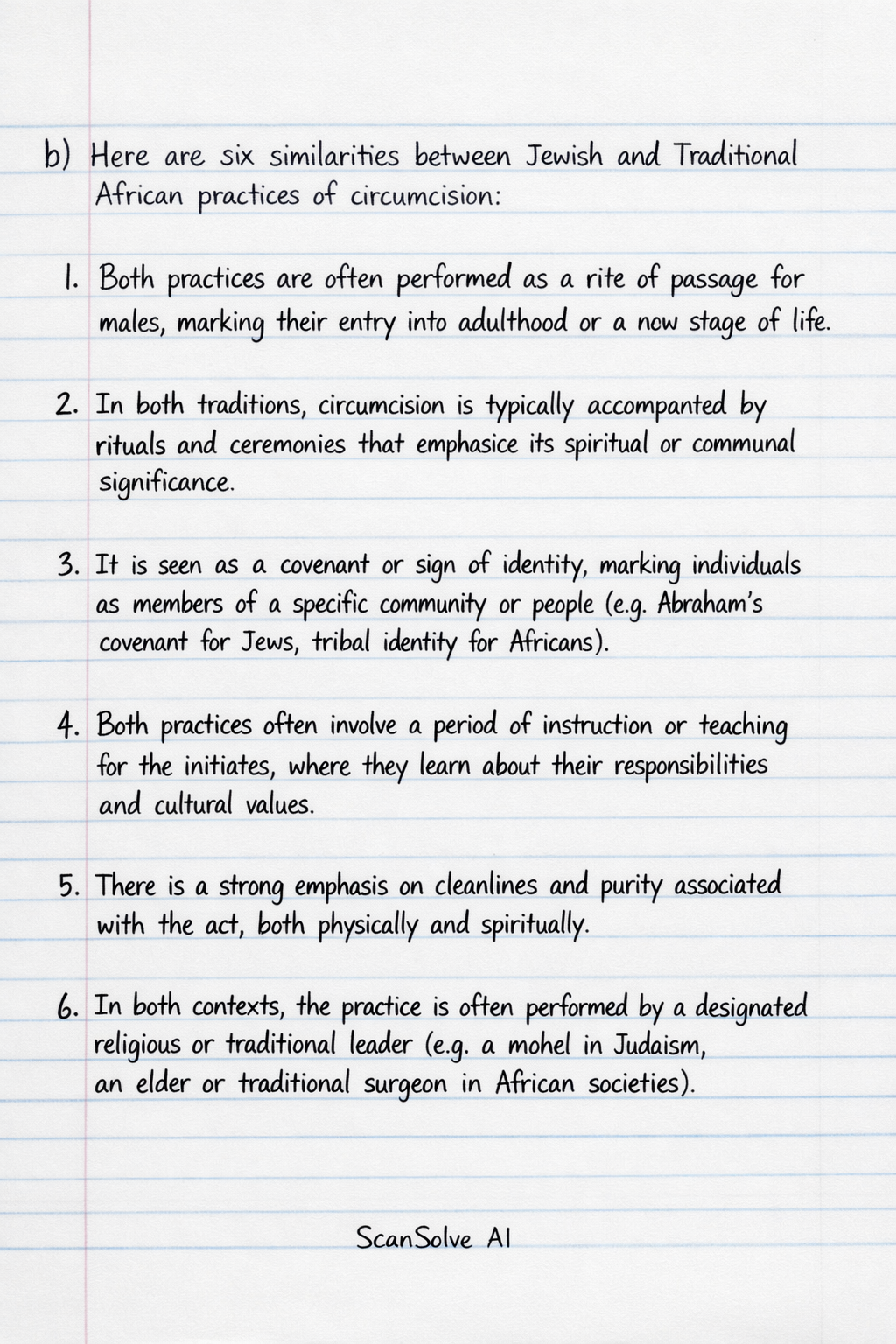
b) Here are six similarities between Jewish and Traditional African practices of circumcision:
- Both practices are often performed as a rite of passage for males, marking their entry into adulthood or a new stage of life.
- In both traditions, circumcision is typically accompanied by rituals and ceremonies that emphasize its spiritual or communal significance.
- It is seen as a covenant or sign of identity, marking individuals as members of a specific community or people (e.g., Abraham's covenant for Jews, tribal identity for Africans).
- Both practices often involve a period of instruction or teaching for the initiates, where they learn about their responsibilities and cultural values.
- There is a strong emphasis on cleanliness and purity associated with the act, both physically and spiritually.
- In both contexts, the practice is often performed by a designated religious or traditional leader (e.g., a mohel in Judaism, an elder or traditional surgeon in African societies).
- Both traditions view circumcision as a command or tradition passed down through generations, emphasizing its historical and religious continuity.
c) Here are six ways in which Christians identify themselves in society today:
- Worship and Fellowship: Christians identify themselves by regularly attending church services, participating in communal worship, and engaging in fellowship with other believers.
- Moral Conduct: They strive to live by Christian ethical principles, demonstrating love, honesty, integrity, and compassion in their daily interactions.
- Service and Charity: Christians often engage in acts of service, charity, and social justice, helping the poor, sick, and marginalized in their communities.
- Evangelism and Witness: They identify themselves by sharing their faith with others, either through direct evangelism or by living a life that reflects Christian values.
- Symbolic Expressions: Many Christians wear religious symbols like crosses, display biblical verses, or use Christian-themed items as outward signs of their faith.
- Adherence to Scripture: They base their beliefs and practices on the Bible, using it as a guide for their lives and decisions.
- Prayer and Devotion: Regular personal prayer, Bible reading, and spiritual disciplines are common practices that identify Christians.
3a) Here are seven failures of King Solomon:
- Accumulation of Horses and Chariots: Solomon amassed a vast number of horses and chariots from Egypt, contrary to God's command for kings not to multiply horses (Deuteronomy 17:16).
- Multiplication of Wives and Concubines: He married many foreign women (700 wives and 300 concubines), which was forbidden by God as it would lead his heart astray (Deuteronomy 17:17, 1 Kings 11:1-3).
- Idolatry: His foreign wives led him to worship other gods and build altars for pagan deities like Ashtoreth, Chemosh, and Molech, turning his heart away from the Lord (1 Kings 11:4-8).
- Love of Wealth: Solomon excessively accumulated gold and silver, violating God's instruction for kings not to multiply wealth for themselves (Deuteronomy 17:17).
- Oppressive Labor and Taxation: He imposed heavy forced labor and high taxes on his people to fund his massive building projects and luxurious lifestyle, leading to widespread discontent (1 Kings 12:4).
- Failure to Keep God's Covenant: Despite God appearing to him twice and warning him, Solomon failed to keep God's statutes and judgments, leading to God's judgment against his kingdom (1 Kings 11:9-13).
- Division of the Kingdom: As a direct consequence of his disobedience, God declared that He would tear the kingdom away from Solomon's son, leading to the division of Israel into two kingdoms (1 Kings 11:11-13).
Was this helpful?
Still stuck on this one?
Ask a follow-up, and the answer starts from this question.
Got a different question?Ask your own question
More History Questions
QCompare and contrast traditional and modern conflict resolution systems, and explain how African…QCompare and contrast traditional East African, Biblical, and scientific views on the origin of man.QExplain why it is important to respect traditional African religions even though many people today…QAs a student of African Studies, how would you characterize African traditional religion to portray…QDiscuss the challenges Moses faced leading the Israelites, the conditions God gave them, and how…
Handwritten Step-by-Step Solution
Get this as a handwritten image on WhatsApp — like a tutor wrote it for you.
Try on WhatsApp