

This history question requires analysis of historical events, causes, and consequences. The detailed answer below provides context, evidence, and a well-structured explanation.
ScanSolve AI Answer
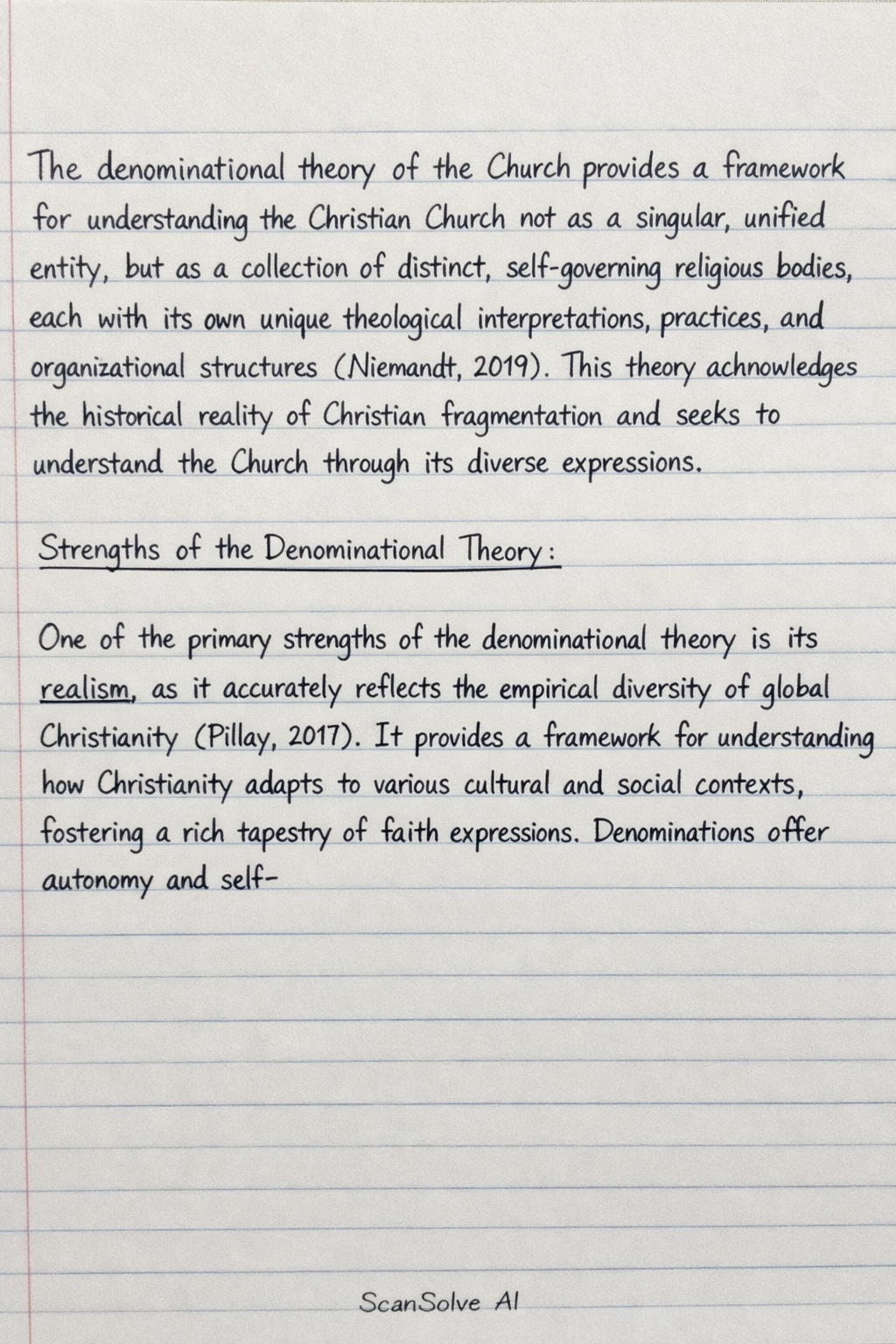
The denominational theory of the Church provides a framework for understanding the Christian Church not as a singular, unified entity, but as a collection of distinct, self-governing religious bodies, each with its own unique theological interpretations, practices, and organizational structures (Niemandt, 2019). This theory acknowledges the historical reality of Christian fragmentation and seeks to understand the Church through its diverse expressions. Strengths of the Denominational Theory: One of the primary strengths of the denominational theory is its realism, as it accurately reflects the empirical diversity of global Christianity (Pillay, 2017). It provides a framework for understanding how Christianity adapts to various cultural and social contexts, fostering a rich tapestry of faith expressions. Denominations offer *autonomy and self-