
We read your photo as:
HOW DID THE POLICIES OF SEGREGATION AFFECT THE ORDINARY LIVES OF SOUTH AFRICANS FROM THE 1920s TO THE 1930s?
ScanSolve AI Answer
Answer
1.1.1 Segregation is the enforced separation of different racial or ethnic groups within a society, leading to unequal access to resources, opportunities, and public facilities.
1.1.2 The source (1A) is not provided. Based on general historical knowledge, four spheres of statuses that provided for racial separation in South Africa were:
- Residential areas
- Workplaces/Employment
- Public facilities
- Political rights
1.1.3 The source (1A) is not provided. Based on general historical knowledge, the Mine and Works Act of 1926 reserved skilled jobs for white workers in:
- Mines (e.g., skilled mining positions requiring blasting certificates)
- Factories/Industrial sectors (e.g., skilled trades)
1.1.4 The source (1A) is not provided. Based on general historical knowledge, the government enacted the Native (Urban Areas) Act in 1923 to segregate urban residential areas for several reasons:
The government aimed to control the influx of African people into urban areas, ensuring a cheap labor supply for industries while preventing permanent African settlement. This policy also sought to prevent social mixing between races and manage the rapid urbanization of Africans, which was perceived as a threat to white dominance and urban order.
1.2.1 The source (1B) is not provided. Based on general historical knowledge:
The Pact government protected whites from competing with black workers in 1924 by implementing the "Civilised Labour Policy". This policy reserved certain jobs for white workers, particularly in government departments and state-owned enterprises, and ensured they received higher wages, thereby shielding them from competition with cheaper black labor.
1.2.2 The source (1B) is not provided. Based on general historical knowledge:
Technical Colleges were likely not forced to issue qualification certificates by the government to all students (especially non-white students) because segregation policies aimed to limit the educational and professional advancement of black Africans. By controlling formal qualifications, the government could restrict access to skilled jobs and professions for non-white individuals, maintaining the racial hierarchy in the labor market.
1.2.3 The source (1B) is not provided. Based on general historical knowledge, three facilities that were separately built for white and non-white races in workplaces included:
- Toilets/Latrines
- Canteens/Eating areas
- Change rooms/Locker rooms
1.3.1 The source (1C) is not provided. Based on general historical knowledge, two aims of the 1923 Native Urban Areas Act were:
- To control the entry and residence of African people in urban areas, treating them as temporary residents whose primary home was in the reserves.
- To segregate urban residential areas by establishing separate "native locations" or townships for Africans, away from white residential areas.
1.3.2 Influx control refers to the system of laws and regulations implemented by the South African government to restrict and manage the movement of black Africans from rural areas into urban areas. During the 1930s, these policies were designed to limit the number of Africans in cities to only those required for labor, prevent permanent urbanization, and maintain racial segregation by controlling where black people could live and work.
1.3.3 This question is incomplete in the provided image. Please provide the full question for an answer.
1.3.4 Every African man had to carry a dompas (pass book) in an urban area as a key instrument of influx control and the broader settlement policy. The dompas contained personal details, employment records, and permits to be in an urban area. Its purpose was to control movement, ensuring Africans only entered urban areas if they had approved employment, and to prevent permanent settlement in white urban areas. It also regulated labor by ensuring a controlled supply of cheap labor and facilitated the identification, arrest, and deportation of any African found in an urban area without the correct documentation.
Still stuck on this one?
Ask a follow-up, and the answer starts from this question.
More History Questions
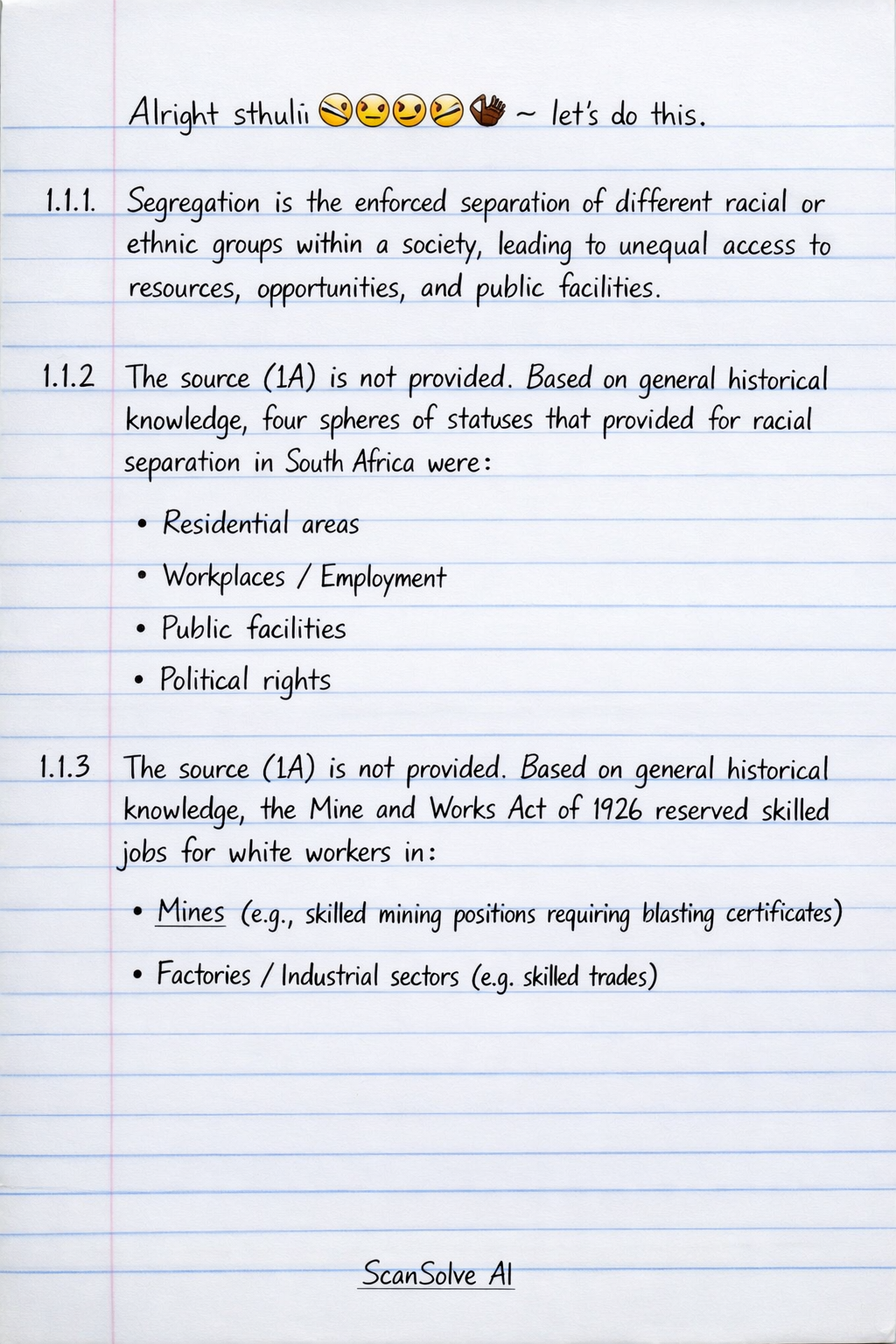
Handwritten Step-by-Step Solution
Get this as a handwritten image on WhatsApp — like a tutor wrote it for you.
Try on WhatsApp