
We read your photo as:
Examine six factors that have hindered the United Nations from achieving some of its aims.
History
ScanSolve AI Answer
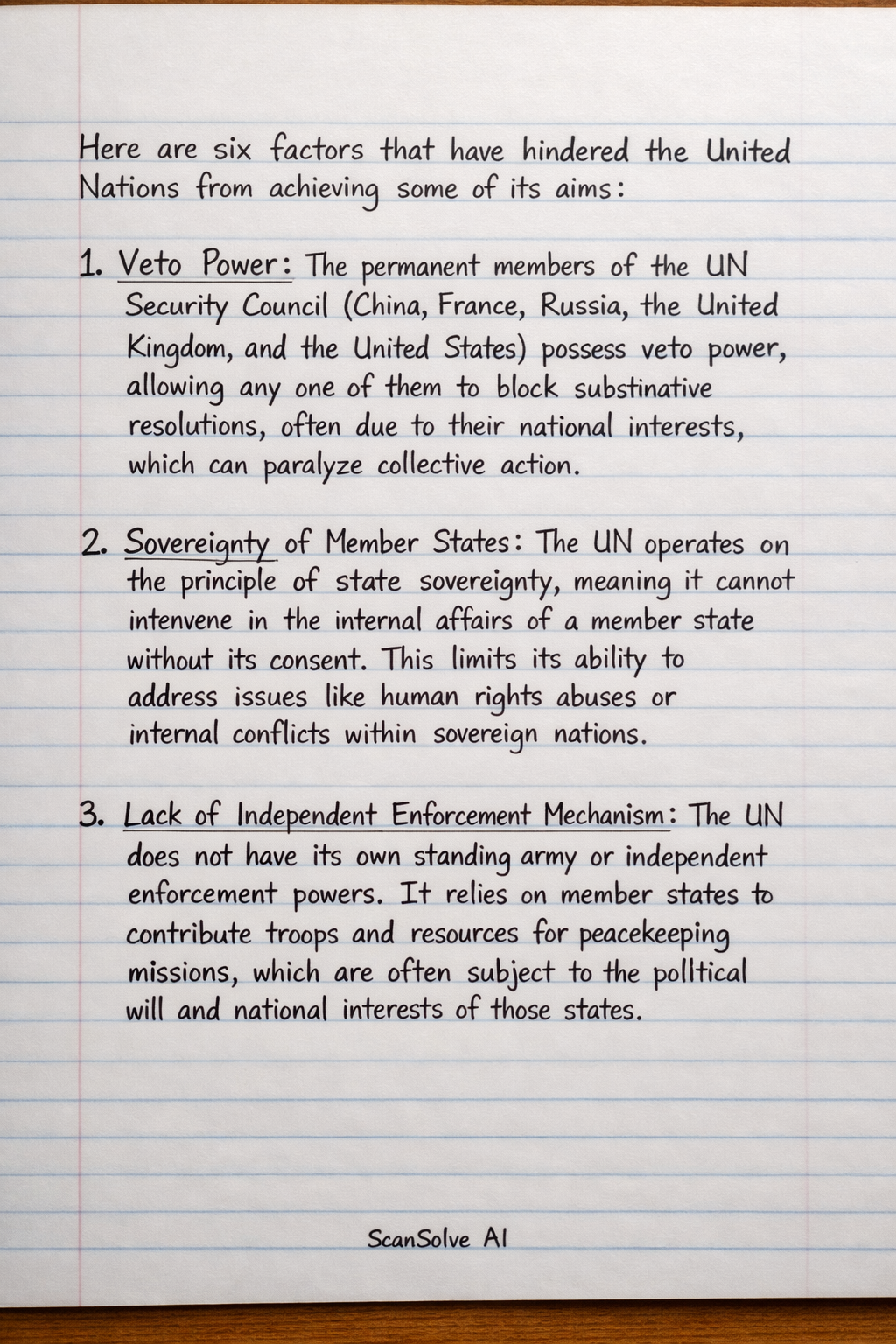
Here are six factors that have hindered the United Nations from achieving some of its aims:
- Veto Power: The permanent members of the UN Security Council (China, France, Russia, the United Kingdom, and the United States) possess veto power, allowing any one of them to block substantive resolutions, often due to their national interests, which can paralyze collective action.
- Sovereignty of Member States: The UN operates on the principle of state sovereignty, meaning it cannot intervene in the internal affairs of a member state without its consent. This limits its ability to address issues like human rights abuses or internal conflicts within sovereign nations.
- Lack of Independent Enforcement Mechanism: The UN does not have its own standing army or independent enforcement powers. It relies on member states to contribute troops and resources for peacekeeping missions, which are often subject to the political will and national interests of those states.
- Financial Constraints: The UN's budget is dependent on contributions from member states. Arrears in payments or insufficient funding can severely limit its operational capacity for peacekeeping, humanitarian aid, and development programs.
- Conflicting National Interests: Member states often prioritize their own national interests over collective global goals. This frequently leads to disagreements and an inability to reach consensus on critical international issues, hindering effective problem-solving.
- Bureaucracy and Inefficiency: The large and complex structure of the UN, with its numerous agencies, committees, and procedures, can sometimes lead to bureaucratic inefficiencies, slow decision-making processes, and duplication of efforts.
Was this helpful?
Still stuck on this one?
Ask a follow-up, and the answer starts from this question.
Got a different question?Ask your own question
More History Questions
QList five achievements of the United Nations Organization.QDeliver a speech on the UN's achievements and failures, focusing on its activities in Uganda.QList the aims, failures, and successor of the League of Nations, and the importance of the UN.QWrite a speech about the achievements and failures of the United Nations, focusing on its activities…QGive three reasons why the League of Nations failed to maintain world peace.
Browse by topic:World History
Handwritten Step-by-Step Solution
Get this as a handwritten image on WhatsApp — like a tutor wrote it for you.
Try on WhatsApp