
We read your photo as:
Factors that gave rise to Igbo Nationalism and contemporary challenges.
History
ScanSolve AI Answer
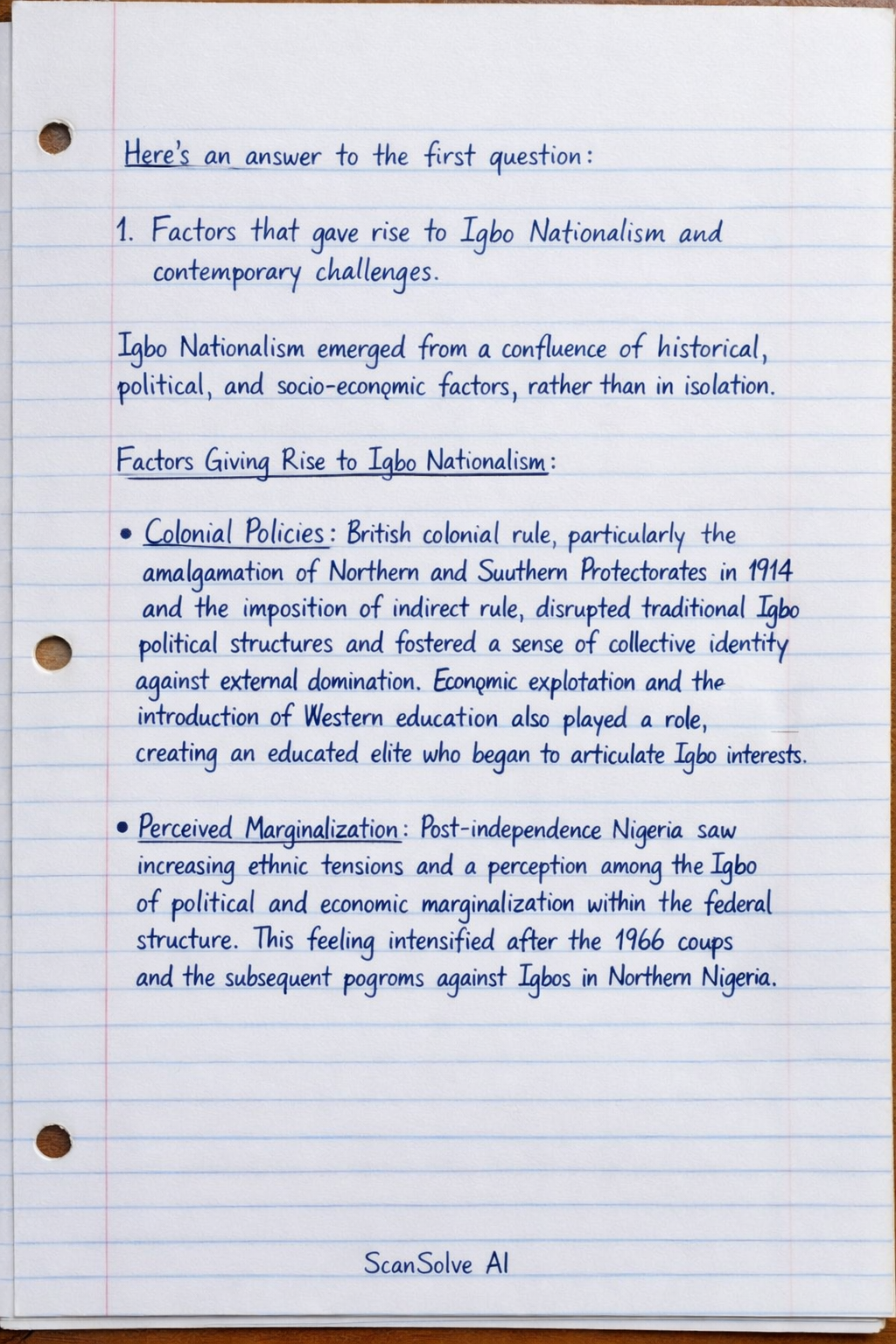
Here's an answer to the first question:
1. Factors that gave rise to Igbo Nationalism and contemporary challenges.
Igbo Nationalism emerged from a confluence of historical, political, and socio-economic factors, rather than in isolation.
-
Factors Giving Rise to Igbo Nationalism:
- Colonial Policies: British colonial rule, particularly the amalgamation of Northern and Southern Protectorates in 1914 and the imposition of indirect rule, disrupted traditional Igbo political structures and fostered a sense of collective identity against external domination. Economic exploitation and the introduction of Western education also played a role, creating an educated elite who began to articulate Igbo interests.
- Perceived Marginalization: Post-independence Nigeria saw increasing ethnic tensions and a perception among the Igbo of political and economic marginalization within the federal structure. This feeling intensified after the 1966 coups and the subsequent pogroms against Igbos in Northern Nigeria.
- The Nigerian Civil War (Biafra): The ultimate catalyst was the Nigerian Civil War (1967-1970), which saw the declaration of the Republic of Biafra. This conflict solidified a strong sense of shared suffering, identity, and a desire for self-determination among the Igbo, deeply embedding nationalist sentiments.
- Cultural and Linguistic Homogeneity: Despite diverse dialects, a shared cultural heritage and language facilitated the development of a collective identity, which was further mobilized by political grievances.
-
Contemporary Challenges Facing Igbo Nationalism:
- Internal Divisions: A lack of unified leadership and diverse ideological approaches (ranging from calls for secession to demands for restructuring within Nigeria) often hinder a cohesive nationalist agenda.
- Political Marginalization: The Igbo continue to face challenges in achieving equitable representation and influence at the federal level, particularly regarding the presidency, leading to persistent feelings of exclusion.
- Economic Underdevelopment: The Southeast region, predominantly Igbo, grapples with issues of infrastructure deficit, industrial decline, and high youth unemployment, which fuel grievances and nationalist sentiments but also pose significant developmental hurdles.
- Security Challenges: The activities of various pro-Biafra groups, and the state's response to them, have led to security crises, human rights concerns, and further destabilization in the region.
- Identity and Integration: Balancing a strong Igbo identity with the broader Nigerian identity remains a complex challenge, with ongoing debates about the path forward for the Igbo within or outside the Nigerian federation.
These factors and challenges highlight the dynamic and evolving nature of Igbo Nationalism, shaped by historical grievances and contemporary realities.
Was this helpful?
Still stuck on this one?
Ask a follow-up, and the answer starts from this question.
Got a different question?Ask your own question
More History Questions
QDiscuss the importance of Igbo culture and traditions, and the challenges facing youth today.QVarious Attributes of Igbo Culture viz. Igbo history, beliefs, thoughts, word views, political and…QWhat were the internal and external factors that contributed to the rise of nationalist movements in…QDiscuss 5 challenges facing the development and promotion of National identity in Ghana.QFactors that contributed to growth of nationalism in Southern Cameroon btw 1946 to 1951
Handwritten Step-by-Step Solution
Get this as a handwritten image on WhatsApp — like a tutor wrote it for you.
Try on WhatsApp