
We read your photo as:
What were the internal and external factors that contributed to the rise of nationalist movements in Africa post-1945?
History
ScanSolve AI Answer
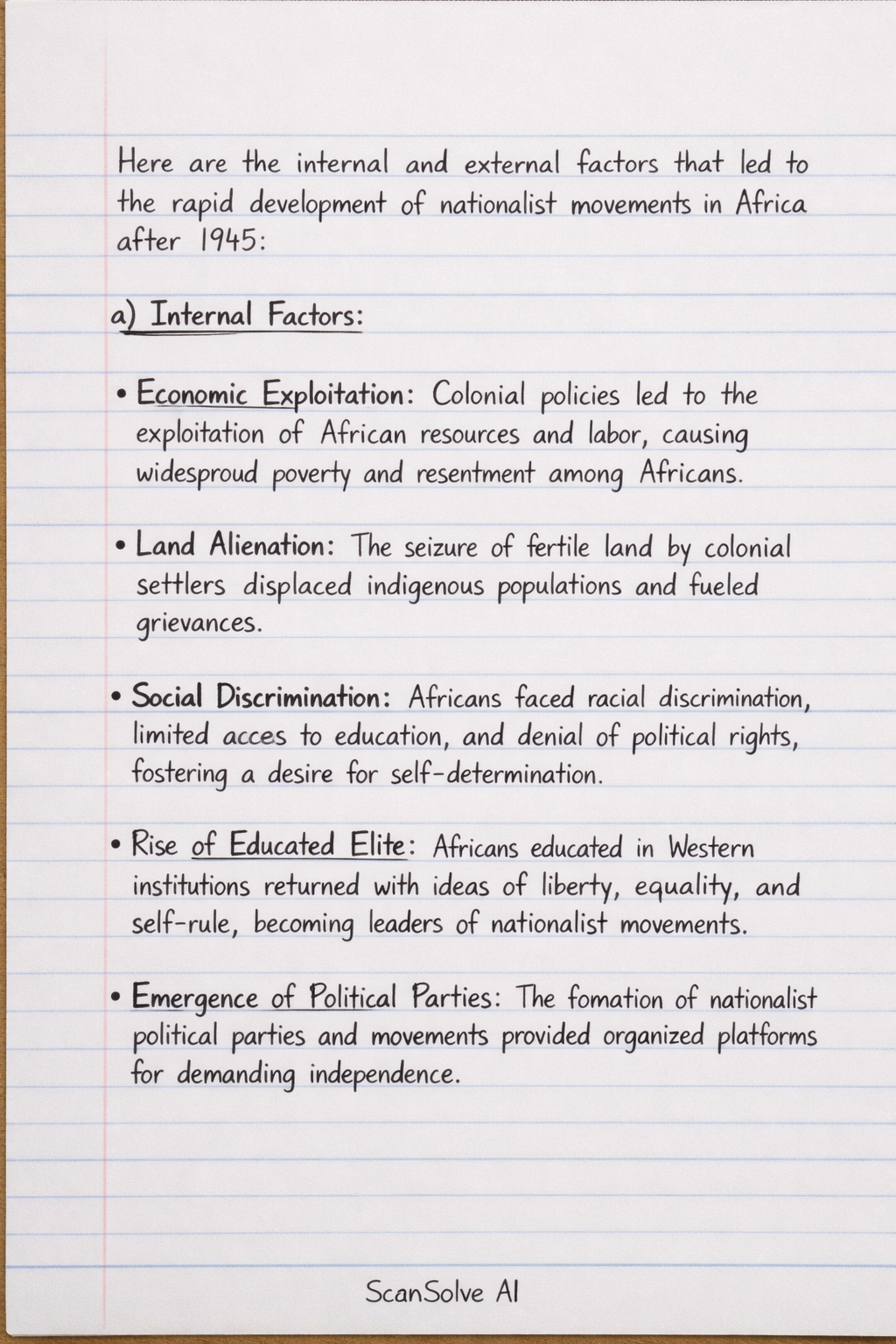
Here are the internal and external factors that led to the rapid development of nationalist movements in Africa after 1945:
a) Internal Factors:
- Economic Exploitation: Colonial policies led to the exploitation of African resources and labor, causing widespread poverty and resentment among Africans.
- Land Alienation: The seizure of fertile land by colonial settlers displaced indigenous populations and fueled grievances.
- Social Discrimination: Africans faced racial discrimination, limited access to education, and denial of political rights, fostering a desire for self-determination.
- Rise of Educated Elite: Africans educated in Western institutions returned with ideas of liberty, equality, and self-rule, becoming leaders of nationalist movements.
- Emergence of Political Parties: The formation of nationalist political parties and movements provided organized platforms for demanding independence.
b) External Factors:
- Impact of World War II: African soldiers fought alongside colonial powers, exposing them to ideas of freedom and democracy, and weakening the myth of European invincibility. The war also weakened colonial powers economically and militarily.
- The Atlantic Charter (1941): This agreement between the USA and Britain promoted the right to self-determination for all peoples, inspiring African nationalists.
- Formation of the United Nations (UN): The UN championed the principle of self-determination and put pressure on colonial powers to decolonize.
- Rise of Superpowers: The USA and USSR, for different reasons, opposed colonialism, providing moral and sometimes material support to anti-colonial movements.
- Pan-Africanism: The Pan-African Congress in Manchester (1945) united African leaders and intellectuals, strengthening the call for independence across the continent.
- Independence of India and Pakistan (1947): This served as a powerful example and inspiration for other colonized nations in Africa.
Was this helpful?
Still stuck on this one?
Ask a follow-up, and the answer starts from this question.
Got a different question?Ask your own question
More History Questions
QDiscuss the factors contributing to the rise of African nationalism post-1945 and explain why…QExplain the factors behind African nationalism post-1945 and why British colonies gained…QWhat were the key factors behind the rise of nationalism in Southern Cameroon (1945-1951) and the…QAnalyze the factors behind African nationalism post-1945 and compare the independence timelines of…QFactors that contributed to growth of nationalism in Southern Cameroon btw 1946 to 1951
Handwritten Step-by-Step Solution
Get this as a handwritten image on WhatsApp — like a tutor wrote it for you.
Try on WhatsApp