
We read your photo as:
Which festival honors Queen Moremi? What is Ife culture known for? What form did the Ife bronze artifacts take? What ritual ends the Edo calendar? Who was the first king of Benin?
ScanSolve AI Answer
Answer
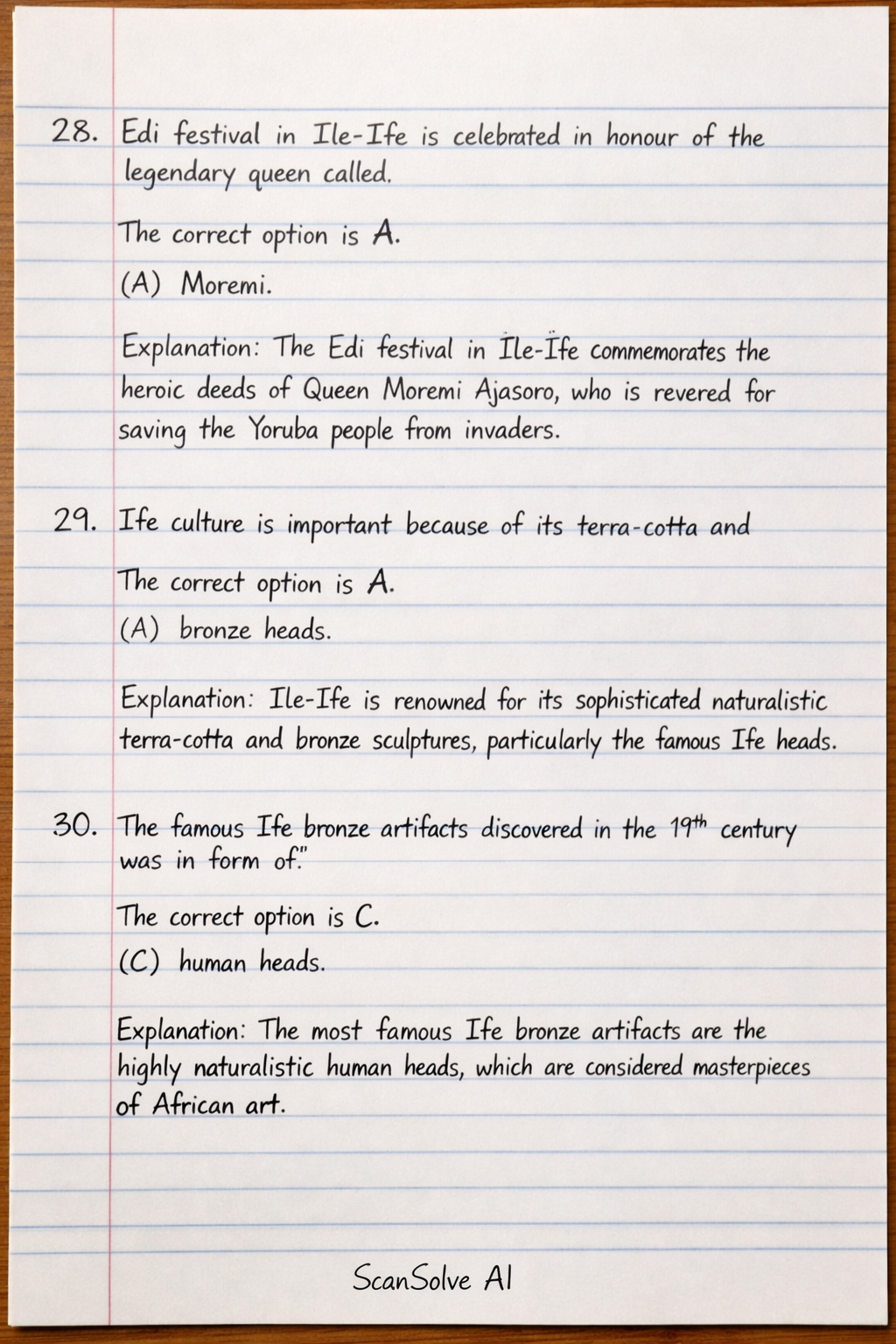
28. Edi festival in Ile-Ife is celebrated in honour of the legendary queen called
The correct option is A.
A) Moremi.
Explanation: The Edi festival in Ile-Ife commemorates the heroic deeds of Queen Moremi Ajasoro, who is revered for saving the Yoruba people from invaders.
29. Ife culture is important because of its terra-cotta and
The correct option is A.
A) bronze heads.
Explanation: Ile-Ife is renowned for its sophisticated naturalistic terra-cotta and bronze sculptures, particularly the famous Ife heads.
30. The famous Ife bronze artifacts discovered in the 19th century was in form of
The correct option is C.
C) human heads.
Explanation: The most famous Ife bronze artifacts are the highly naturalistic human heads, which are considered masterpieces of African art.
31. The ritual ceremony that marks the end of the Edo calendar and ushers in a new one is ______ festival.
The correct option is C.
C) Igue
Explanation: The Igue festival is a significant annual ceremony in the Benin Kingdom that marks the end of the old year and the beginning of a new one, involving rituals for purification and blessings.
32. The first king of Benin Kingdom was Oba
The correct option is B.
B) Eweka.
Explanation: Oral traditions and historical accounts identify Oba Eweka I as the first Oba (king) of the present Benin dynasty.
33. The king of Benin with Yoruba origin was
The correct option is D.
D) Oranmiyan.
Explanation: According to Benin oral tradition, Oranmiyan, a Yoruba prince from Ile-Ife, was invited to establish the new dynasty in Benin, and his son Eweka I became the first Oba.
34. The art work of wood carving is associated with which of the following Nigerian ancient cultures?
The correct option is A.
A) Benin.
Explanation: While many Nigerian cultures practice wood carving, the Benin Kingdom is particularly famous for its elaborate and highly skilled wood carvings, often used in royal regalia and ceremonial objects.
35. The celebrated FESTAC symbol in 1977 was the work of arts from
The correct option is A.
A) Benin.
Explanation: The symbol for FESTAC '77 (Second World Black and African Festival of Arts and Culture) was a replica of the 16th-century ivory mask of Queen Idia from the Benin Kingdom.
36. The lost-wax casting technique is most commonly used by Artists from
The correct option is A.
A) Benin.
Explanation: The lost-wax casting technique was extensively and skillfully employed by artists in the Benin Kingdom to produce their renowned bronze and brass sculptures.
37. The first site of Igbo-Ukwu was discovered while
The correct option is A.
A) digging.
Explanation: The archaeological site of Igbo-Ukwu was first discovered in 1938 by a local resident, Isaiah Anozie, while he was digging a cistern for water.
Try one yourself
A new problem that tests the same skill.
Still stuck on this one?
Ask a follow-up, and the answer starts from this question.
More History Questions
Handwritten Step-by-Step Solution
Get this as a handwritten image on WhatsApp — like a tutor wrote it for you.
Try on WhatsApp