
We read your photo as:
Mention two (2) famous festival in Igbo and Hausa land. Benin expedition was carried out by the British in _ year. Invaded Ghana Empire in 11th century. The capital Songhai Empire was _.
ScanSolve AI Answer
Here are the answers to your questions:
-
Two famous festivals are:
- Igbo land: New Yam Festival (Iwa Ji)
- Hausa land: Durbar Festival (Hawan Daushe)
-
The Benin expedition was carried out by the British in 1897.
-
The premise of the question is historically inaccurate. The British did not invade the Ghana Empire in the 11th century. The Ghana Empire declined due to factors such as the Almoravid invasion and internal conflicts.
-
The capital of the Songhai Empire was Gao.
Here are five factors that led to the rise of the Ghana Empire: 9. Control of Trans-Saharan Trade Routes: Ghana controlled the trade of gold and salt, which were vital commodities. 10. Abundant Gold Resources: The empire had access to rich gold mines, which fueled its economy. 11. Strong Military: A well-organized army helped protect trade routes and expand territory. 12. Effective Taxation System: The empire levied taxes on goods passing through its territory, generating significant wealth. 13. Strategic Location: Its position between the Sahara Desert and the gold-producing regions made it a crucial trade hub.
Here are three factors that led to the fall of the Mali Empire: 14. Internal Succession Disputes: Frequent power struggles and weak leadership after the reign of Mansa Musa led to instability. 15. External Invasions: The empire faced attacks from groups like the Tuareg and the rising Songhai Empire. 16. Decline in Trade Revenue: Shifting trade routes and the loss of control over key gold-producing regions reduced its economic power.
Here are three differences in the socio-political structure of the Igbo and Benin Empire: 17. Igbo: Decentralized political system with no central king; power was distributed among various village councils, age grades, and title societies. Benin: Highly centralized monarchy ruled by a powerful Oba (king) who held absolute authority. 18. Igbo: Society was largely egalitarian, with social mobility based on achievement and acquisition of titles. Benin: Society was hierarchical, with a clear social structure including the Oba, chiefs, guilds, and commoners. 19. Igbo: Decision-making involved communal participation and consensus among elders and titled men. Benin: Decisions were made by the Oba and his council of chiefs, with a well-defined bureaucracy.
- The Nigerian/Biafran war lasted from 1967 to 1970.
PROJECT:
This is a practical task that requires you to draw your family tree on cardboard. I cannot complete this for you, but you should start with your grandfather and trace down to yourself, including parents, uncles, aunts, and siblings.
Still stuck on this one?
Ask a follow-up, and the answer starts from this question.
More History Questions
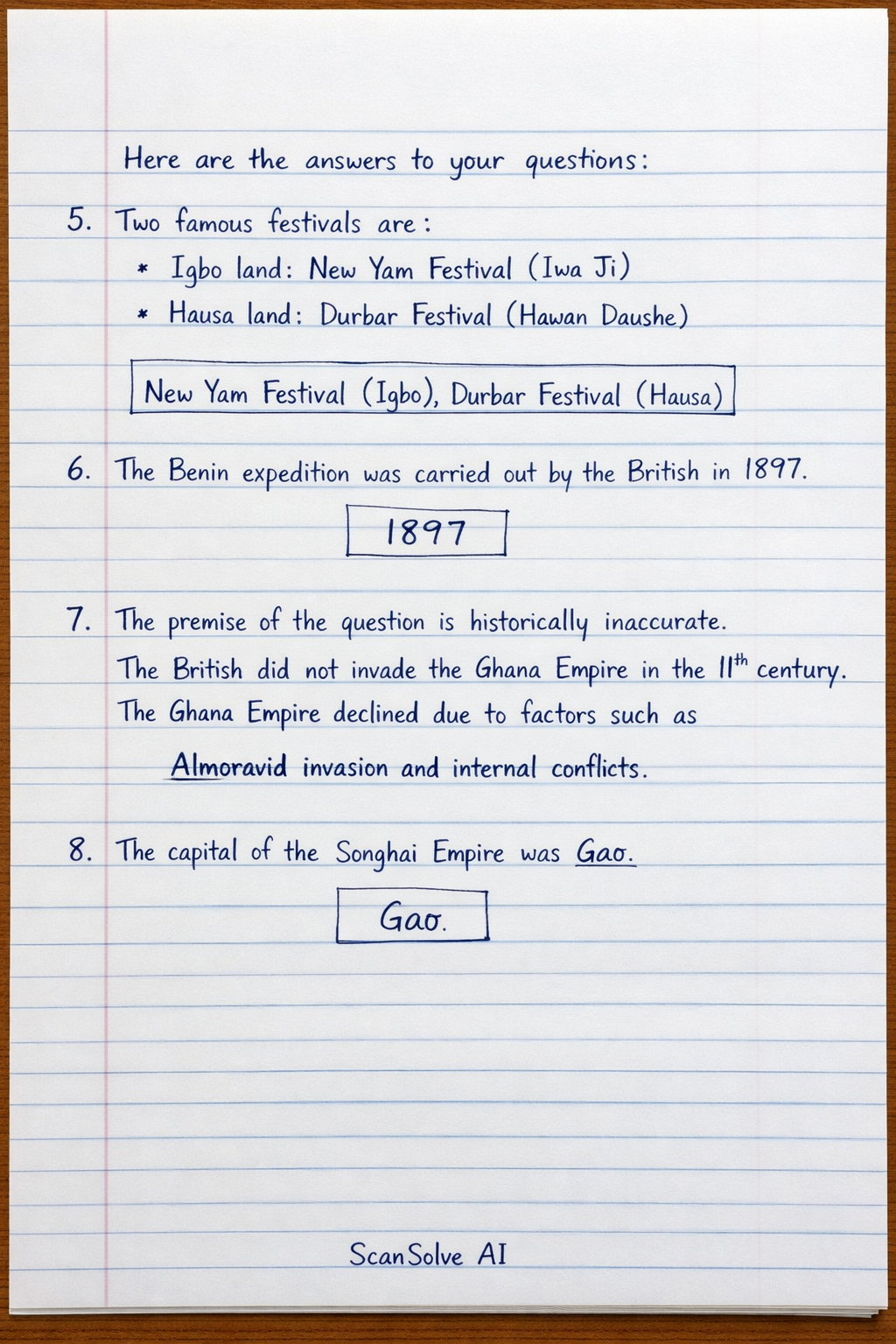
Handwritten Step-by-Step Solution
Get this as a handwritten image on WhatsApp — like a tutor wrote it for you.
Try on WhatsApp