
GKA TRIALS (a) Explain term creativity as used in the arts. (b) What is the difference between art appreciation and art criticism? (c) A school of taught believe that a creative person exhibits some characteristics, Enumerates and explain any four (4) of such traits. 2. (a) What are secret societies in Traditional African Art? (b) Explain three relevance of the secret societies to the Dogon people. C) Discuss three foreign influences on African(a) Write shorts notes on the following Animism Ancestor Veneration The Sphinx Art for Eternity (b) According to the Ashanti’s of Ghana, the Akuaba Doll has many functions, state any four characteristics of the wooden Akuaba Doll (a) List down four Visual Art Associations in Ghana. (b) State any two of these association. (c) Describe four roles of Art Associations and industries in nation building
ScanSolve AI Answer
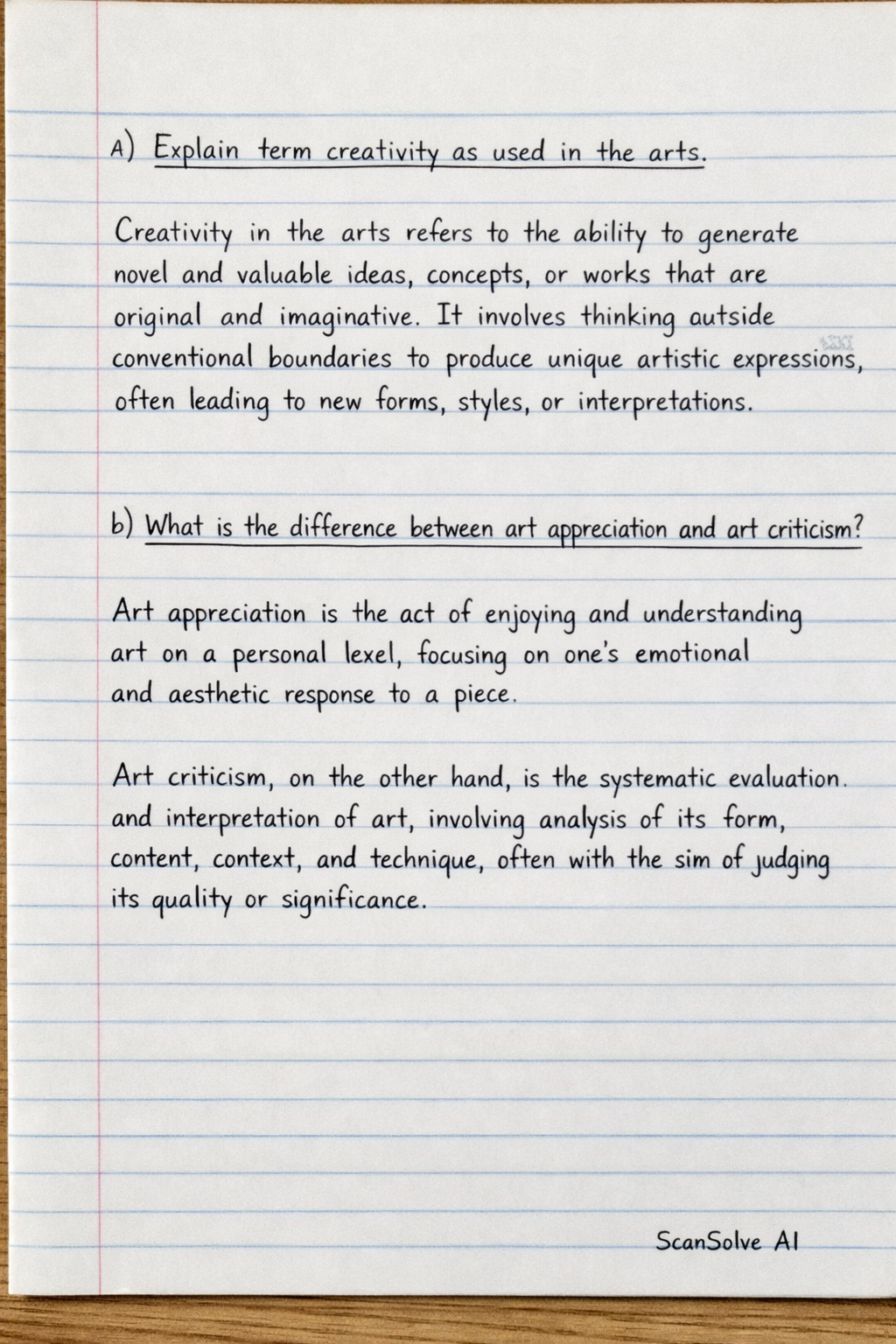
a) Explain term creativity as used in the arts.
Creativity in the arts refers to the ability to generate novel and valuable ideas, concepts, or works that are original and imaginative. It involves thinking outside conventional boundaries to produce unique artistic expressions, often leading to new forms, styles, or interpretations.
b) What is the difference between art appreciation and art criticism?
Art appreciation is the act of enjoying and understanding art on a personal level, focusing on one's emotional and aesthetic response to a piece. Art criticism, on the other hand, is the systematic evaluation and interpretation of art, involving analysis of its form, content, context, and technique, often with the aim of judging its quality or significance.
c) A school of thought believes that a creative person exhibits some characteristics. Enumerates and explain any four (4) of such traits.
Four characteristics of a creative person include:
- Curiosity: Creative individuals possess a strong desire to explore, question, and learn about the world around them, constantly seeking new information and experiences.
- Open-mindedness: They are receptive to new ideas, perspectives, and unconventional approaches, willing to challenge existing norms and embrace ambiguity.
- Persistence: Creative people demonstrate resilience and determination, continuing to work on their ideas despite encountering obstacles, failures, or criticism.
- Imagination: They have a vivid capacity to form new images, concepts, and scenarios in their minds, allowing them to envision possibilities beyond what is immediately present.
2. a) What are secret societies in Traditional African Art?
Secret societies in Traditional African Art are exclusive groups with restricted membership, often based on age, gender, or initiation rites. These societies utilize specific art forms, such as masks, costumes, and sculptures, in their rituals and ceremonies to maintain social order, transmit knowledge, and connect with spiritual realms.
b) Explain three relevance of the secret societies to the Dogon people.
Three relevance of secret societies to the Dogon people are:
- Social Control: They play a crucial role in enforcing laws, maintaining order, and resolving disputes within the community, ensuring adherence to cultural norms.
- Education and Initiation: Secret societies are responsible for transmitting cultural knowledge, history, and moral values to younger generations, often through elaborate initiation rites that mark transitions in life stages.
- Spiritual Connection: Through their masked dances and rituals, these societies facilitate communication with ancestors and spirits, acting as intermediaries between the physical and spiritual worlds to ensure community well-being and fertility.
C) Discuss three foreign influences on African art.
Three foreign influences on African art include:
- Islamic Influence: The spread of Islam, particularly in North and West Africa, introduced new artistic conventions such as geometric patterns, calligraphy, and aniconism (the avoidance of figural representation), which influenced architecture, textiles, and decorative arts.
- Christian Influence: With the arrival of Christianity, especially during the colonial era, new iconographies, styles, and materials were introduced. This led to the creation of syncretic art forms that blended traditional African aesthetics with Christian themes and imagery.
- Colonialism and Westernization: European colonialism brought Western art education systems, materials, and techniques. This influence led to the development of contemporary African art that often incorporates Western artistic principles while still engaging with traditional African themes and cultural identities.
a) Write short notes on the following
- Animism: Animism is the belief that all objects, places, and creatures possess a distinct spiritual essence or soul. In many traditional African cultures, it involves the belief that a spiritual world interacts with the physical world, and that spirits can inhabit natural phenomena or man-made objects.
- Ancestor Veneration: Ancestor veneration is the practice of honoring and respecting deceased family members, believing that they continue to exist in a spiritual realm and can influence the lives of the living. It is a fundamental aspect of many African belief systems, often involving rituals, offerings, and prayers.
- The Sphinx: The Sphinx is a mythical creature with the head of a human (often a pharaoh) and the body of a lion, prominently featured in ancient Egyptian art and mythology. It symbolized royalty, power, and protection, often guarding tombs and temples, such as the Great Sphinx of Giza.
- Art for Eternity: This concept is central to ancient Egyptian art, where artworks were created with the intention of lasting forever. The durable materials and meticulous craftsmanship were meant to ensure the eternal well-being of the deceased or to provide a permanent dwelling for the ka (life force) in the afterlife.
b) According to the Ashanti’s of Ghana, the Akuaba Doll has many functions, state any four characteristics of the wooden Akuaba Doll.
Four characteristics of the wooden Akuaba Doll are:
- Large, disc-shaped head: This prominent feature symbolizes beauty, fertility, and the ideal of a healthy, beautiful child.
- Stylized body: The doll typically has a slender, elongated body with a ringed neck, which represents beauty and prosperity.
- Small, outstretched arms: The arms are often depicted as small and extended, symbolizing the welcoming embrace of a child.
- Smooth, dark wood finish: The doll is usually carved from dark wood and polished to a smooth finish, representing health, vitality, and the beauty of dark skin.
a) List down four Visual Art Associations in Ghana.
- Ghana Association of Visual Artists (GAVA)
- Society of Ghanaian Artists (SOGA)
- Foundation for Contemporary Art - Ghana (FCA)
- Artists Alliance Gallery (functions as a collective hub)
b) State any two of these association.
- Ghana Association of Visual Artists (GAVA)
- Society of Ghanaian Artists (SOGA)
c) Describe four roles of Art Associations and industries in nation building.
Four roles of Art Associations and industries in nation building are:
- Cultural Preservation and Promotion: They safeguard and promote traditional art forms, cultural heritage, and indigenous knowledge, ensuring their continuity and relevance for future generations.
- Economic Development and Employment: Art industries create jobs for artists, artisans, and related professionals, contributing to the national economy through sales, tourism, and creative exports.
- Education and Skill Development: These associations provide platforms for training, workshops, and mentorship, fostering artistic talent and developing practical skills among aspiring artists and designers.
- Fostering National Identity and Unity: Art associations help to articulate and celebrate a unique national identity through diverse artistic expressions, promoting social cohesion and pride among citizens.
Still stuck on this one?
Ask a follow-up, and the answer starts from this question.
More History Questions
Handwritten Step-by-Step Solution
Get this as a handwritten image on WhatsApp — like a tutor wrote it for you.
Try on WhatsApp