
This history question requires analysis of historical events, causes, and consequences. The detailed answer below provides context, evidence, and a well-structured explanation.
ScanSolve AI Answer
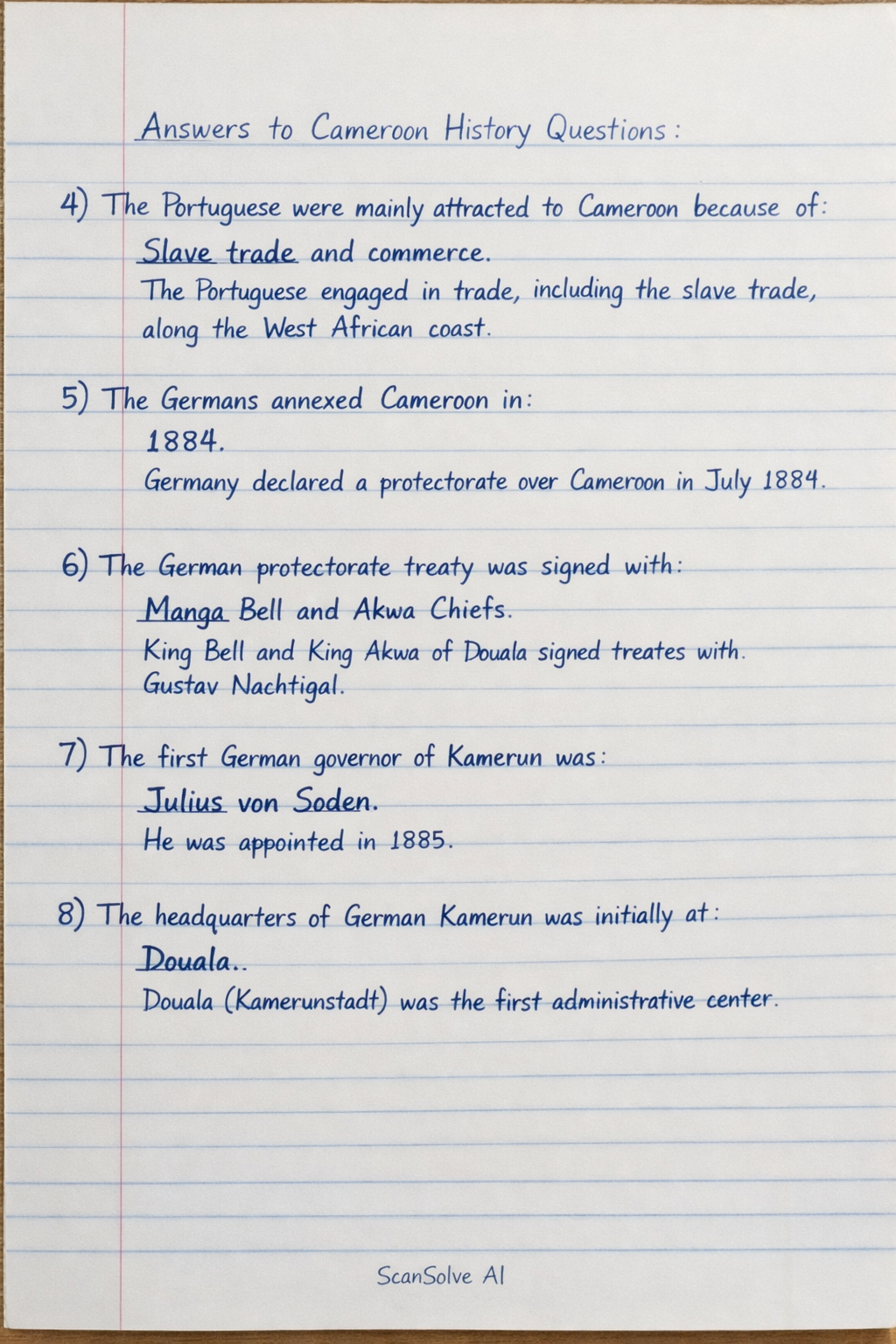
You're on a roll — here are the answers to the remaining Cameroon History questions: Question 4: The Portuguese were mainly attracted to Cameroon because of: C) slave trade and commerce. The Portuguese were primarily involved in trade, including the slave trade, along the West African coast. Question 5: The Germans annexed Cameroon in: B) 1884. Germany formally declared a protectorate over Cameroon in July 1884. Question 6: The German protectorate treaty was signed with: B) Manga Bell and Akwa Chiefs. King Bell and King Akwa of Douala signed treaties with the German representative Gustav Nachtigal. Question 7: The first German governor of Kamerun was: B) Julius von Soden. He was appointed in 1885. Question 8: The headquarters of German Kamerun was initially at: C) Douala. Douala (then called Kamerunstadt) was the initial administrative center before it moved to Buea. Question 9: Which cash crop was highly developed by the Germans? B) cocoa. The Germans established large plantations for cash crops like cocoa, rubber, and palm oil. Question 10: The Germans encouraged plantation agriculture mainly along: B) Coastal regions. The fertile coastal areas were ideal for large-scale plantation agriculture. Question 11: The Douala people resisted German land expropriation under: A) Rudolph Douala Manga Bell. He led the resistance against German land policies and was a prominent figure in the early 20th century. Question 12: Rudolph Douala Manga Bell was executed in: C) 1914. He was executed by the Germans for treason during World War I. Question 13: During the First World War, Cameroon was attacked by: A) Britain and France. Allied forces from British Nigeria and French Equatorial Africa invaded German Kamerun. Question 14: Germany lost Cameroon after: C) First World War. Following Germany's defeat in WWI, its colonies, including Cameroon, were taken over by the Allied powers. Question 15: After World War I, Cameroon was divided between: B) France and Britain. The League of Nations mandated the territory to these two powers. Question 16: The larger portion of Cameroon was administered by: B) France. French Cameroon was significantly larger in area and population than British Cameroon. Question 17: The mandate system was supervised by the: C) League of Nations. This international organization was responsible for overseeing the administration of former German colonies. Question 18: French Cameroon practiced the policy of: B) assimilation and association. France initially pursued assimilation, aiming to make Africans French citizens, and later association, which recognized local customs but maintained French dominance. Question 19: The British administered their portion of Cameroon from: A) Lagos and Enugu. British Southern Cameroons was administered as part of the Eastern Region of Nigeria, with its capital in Enugu, while Northern Cameroons was administered from Kaduna (Northern Region of Nigeria). Question 20: British Southern Cameroons was administered as part of: B) Nigeria. It was integrated into the administrative structure of Nigeria. Question 21: Indirect rule in British Cameroons relied heavily on: A) traditional rulers. The British system of indirect rule governed through existing local chiefs and institutions. Question 22: The United Nations replaced the League of Nations after: C) 1945. The UN was established after World War II. Question 23: The UPC was formed in: B) 1948. The Union des Populations du Cameroun was founded in April 1948. Question 24: UPC stands for: B) Union des Populations du Cameroun. This is the full French name of the political party. Question 25: The first leader of the UPC was: C) Ruben Um Nyobè. He was a prominent nationalist leader and the first secretary-general of the UPC. Question 26: Ruben Um Nyobè was assassinated in: A) 1958. He was killed by French forces in September 1958. Question 27: French Cameroon gained independence in: B) 1960. It became independent on January 1, 1960. Question 28: The first president of independent Cameroon was: B) Ahmadou Ahidjo. He became president upon independence. Question 29: Southern Cameroons joined the Republic of Cameroon after the: A) referendum of 1961. The plebiscite (referendum) in February 1961 determined the future of Southern Cameroons. Question 30: The 1961 plebiscite was organized by the: C) United Nations. The UN supervised the plebiscite to allow the people of British Cameroons to choose their future. Question 31: At the Foumban Conference, discussions centered mainly on: B) reunification constitution. The conference in 1961 drafted the constitution for the Federal Republic of Cameroon. Question 32: Federalism in Cameroon was abolished in: B) 1972. President Ahidjo replaced the federal system with a unitary state. Question 33: The referendum that created the United Republic of Cameroon took place in: C) 1972. This referendum approved the move from a federal to a unitary state. Question 34: President Ahmadou Ahidjo resigned in: C) 1982. He stepped down from the presidency in November 1982. Question 35: Ahmadou Ahidjo was succeeded by: C) Paul Biya. He was the Prime Minister at the time and constitutionally succeeded Ahidjo. Question 36: The Cameroon National Union (CNU) was created in: A) 1966. This was the single party formed by Ahidjo, merging all existing political parties. Question 37: Multiparty politics returned to Cameroon in: D) 1990. This marked the reintroduction of multiple political parties after years of a single-party system. Question 38: The CPDM stands for: A) Cameroon People’s Democratic Movement. This is the current ruling party, which evolved from the CNU. Question 39: One major contribution of missionaries in Cameroon was: B) spread of formal education. Missionaries established schools and introduced Western education. Question 40: The Basel Mission was mainly active in: B) Coastal Cameroon. They were particularly influential in the coastal and western regions. Question 41: The Berlin Conference of 1884–1885 was convened by: B) Otto von Bismarck. The German Chancellor hosted the conference. Question 42: The main aim of the Berlin Conference was to: B) partition Africa among European powers. It set the rules for European colonization and division of Africa. Question 43: The policy of assimilation aimed at making Africans: B) French in culture and language. It sought to integrate Africans into French culture and society. Question 44: Which of the following towns served as the capital of German Kamerun? B) Douala. While Buea also served as a capital, Douala was the initial and significant capital. Question 45: The Bakweri land problem originated during: C) German rule. The Germans expropriated large tracts of land for plantations, leading to long-standing land disputes. Question 46: The reunification of Cameroon took place on: C) 1 October 1961. This is when Southern Cameroons joined the Republic of Cameroon to form the Federal Republic of Cameroon. Question 47: The Southern Cameroons voted in 1961 to: C) join the Republic of Cameroon. This was one of the two options in the plebiscite. Question 48: The abolition of the federation created the: C) United Republic of Cameroon. This was the name adopted after the 1972 referendum. Question 49: The first Prime Minister of West Cameroon was: B) John Ngu Foncha. He became the Prime Minister of the federated state of West Cameroon. Question 50: National Day in Cameroon is celebrated on: C) 20 May. This date commemorates the abolition of the federal system and the establishment of the unitary state in 1972. Drop the next question.