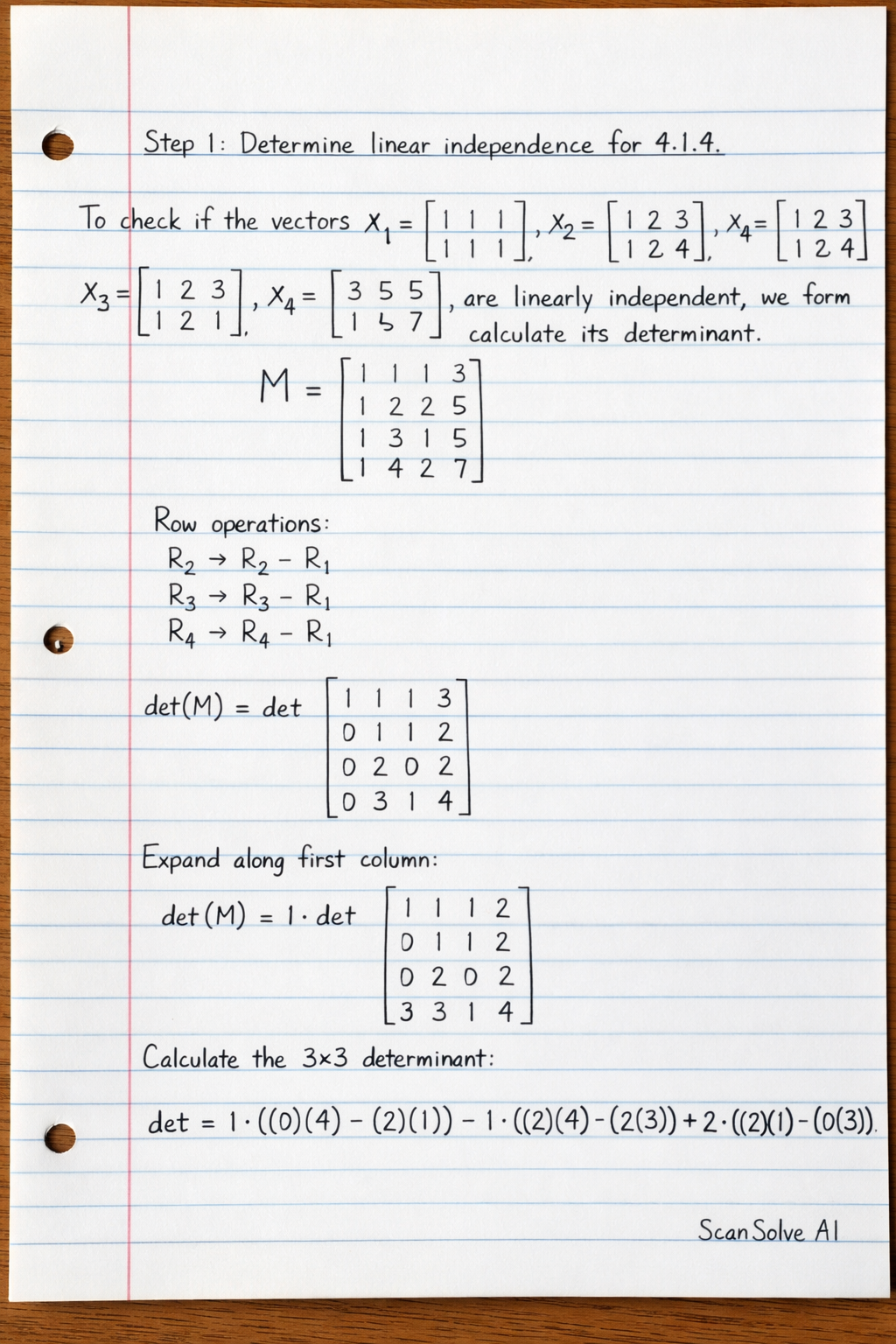
Step 1: Determine linear independence for 4.1.4.
To determine if the vectors x1=1111, x2=1234, x3=1212, and x4=3557 are linearly independent, we form a matrix M with these vectors as columns and calculate its determinant.
M=1111123412123557
Perform row operations to simplify the determinant calculation:
R2←R2−R1R3←R3−R1R4←R4−R1det(M)=det1000112311013224
Expand along the first column:
det(M)=1⋅det123101224
Calculate the determinant of the 3×3 matrix:
det=1⋅((0)(4)−(2)(1))−1⋅((2)(4)−(2)(3))+2⋅((2)(1)−(0)(3))det=1⋅(−2)−1⋅(8−6)+2⋅(2−0)det=−2−1⋅(2)+2⋅(2)det=−2−2+4det=0
Since det(M)=0, the vectors are linearly dependent.
The set of vectors is linearlydependent.
Step 2: Determine which sets of vectors are bases for R4 (Question 4.2).
A set of vectors forms a basis for R4 if it contains exactly four vectors and these vectors are linearly independent.
For 4.2.1: [(0,1,0,1)′,(1,1,0,0)′,(0,0,1,1)′]
This set contains only 3 vectors. Since a basis for R4 must have 4 vectors, this set cannot be a basis for R4.
The set in 4.2.1 is notabasisforR4.
Step 3: Check linear independence for 4.2.2.
For 4.2.2: [(2,2,2,1)′,(2,1,1,1)′,(3,2,1,1)′,(1,1,1,1)′]
This set contains 4 vectors. We form a matrix M with these vectors as columns and calculate its determinant.
M=2221211132111111
Swap R1 and R4 (this changes the sign of the determinant):
M′=1222111212131111
Perform row operations:
R2←R2−2R1R3←R3−2R1R4←R4−2R1M′′=10001−1−1010−111−1−1−1
Expand along the first column:
det(M′′)=1⋅det−1−100−11−1−1−1
Calculate the determinant of the 3×3 matrix:
det=−1⋅((−1)(−1)−(−1)(1))−0⋅(…)+(−1)⋅((−1)(1)−(−1)(0))det=−1⋅(1+1)−0+(−1)⋅(−1−0)det=−1⋅(2)+(−1)⋅(−1)det=−2+1=−1
Since det(M′′)=−1, then det(M)=−(−1)=1.
Since det(M)=1=0, the vectors are linearly independent. As there are 4 linearly independent vectors in R4, this set forms a basis.
The set in 4.2.2 is abasisforR4.
Step 4: Check linear independence for 4.2.3.
For 4.2.3: [(2,0,1,1)′,(3,1,2,2)′,(2,1,1,2)′,(2,1,2,1)′]
This set contains 4 vectors. We form a matrix M with these vectors as columns and calculate its determinant.
M=2011312221122121
Swap R1 and R3 (this changes the sign of the determinant):
M′=1021213211222121
Perform row operations:
R3←R3−2R1R4←R4−R1M′′=100021−10110121−2−1
Expand along the first column:
det(M′′)=1⋅det1−101011−2−1
Calculate the determinant of the 3×3 matrix:
det=1⋅((0)(−1)−(−2)(1))−1⋅((−1)(−1)−(−2)(0))+1⋅((−1)(1)−(0)(0))det=1⋅(0+2)−1⋅(1−0)+1⋅(−1−0)det=2−1−1
Was this helpful?
Need help with your own homework?
Get instant step-by-step solutions to any question. Free to start.
This history question requires analysis of historical events, causes, and consequences. The detailed answer below provides context, evidence, and a well-structured explanation.
ScanSolve AI Answer
Step 1: Determine linear independence for 4.1.4. To determine if the vectors x_1 = 1 \\ 1 \\ 1 \\ 1 , x_2 = 1 \\ 2 \\ 3 \\ 4 , x_3 = 1 \\ 2 \\ 1 \\ 2 , and x_4 = 3 \\ 5 \\ 5 \\ 7 are linearly independent, we form a matrix M with these vectors as columns and calculate its determinant. M = 1 & 1 & 1 & 3 \\ 1 & 2 & 2 & 5 \\ 1 & 3 & 1 & 5 \\ 1 & 4 & 2 & 7 Perform row operations to simplify the determinant calculation: R_2 R_2 - R_1 R_3 R_3 - R_1 R_4 R_4 - R_1 (M) = 1 & 1 & 1 & 3 \\ 0 & 1 & 1 & 2 \\ 0 & 2 & 0 & 2 \\ 0 & 3 & 1 & 4 Expand along the first column: (M) = 1 · 1 & 1 & 2 \\ 2 & 0 & 2 \\ 3 & 1 & 4 Calculate the determinant of the 3 × 3 matrix: = 1 · ((0)(4) - (2)(1)) - 1 · ((2)(4) - (2)(3)) + 2 · ((2)(1) - (0)(3)) = 1 · (-2) - 1 · (8 - 6) + 2 · (2 - 0) = -2 - 1 · (2) + 2 · (2) = -2 - 2 + 4 = 0 Since (M) = 0, the vectors are linearly dependent. The set of vectors is linearly dependent. Step 2: Determine which sets of vectors are bases for R^4 (Question 4.2). A set of vectors forms a basis for R^4 if it contains exactly four vectors and these vectors are linearly independent. For 4.2.1: [(0,1,0,1)', (1,1,0,0)', (0,0,1,1)'] This set contains only 3 vectors. Since a basis for R^4 must have 4 vectors, this set cannot be a basis for R^4. The set in 4.2.1 is not a basis for R^4. Step 3: Check linear independence for 4.2.2. For 4.2.2: [(2,2,2,1)', (2,1,1,1)', (3,2,1,1)', (1,1,1,1)'] This set contains 4 vectors. We form a matrix M with these vectors as columns and calculate its determinant. M = 2 & 2 & 3 & 1 \\ 2 & 1 & 2 & 1 \\ 2 & 1 & 1 & 1 \\ 1 & 1 & 1 & 1 Swap R_1 and R_4 (this changes the sign of the determinant): M' = 1 & 1 & 1 & 1 \\ 2 & 1 & 2 & 1 \\ 2 & 1 & 1 & 1 \\ 2 & 2 & 3 & 1 Perform row operations: R_2 R_2 - 2R_1 R_3 R_3 - 2R_1 R_4 R_4 - 2R_1 M'' = 1 & 1 & 1 & 1 \\ 0 & -1 & 0 & -1 \\ 0 & -1 & -1 & -1 \\ 0 & 0 & 1 & -1 Expand along the first column: (M'') = 1 · -1 & 0 & -1 \\ -1 & -1 & -1 \\ 0 & 1 & -1 Calculate the determinant of the 3 × 3 matrix: = -1 · ((-1)(-1) - (-1)(1)) - 0 · () + (-1) · ((-1)(1) - (-1)(0)) = -1 · (1 + 1) - 0 + (-1) · (-1 - 0) = -1 · (2) + (-1) · (-1) = -2 + 1 = -1 Since (M'') = -1, then (M) = -(-1) = 1. Since (M) = 1 ≠ 0, the vectors are linearly independent. As there are 4 linearly independent vectors in R^4, this set forms a basis. The set in 4.2.2 is a basis for R^4. Step 4: Check linear independence for 4.2.3. For 4.2.3: [(2,0,1,1)', (3,1,2,2)', (2,1,1,2)', (2,1,2,1)'] This set contains 4 vectors. We form a matrix M with these vectors as columns and calculate its determinant. M = 2 & 3 & 2 & 2 \\ 0 & 1 & 1 & 1 \\ 1 & 2 & 1 & 2 \\ 1 & 2 & 2 & 1 Swap R_1 and R_3 (this changes the sign of the determinant): M' = 1 & 2 & 1 & 2 \\ 0 & 1 & 1 & 1 \\ 2 & 3 & 2 & 2 \\ 1 & 2 & 2 & 1 Perform row operations: R_3 R_3 - 2R_1 R_4 R_4 - R_1 M'' = 1 & 2 & 1 & 2 \\ 0 & 1 & 1 & 1 \\ 0 & -1 & 0 & -2 \\ 0 & 0 & 1 & -1 Expand along the first column: (M'') = 1 · 1 & 1 & 1 \\ -1 & 0 & -2 \\ 0 & 1 & -1 Calculate the determinant of the 3 × 3 matrix: = 1 · ((0)(-1) - (-2)(1)) - 1 · ((-1)(-1) - (-2)(0)) + 1 · ((-1)(1) - (0)(0)) = 1 · (0 + 2) - 1 · (1 - 0) + 1 · (-1 - 0) = 2 - 1 - 1