
We read your photo as:
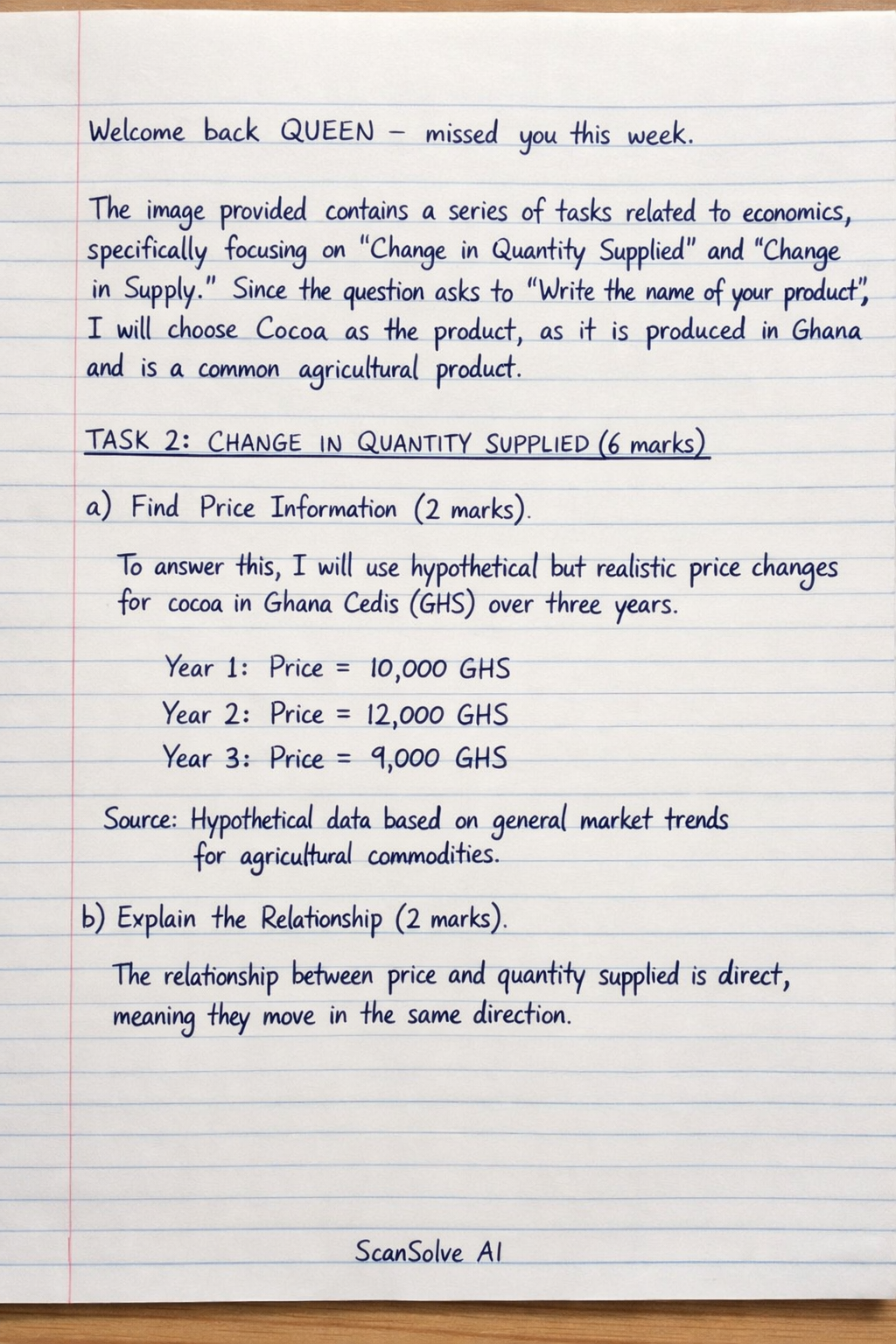
Welcome back QUEEN — missed you this week.
ScanSolve AI Answer
The image provided contains a series of tasks related to economics, specifically focusing on "Change in Quantity Supplied" and "Change in Supply." Since the question asks to "Write the name of your product" and then proceeds with tasks that require specific product information, I will choose Cocoa as the product, as it is listed as one of the products produced in Ghana and is a common agricultural product.
TASK 2: CHANGE IN QUANTITY SUPPLIED (6 marks)
a) Find Price Information (2 marks)
To answer this, I will use hypothetical but realistic price changes for cocoa in Ghana Cedis (GHS) over three years.
- Year 1: Price = 10,000 (GHS)
- Year 2: Price = 12,000 (GHS)
- Year 3: Price = 9,000 (GHS)
- Source: Hypothetical data based on general market trends for agricultural commodities.
b) Explain the Relationship (2 marks)
The relationship between price and quantity supplied is direct, meaning they move in the same direction.
- When the price of cocoa went up, the quantity supplied by farmers increased because higher prices make production more profitable.
- When the price of cocoa went down, the quantity supplied by farmers decreased as lower prices reduce profitability, making farmers less willing to supply as much.
c) Draw a Simple Diagram (2 marks)
A diagram showing a change in quantity supplied involves movement along a single supply curve.
\begin{tikzpicture}[scale=0.8]
\draw[->] (0,0) -- (6,0) node[below] {Quantity};
\draw[->] (0,0) -- (0,6) node[left] {Price};
\draw[thick, blue] (1,1) node[below left] {$S$} .. controls (2,2) and (4,4) .. (5,5);

\fill (2,2) circle (2pt) node[above left] {A};
\fill (4,4) circle (2pt) node[above right] {B};

\draw[->, thick, red] (2,2) -- (4,4);
\node at (3,3.5) [above] {Change in Quantity Supplied};

\draw[dashed] (0,2) -- (2,2) -- (2,0);
\node at (-0.3,2) {$P_A$};
\node at (2,-0.3) {$Q_A$};

\draw[dashed] (0,4) -- (4,4) -- (4,0);
\node at (-0.3,4) {$P_B$};
\node at (4,-0.3) {$Q_B$};
\end{tikzpicture}
- The diagram shows a supply curve (S) sloping upwards.
- Point A represents a low price () and a low quantity ().
- Point B represents a high price () and a high quantity ().
- The arrow from A to B indicates an increase in quantity supplied due to an increase in price, moving along the existing supply curve.
- The vertical axis is labeled "Price" and the horizontal axis is labeled "Quantity."
TASK 3: CHANGE IN SUPPLY (6 marks)
a) Identify ONE Factor (2 marks)
A change in supply is caused by factors other than the product's own price. For cocoa, a significant factor could be technology.
- What is the factor? Improved farming technology (e.g., new irrigation systems or disease-resistant cocoa varieties).
- Did it improve or worsen? It improved the supply of cocoa.
- What happened to supply? Supply increased because the new technology made cocoa farming more efficient, leading to higher yields or lower production costs.
b) Draw Two Simple Diagrams (4 marks)
Diagram 1: Increase in Supply
An increase in supply is represented by a rightward shift of the supply curve.
\begin{tikzpicture}[scale=0.8]
\draw[->] (0,0) -- (6,0) node[below] {Quantity};
\draw[->] (0,0) -- (0,6) node[left] {Price};

\draw[thick, blue] (1,1) node[below left] {$S_1$} .. controls (2,2) and (4,4) .. (5,5);
\draw[thick, red, dashed] (2,1) node[below left] {$S_2$} .. controls (3,2) and (5,4) .. (6,5);

\node at (4,5.5) {Supply Increased};
\node at (4,5) {Reason: Improved farming technology};
\end{tikzpicture}
- The original supply curve is .
- The new supply curve is shifted to the RIGHT of .
- This shift indicates that at any given price, a greater quantity of cocoa is supplied.
- The reason for this increase is the improved farming technology.
Diagram 2: Decrease in Supply
A decrease in supply is represented by a leftward shift of the supply curve. For this, I will use a different factor, such as adverse weather conditions.
\begin{tikzpicture}[scale=0.8]
\draw[->] (0,0) -- (6,0) node[below] {Quantity};
\draw[->] (0,0) -- (0,6) node[left] {Price};

\draw[thick, blue] (1,1) node[below left] {$S_1$} .. controls (2,2) and (4,4) .. (5,5);
\draw[thick, green, dashed] (0,2) node[below left] {$S_2$} .. controls (1,3) and (3,5) .. (4,6);

\node at (4,5.5) {Supply Decreased};
\node at (4,5) {Reason: Adverse weather conditions};
\end{tikzpicture}
- The original supply curve is .
- The new supply curve is shifted to the LEFT of .
- This shift indicates that at any given price, a smaller quantity of cocoa is supplied.
- The reason for this decrease is adverse weather conditions (e.g., drought or excessive rain) that negatively impacted cocoa yields.
Still stuck on this one?
Ask a follow-up, and the answer starts from this question.
More History Questions
Handwritten Step-by-Step Solution
Get this as a handwritten image on WhatsApp — like a tutor wrote it for you.
Try on WhatsApp