
We read your photo as:
List and describe 5 Adinkra symbols and their meanings. Also, identify and explain the significance of the Venus of Willendorf.
ScanSolve AI Answer
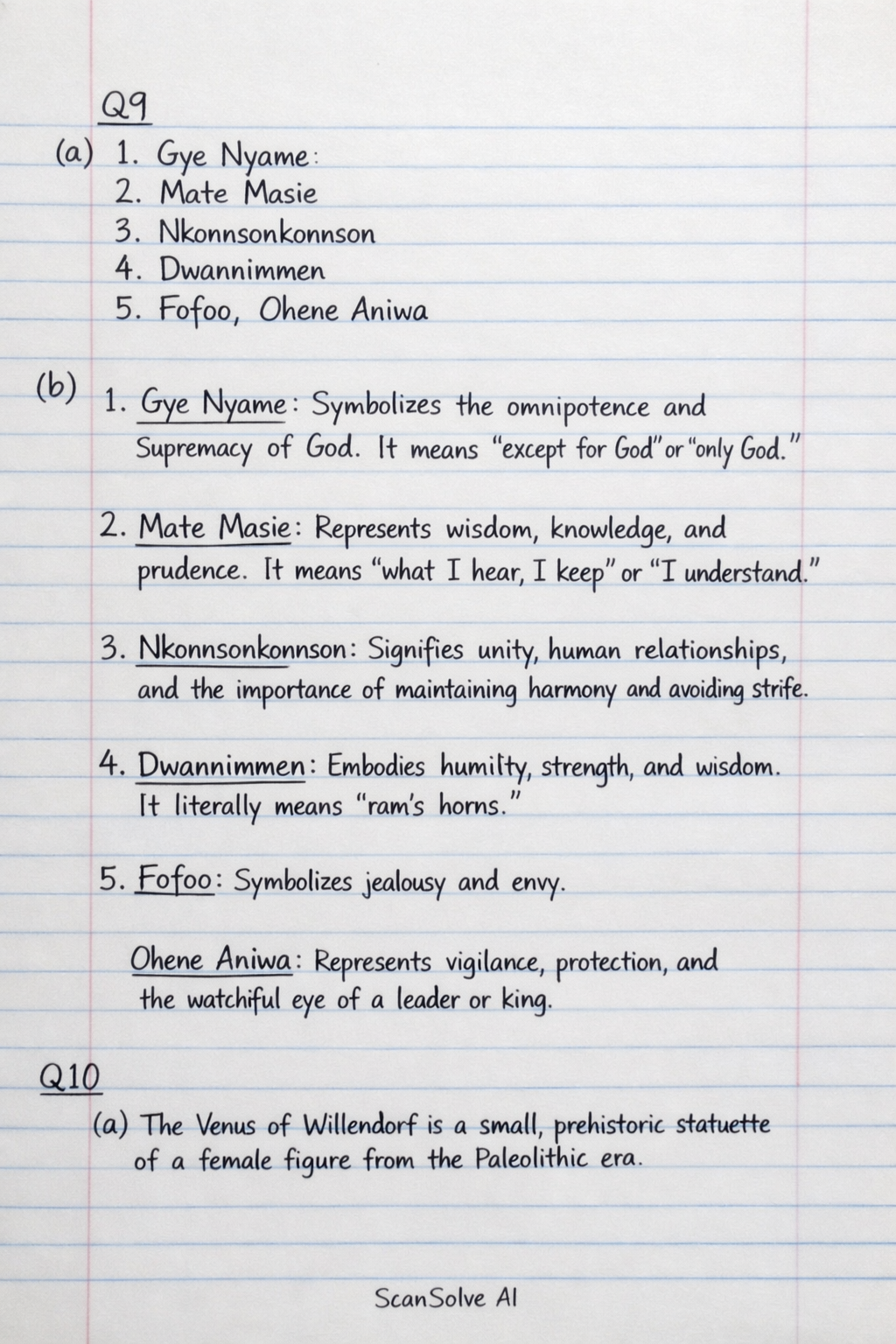
Q9
a)
- Gye Nyame
- Mate Masie (Assuming "Mate music" is a typo for Mate Masie)
- Nkonnsonkonnson
- Dwannimmen
- Fofoo, Ohene Aniwa (Interpreted as two distinct symbols due to the phrasing)
b)
- Gye Nyame: Symbolizes the omnipotence and supremacy of God. It means "except for God" or "only God."
- Mate Masie: Represents wisdom, knowledge, and prudence. It means "what I hear, I keep" or "I understand."
- Nkonnsonkonnson: Signifies unity, human relationships, and the importance of maintaining harmony and avoiding strife.
- Dwannimmen: Embodies humility, strength, and wisdom. It literally means "ram's horns."
- Fofoo: Symbolizes jealousy and envy. Ohene Aniwa: Represents vigilance, protection, and the watchful eye of a leader or king.
Q10
a) The Venus of Willendorf is a small, prehistoric statuette of a female figure from the Paleolithic era.
b) It is called the Venus of Willendorf for two main reasons:
- Venus: This term is commonly used for prehistoric female figurines, often implying associations with fertility, beauty, or a mother goddess.
- Willendorf: This refers to the village of Willendorf in der Wachau, Austria, where the statuette was discovered in 1908.
c) The Venus of Willendorf is a small (approximately or tall) figurine carved from oolitic limestone. It features exaggerated female characteristics such as large breasts, a prominent belly, wide hips, and buttocks, which are often interpreted as symbols of fertility and abundance. The figure has no discernible face; instead, its head is covered with intricate carvings, possibly representing braided hair or a headdress. Its small arms rest on its breasts, and it lacks feet, suggesting it was meant to be held or stood upright in soft ground.
Still stuck on this one?
Ask a follow-up, and the answer starts from this question.
More History Questions
Handwritten Step-by-Step Solution
Get this as a handwritten image on WhatsApp — like a tutor wrote it for you.
Try on WhatsApp