
We read your photo as:
Describe how miners resisted poor working conditions and evaluate the effectiveness of their resistance.
ScanSolve AI Answer
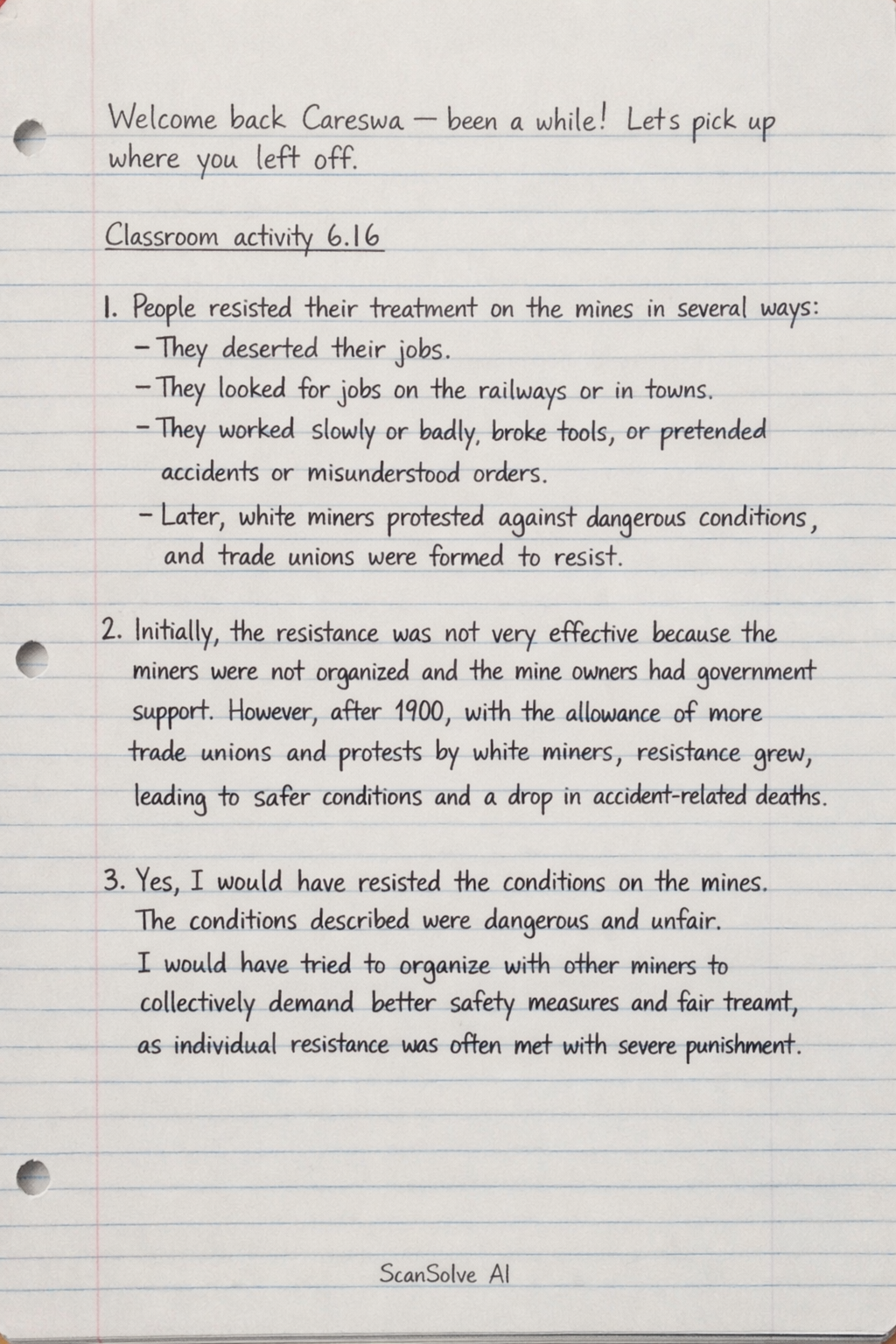
Classroom activity 6.16
-
People resisted their treatment on the mines in several ways:
- They deserted their jobs.
- They looked for jobs on the railways or in towns.
- They worked slowly or badly, broke tools, or pretended accidents or misunderstood orders.
- Later, white miners protested against dangerous conditions, and trade unions were formed to resist.
-
Initially, the resistance was not very effective because the miners were not organized and the mine owners had government support. However, after 1900, with the allowance of more trade unions and protests by white miners, resistance grew, leading to safer conditions and a drop in accident-related deaths.
-
Yes, I would have resisted the conditions on the mines. The conditions described were dangerous and unfair. I would have tried to organize with other miners to collectively demand better safety measures and fair treatment, as individual resistance was often met with severe punishment.
-
Mine owners had more power than the miners because they were supported by the government (Chamber of Mines). They could easily replace miners who deserted, and the migrant labour system meant miners who left their jobs would lose their passes and be treated as criminals. Miners were also initially unorganized and black miners were not allowed to form trade unions, leaving them without collective bargaining power.
-
No, it is not fair that the mine owners were more powerful. This imbalance of power led to exploitation, extremely dangerous working conditions, and a lack of basic rights for the miners, resulting in many deaths and suffering.
Classroom activity 6.17
-
Trade unions are organizations that protect their members (workers) and negotiate with employers on their behalf to improve working conditions, wages, and benefits. They aim to ensure fair treatment and safety in the workplace.
-
Three trade unions in South Africa today are:
- COSATU (Congress of South African Trade Unions)
- NUM (National Union of Mineworkers)
- SADTU (South African Democratic Teachers' Union)
-
Trade unions give power to workers by allowing them to act collectively. Instead of individual workers having little leverage, a union represents many workers, giving them a stronger, unified voice to negotiate for better wages, safer conditions, and fair treatment. This collective power makes it harder for employers to ignore their demands.
-
Trade unions are generally good for a country. They play a crucial role in protecting workers' rights, ensuring fair labor practices, and contributing to safer working environments. By advocating for fair wages and conditions, they can help reduce inequality and improve the overall quality of life for workers, which benefits society as a whole.
Still stuck on this one?
Ask a follow-up, and the answer starts from this question.
More History Questions
Handwritten Step-by-Step Solution
Get this as a handwritten image on WhatsApp — like a tutor wrote it for you.
Try on WhatsApp