
We read your photo as:
Explain the Native Land Act of 1913, its purpose, and its impact on land distribution in South Africa.
ScanSolve AI Answer
Step-by-step solution
10 stepsHere's an explanation of the Native Land Act of 1913 and its related aspects:
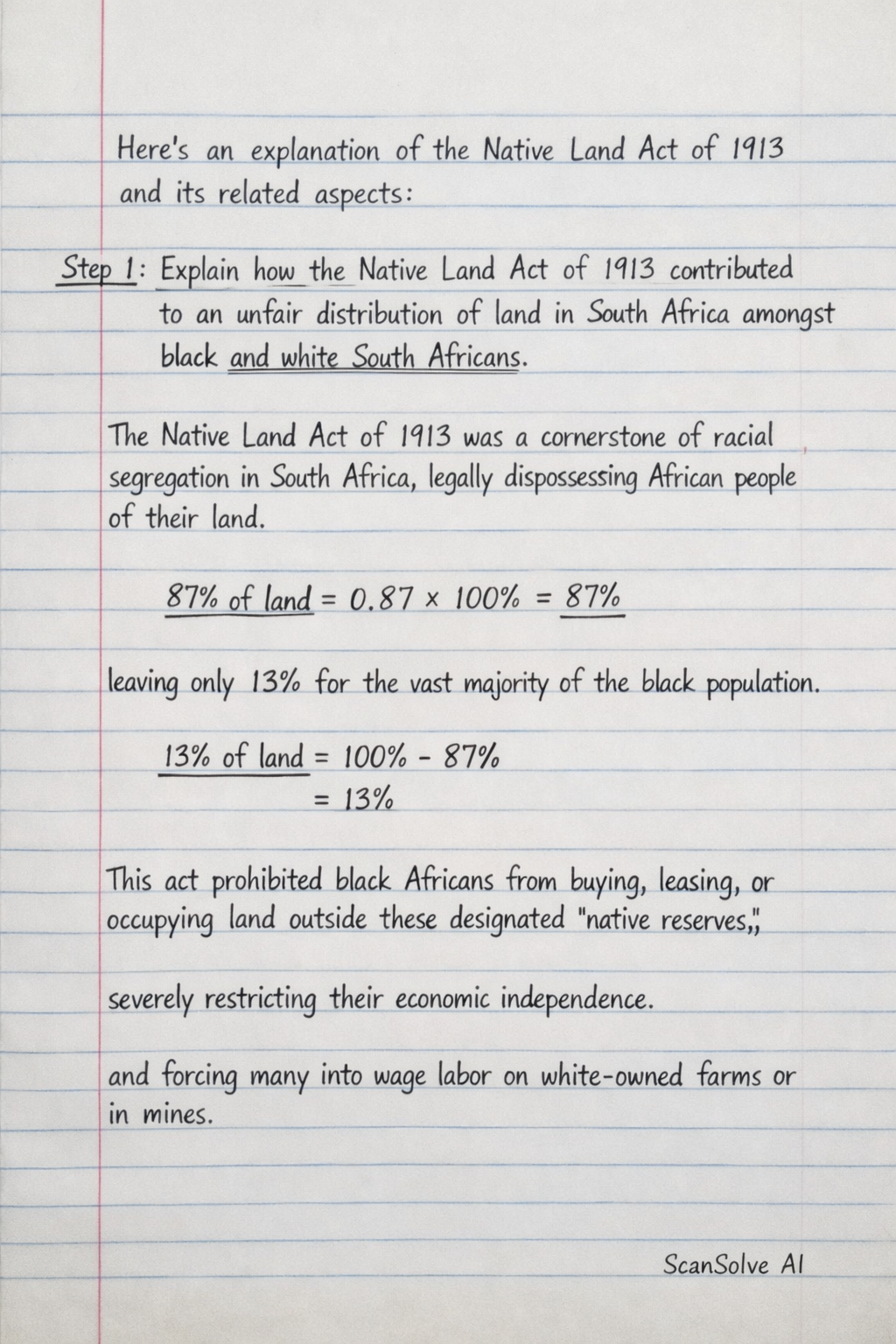
Explain how the Native Land Act of 1913 contributed to an unfair distribution of land in South Africa amongst black and white South Africans.
The Native Land Act of 1913 was a cornerstone of racial segregation in South Africa, legally dispossessing African people of their land. It designated approximately 87% of the land for white ownership, leaving only 13% for the vast majority of the black population. This act prohibited black Africans from buying, leasing, or occupying land outside these designated "native reserves," severely restricting their economic independence and forcing many into wage labor on white-owned farms or in mines.
Why was the Native Land Act of 1913 passed in 1913?
The Act was passed to entrench white economic and political dominance after the formation of the Union of South Africa in 1910. It aimed to prevent black Africans from competing with white farmers, secure a cheap labor supply for white farms and industries, and solidify racial segregation by confining black people to specific, often unproductive, areas.
How did it impact on land distribution in South Africa?
The Act formalized and exacerbated the unequal distribution of land, creating a dual land system. It stripped black Africans of their right to own land in most of the country, leading to overcrowding, poverty, and environmental degradation in the reserves, while vast tracts of fertile land remained in white hands.
Discuss the formation of the SANNC in 1912.
The South African Native National Congress (SANNC) was formed in 1912 (later renamed the African National Congress, ANC) by educated black professionals and chiefs. Its primary goal was to unite African people across tribal lines and advocate for their rights, particularly in response to discriminatory legislation like the impending Native Land Act.
What role did the SANNC play in resistance to the act?
The SANNC immediately mobilized against the Native Land Act, organizing petitions, public meetings, and sending delegations to appeal to the South African government and the British Crown. They highlighted the injustice and devastating impact of the Act on African communities.
Discuss the role played by Sol Plaatjie in collecting information from affected members of the farming community.
Sol Plaatjie, a founding member of the SANNC, played a crucial role in documenting the Act's impact. He traveled extensively, interviewing black families who had been forcibly removed from their land or rendered landless, meticulously recording their stories and experiences in his influential book, "Native Life in South Africa."
Describe the reaction of the British government to the SANNC delegation which went to London.
The SANNC sent a delegation to London in 1914 to appeal directly to the British government. However, the British government, bound by the terms of the Union of South Africa's self-governance, declined to intervene in what it considered an internal matter. This left the SANNC's appeals largely unheeded.
Discuss the economic and social impact of the 1913 Land Act on African people in South Africa.
Economically, the Act led to widespread poverty, landlessness, and dependence on white employers for African people. Socially, it caused immense disruption, forced removals, the breakdown of traditional communities, and the creation of a migrant labor system, deepening racial inequality and resentment.
Explain how the 1913 Land Act was used as a precursor to Grand Apartheid that was initiated in 1948.
The 1913 Land Act laid the legal and ideological foundation for Grand Apartheid. By establishing the principle of territorial segregation and restricting black land ownership, it created the framework for later apartheid laws that further entrenched racial separation, forced removals, and the creation of "Bantustans" or homelands.
What are some current issues concerning land restitution in South Africa?
Current issues include the slow pace of land claims processing, disputes over compensation and land valuation, challenges in providing support for successful claimants to utilize the land productively, and ongoing debates about land expropriation without compensation to address historical injustices.
Still stuck on this one?
Ask a follow-up, and the answer starts from this question.
More History Questions
Handwritten Step-by-Step Solution
Get this as a handwritten image on WhatsApp — like a tutor wrote it for you.
Try on WhatsApp