

This history question requires analysis of historical events, causes, and consequences. The detailed answer below provides context, evidence, and a well-structured explanation.
ScanSolve AI Answer
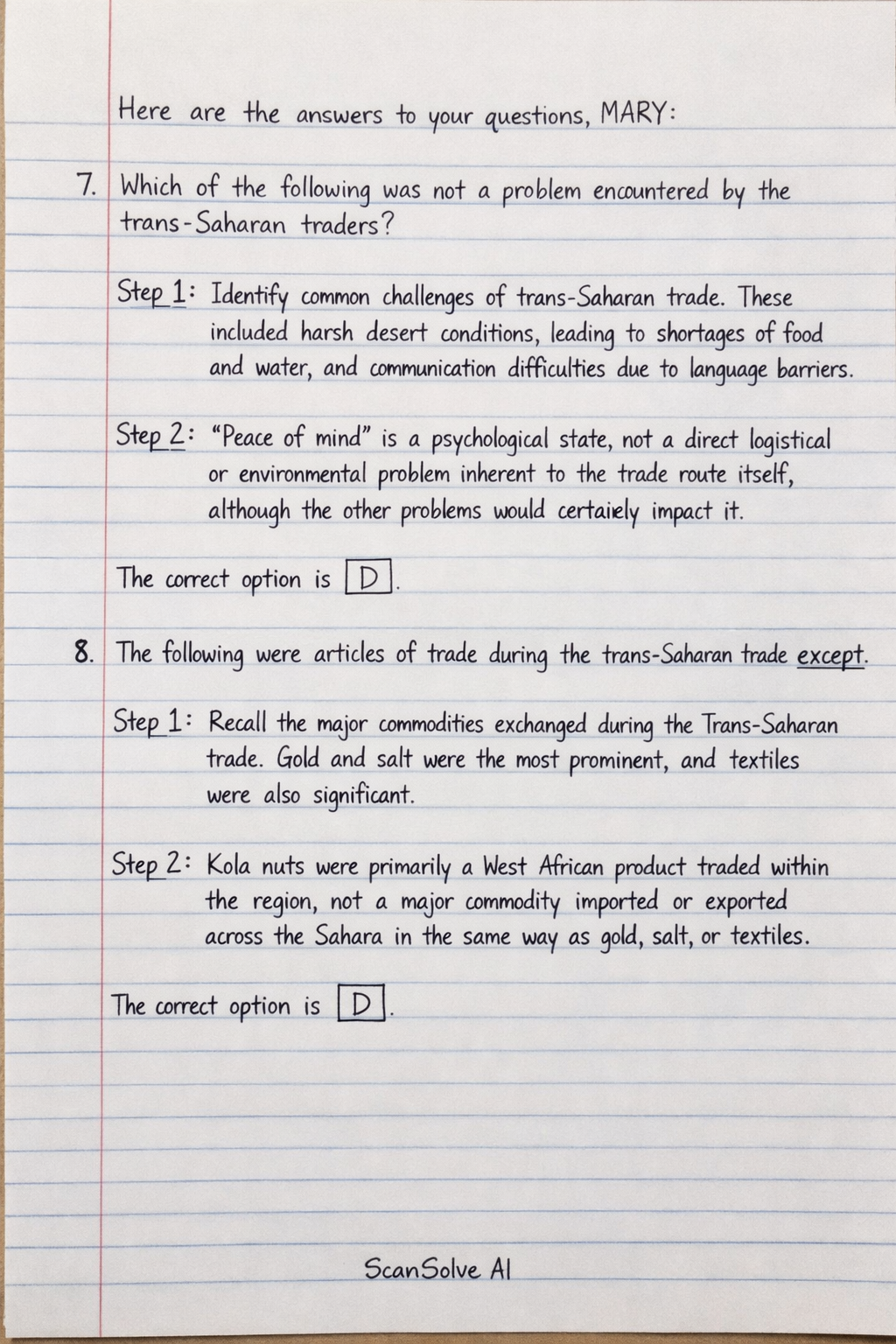
Here are the answers to your questions, MARY: 7. Which of the following was not a problem encountered by the trans-Saharan traders? Step 1: Identify common challenges of trans-Saharan trade. These included harsh desert conditions leading to shortages of food and water, and communication difficulties due to language barriers. Step 2: "Peace of mind" is a psychological state, not a direct logistical or environmental problem inherent to the trade route itself, although the other problems would certainly impact it. The correct option is D. D 8. The following were articles of trade during the trans-Saharan trade except Step 1: Recall the major commodities exchanged during the Trans-Saharan trade. Gold and salt were the most prominent, and textiles were also significant. Step 2: Kola nuts were primarily a West African product traded within the region, not a major commodity imported or exported across the Sahara in the same way as gold, salt, or textiles. The correct option is D. D 9. One of the commodities imported from North Africa to Western Africa during the trans-Saharan trade was Step 1: Distinguish between goods exported from and imported to West Africa. Gold and ivory were major exports from West Africa. Kola nuts were a West African product. Step 2: Dried figs, along with other foodstuffs, manufactured goods, and horses, were commonly imported into West Africa from North Africa. The correct option is C. C 10. Islam did not only bring a new religion in West Africa, but also a system of Step 1: Consider the broader impacts of Islam beyond religious conversion. Islam introduced new legal systems, administrative structures, and forms of governance. Step 2: The most significant systemic change brought by Islam, besides religion, was in political administration, leading to more centralized states and written laws. The correct option is C. C 11. Islam reached West Africa mainly through the Step 1: Identify the primary means by which Islam initially spread into West Africa. Step 2: The trans-Saharan trade routes were the main conduits through which Muslim traders and scholars introduced Islam to West African societies. The correct option is D. D 12. The following were effects of the spread of Islam in West Africa except Step 1: Evaluate the known effects of Islam's spread in West Africa. It introduced a new religion, often strengthened rulers, and brought Arabic literacy. Step 2: While Islam gained prominence, it did not lead to the total abolition of traditional worship; rather, traditional practices often coexisted or blended with Islamic beliefs. The correct option is D. D 13. The two renowned centres of Islamic education in West Africa were Step 1: Recall the most famous centers of learning in West Africa during the Islamic period. Step 2: Timbuktu was a preeminent center of Islamic scholarship, and Jenne (Djenne) was also a significant intellectual and commercial hub. The correct option is C. C 14. The only way by which Islam did not spread in West Africa peaceably was Step 1: Consider the methods of Islamic spread. Trade, intermarriage, and education are generally peaceful. Step 2: Jihad, particularly in its military context, involved conquest and was not a peaceful method of spreading Islam. The correct option is C. C 15. The European nation that first made contact with West Africans was Step 1: Identify the pioneering European country in maritime exploration along the West African coast. Step 2: Portugal was the first European nation to establish significant contact with West African societies in the 15th century. The correct option is A. A 16. In what way did the coming of the Europeans affect the social life of the people of West Africa? Step 1: Analyze the broad social impacts of European arrival. Step 2: The most encompassing social effect was the gradual adoption of European culture, including aspects like language, religion, education, and social customs, which significantly altered West African societies over time. The correct option is C. C That's 2 down. 3 left today — send the next one.