
We read your photo as:
Describe the origins of the Cold War, mentioning key events and figures like the Iron Curtain and the Berlin Blockade.
ScanSolve AI Answer
Scope Section:
-
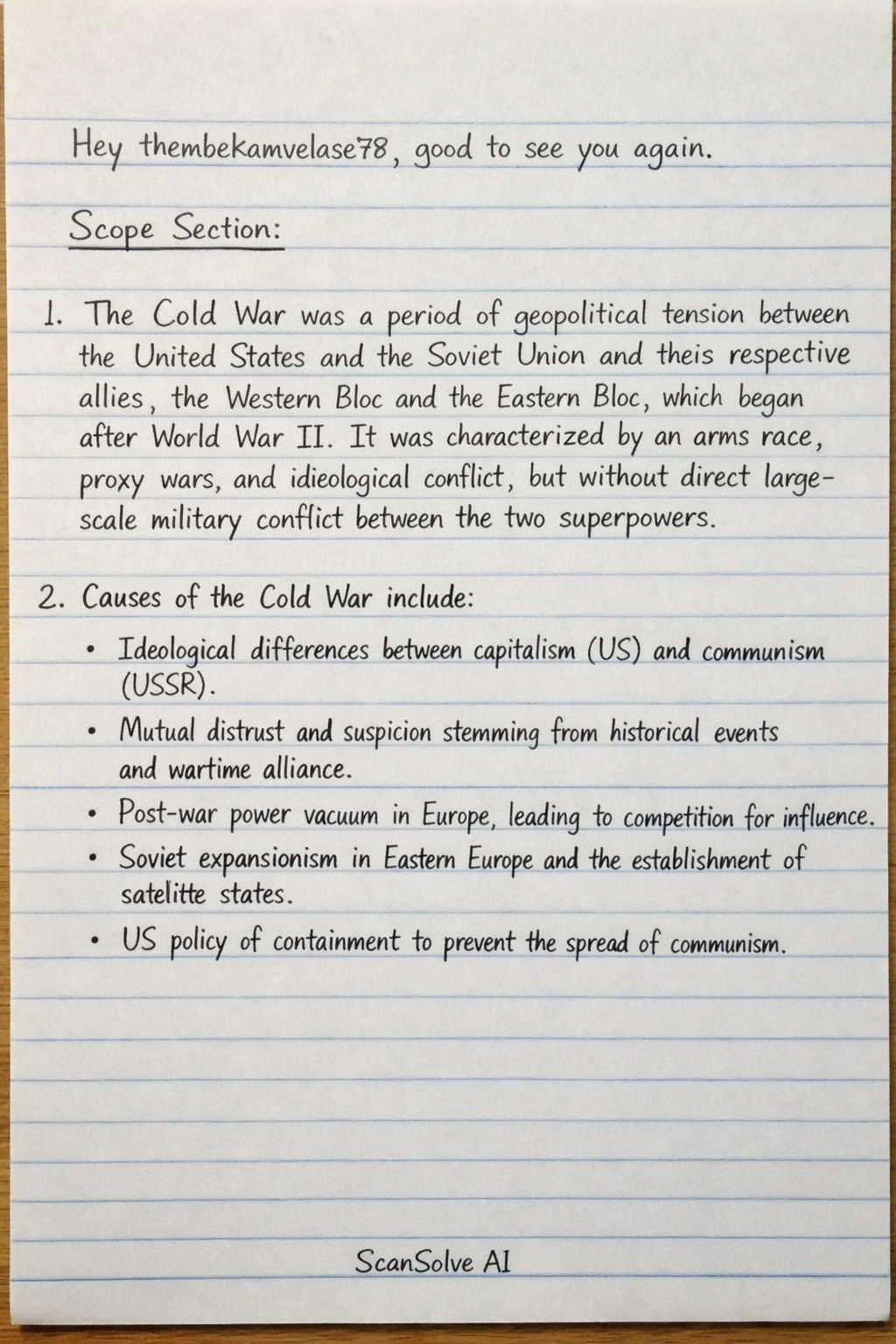
The Cold War was a period of geopolitical tension between the United States and the Soviet Union and their respective allies, the Western Bloc and the Eastern Bloc, which began after World War II. It was characterized by an arms race, proxy wars, and ideological conflict, but without direct large-scale military conflict between the two superpowers.
-
Causes of the Cold War include:
- Ideological differences between capitalism (US) and communism (USSR).
- Mutual distrust and suspicion stemming from historical events and wartime alliances.
- Post-war power vacuum in Europe, leading to competition for influence.
- Soviet expansionism in Eastern Europe and the establishment of satellite states.
- US policy of containment to prevent the spread of communism.
-
In his speech on March 5, 1946, at Westminster College in Fulton, Missouri, Winston Churchill declared that an "Iron Curtain" had descended across Europe, dividing the continent into two spheres: the democratic West and the Soviet-dominated East. He warned of the Soviet Union's expansionist ambitions and called for a strong Anglo-American alliance to counter them.
-
Three events that led to the Berlin Blockade (Soviet Blockade of Berlin) were:
- The introduction of a new currency (Deutsche Mark) in the Western zones of Germany and West Berlin without Soviet approval.
- The merger of the Western occupation zones (Bizonia and later Trizonia), which the Soviets viewed as a step towards a separate West German state.
- The Western Allies' refusal to grant the Soviet Union reparations from the industrial capacity of the Ruhr region.
Question Section:
-
At the end of the Second World War, Germany was divided into four occupation zones, governed by the United States, Great Britain, France, and the Soviet Union.
-
Key decisions made at the Yalta Conference (February 1945) included:
- Agreement on the post-war division of Germany into four occupation zones.
- Plans for the demilitarization and denazification of Germany.
- Agreement that the Soviet Union would enter the war against Japan after Germany's defeat.
- Discussions on the formation of the United Nations.
- Declaration on Liberated Europe, pledging free elections in liberated countries.
-
The Policy of Containment was introduced by George F. Kennan in 1947.
-
The aim of the Containment Policy was to prevent the spread of communism beyond its existing borders, primarily by countering Soviet geopolitical expansion during the Cold War. Countries in Europe who agreed with this policy included Great Britain, France, Italy, Greece, and Turkey, among others, particularly those that became members of NATO.
Question 3 Section:
-
The US Secretary of State in 1947 was George C. Marshall.
-
The aim of the Marshall Plan (officially the European Recovery Program) of 1947 was to provide economic aid to help rebuild war-torn Western European economies after World War II. This was intended to prevent the spread of communism by alleviating poverty and instability, fostering economic recovery, and promoting democratic governments. Countries in Europe that supported this plan and received aid included Great Britain, France, Italy, West Germany, and many other Western European nations.
Still stuck on this one?
Ask a follow-up, and the answer starts from this question.
More History Questions
Handwritten Step-by-Step Solution
Get this as a handwritten image on WhatsApp — like a tutor wrote it for you.
Try on WhatsApp