Explain the meaning of Bank and the structure of Indian Banking System.

Economics
Explain the meaning of Bank and the structure of Indian Banking System.

ScanSolve AI Answer

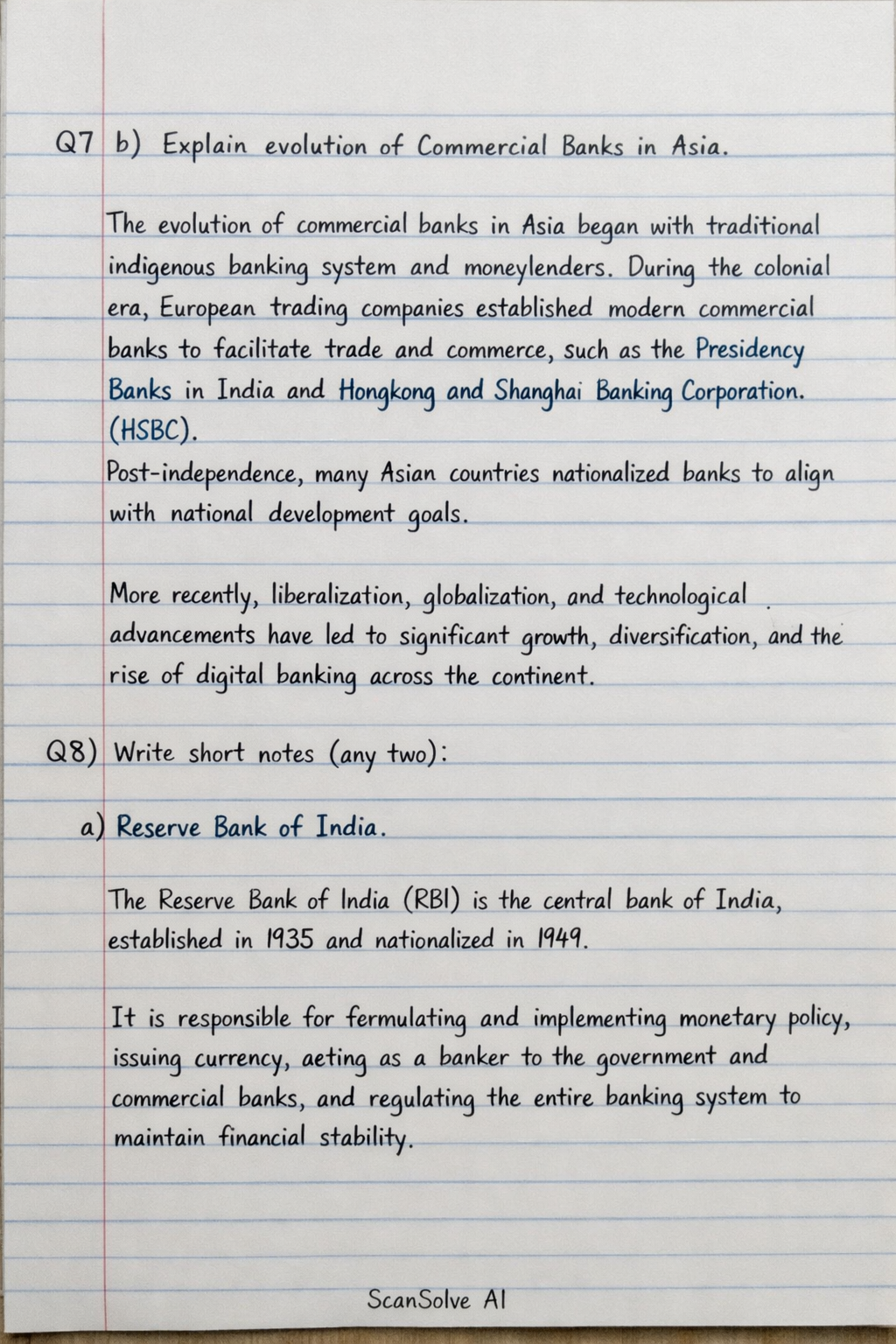
Q7 b) Explain evolution of Commercial Banks in Asia. The evolution of commercial banks in Asia began with traditional indigenous banking systems and moneylenders. During the colonial era, European trading companies established modern commercial banks to facilitate trade and commerce, such as the Presidency Banks in India and Hongkong and Shanghai Banking Corporation (HSBC). Post-independence, many Asian countries nationalized banks to align with national development goals. More recently, liberalization, globalization, and technological advancements have led to significant growth, diversification, and the rise of digital banking across the continent.

Q8) Write short notes (any two):

a) Reserve Bank of India. The Reserve Bank of India (RBI) is the central bank of India, established in 1935 and nationalized in 1949. It is responsible for formulating and implementing monetary policy, issuing currency, acting as a banker to the government and commercial banks, and regulating the entire banking system to maintain financial stability.

c) NEFT and RTGS. NEFT (National Electronic Funds Transfer) and RTGS (Real Time Gross Settlement) are electronic fund transfer systems in India. NEFT operates on a deferred net settlement basis, processing transactions in batches, with no minimum or maximum transfer limits. RTGS, on the other hand, processes transactions individually on a real-time and gross settlement basis, meaning funds are transferred immediately. RTGS has a minimum transfer amount of ₹2 lakh, with no upper limit, making it suitable for large-value transactions.

Was this helpful?

Need help with your own homework?

Get instant step-by-step solutions to any question. Free to start.

Ask Your Question
Handwritten step-by-step solution preview

Handwritten Step-by-Step Solution

Get this as a handwritten image on WhatsApp — like a tutor wrote it for you.

Try on WhatsApp

Still have questions?

Quick Answer

Q7 b) Explain evolution of Commercial Banks in Asia. The evolution of commercial banks in Asia began with traditional indigenous banking systems and moneylenders.

Explain the meaning of Bank and the structure of Indian Banking System.
Economics

This economics question tests your understanding of economic models and analysis. The step-by-step answer below applies the relevant framework and explains the reasoning.

ScanSolve AI Answer
Q7 b) Explain evolution of Commercial Banks in Asia. The evolution of commercial banks in Asia began with traditional indigenous banking systems and moneylenders. During the colonial era, European trading companies established modern commercial banks to facilitate trade and commerce, such as the Presidency Banks in India and Hongkong and Shanghai Banking Corporation (HSBC). Post-independence, many Asian countries nationalized banks to align with national development goals. More recently, liberalization, globalization, and technological advancements have led to significant growth, diversification, and the rise of digital banking across the continent. Q8) Write short notes (any two): a) Reserve Bank of India. The Reserve Bank of India (RBI) is the central bank of India, established in 1935 and nationalized in 1949. It is responsible for formulating and implementing monetary policy, issuing currency, acting as a banker to the government and commercial banks, and regulating the entire banking system to maintain financial stability. c) NEFT and RTGS. NEFT (National Electronic Funds Transfer) and RTGS (Real Time Gross Settlement) are electronic fund transfer systems in India. NEFT operates on a deferred net settlement basis, processing transactions in batches, with no minimum or maximum transfer limits. RTGS, on the other hand, processes transactions individually on a real-time and gross settlement basis, meaning funds are transferred immediately. RTGS has a minimum transfer amount of ₹2 lakh, with no upper limit, making it suitable for large-value transactions.