
We read your photo as:
Define the Scramble for Africa and list its political and social causes.
ScanSolve AI Answer
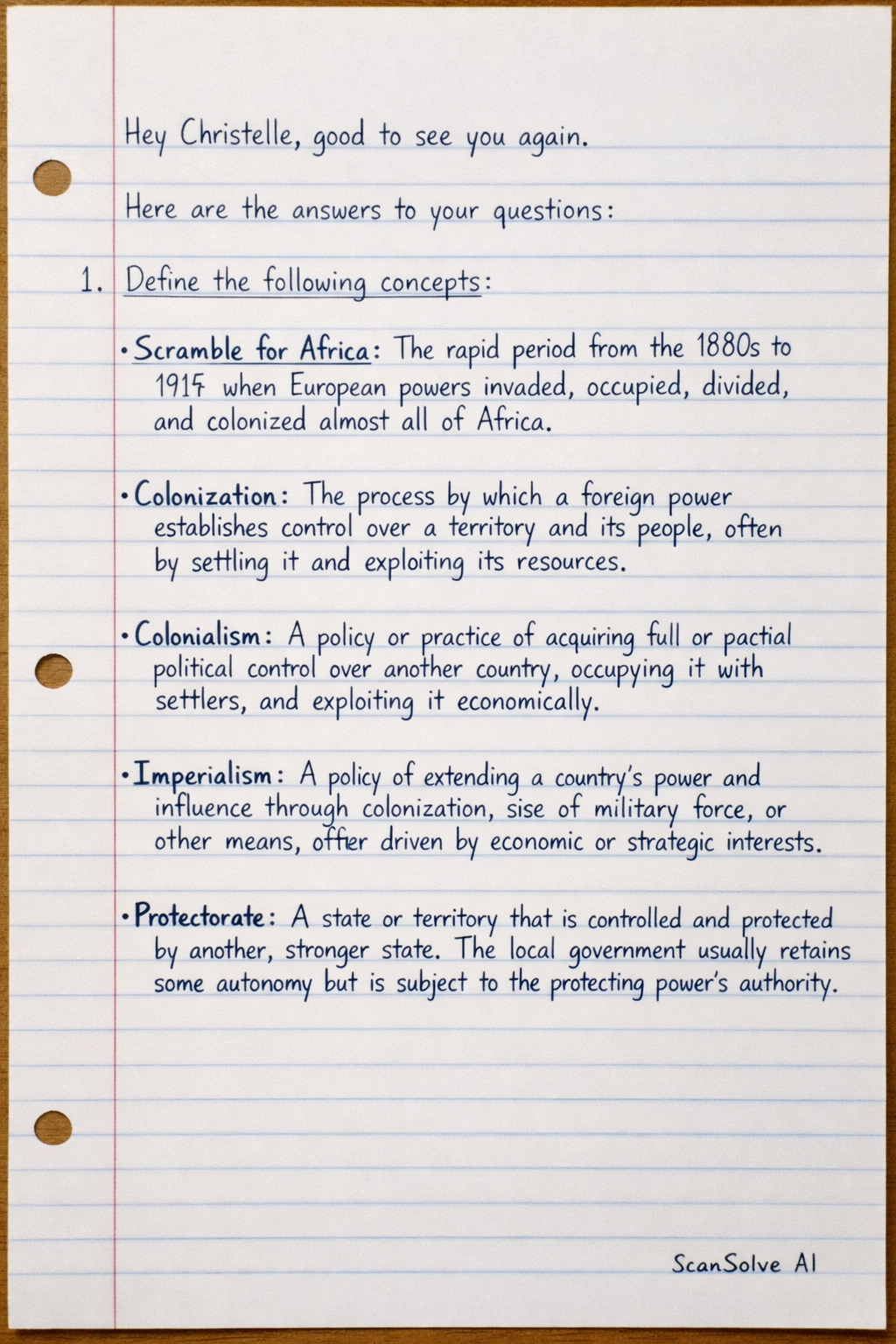
Here are the answers to your questions:
-
Define the following concepts:
- Scramble for Africa: The rapid period from the 1880s to 1914 when European powers invaded, occupied, divided, and colonized almost all of Africa.
- Colonization: The process by which a foreign power establishes control over a territory and its people, often by settling it and exploiting its resources.
- Colonialism: A policy or practice of acquiring full or partial political control over another country, occupying it with settlers, and exploiting it economically.
- Imperialism: A policy of extending a country's power and influence through colonization, use of military force, or other means, often driven by economic or strategic interests.
- Protectorate: A state or territory that is controlled and protected by another, stronger state. The local government usually retains some autonomy but is subject to the protecting power's authority.
- Concessions: In a colonial context, these were grants of specific rights, such as land, mining rights, or trade monopolies, given by a local ruler or government to a foreign power or company.
-
Political and social reasons why the European Scramble for Africa was organized:
- Political Reasons: European nations sought to expand their empires for national prestige and power, to gain strategic advantages (e.g., control over trade routes), and to maintain a balance of power among themselves.
- Social Reasons: These included the belief in a civilizing mission to spread Christianity and European culture, and the influence of Social Darwinism, which promoted the idea of European racial superiority.
-
Reason why the Berlin Conference was organized: The Berlin Conference (1884-1885) was organized to regulate European colonization and trade in Africa and to prevent conflicts among the European powers themselves as they competed for territory. It established rules for claiming and administering African lands.
-
Consequences of the methods used by European powers to acquire colonies: The methods led to the loss of sovereignty for African states, exploitation of natural resources, the creation of artificial borders that ignored ethnic and cultural divisions, and the disruption of traditional social and economic structures. This often resulted in widespread violence, oppression, and long-term economic dependence on European powers.
-
Reason why the Federal System collapsed between 1972-1982: The collapse of federal systems in many post-colonial states during this period was often due to ethnic and regional tensions, weak political institutions, the centralization of power by leaders, economic disparities among regions, and frequent military interventions that favored unitary control over federal structures.
-
Unitary System: A unitary system of government is one in which the central government holds most of the power. Any administrative divisions (like states or provinces) exercise only the powers that the central government chooses to delegate to them.
-
Achievement of the domestic policy objective: A domestic policy objective is a specific goal a government sets for issues within its own country (e.g., economic growth, public health). Its achievement is measured by evaluating whether the intended outcomes have been realized, typically through measurable indicators and comparing actual results against set targets.
Still stuck on this one?
Ask a follow-up, and the answer starts from this question.
More History Questions
Handwritten Step-by-Step Solution
Get this as a handwritten image on WhatsApp — like a tutor wrote it for you.
Try on WhatsApp