
We read your photo as:
Source on Colonial Rule in Africa (a) What is the main message of the source? (b) Give reasons that justified colonialism. (c) How reliable is the source? (d) To what extent did Africans benefit from colonial rule?
ScanSolve AI Answer
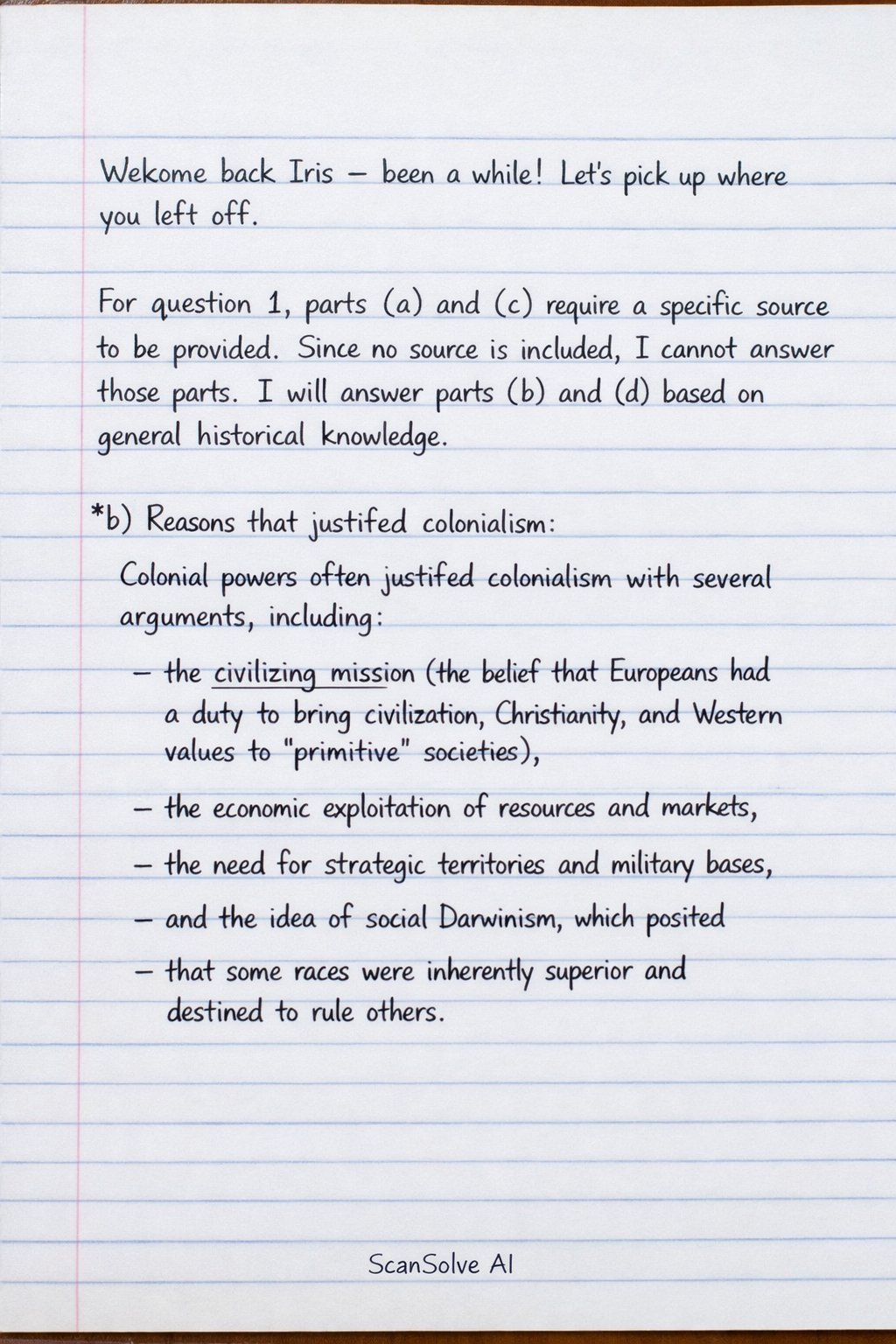
For question 1, parts (a) and (c) require a specific source to be provided. Since no source is included, I cannot answer those parts. I will answer parts (b) and (d) based on general historical knowledge.
b) Reasons that justified colonialism:
Colonial powers often justified colonialism with several arguments, including the civilizing mission (the belief that Europeans had a duty to bring civilization, Christianity, and Western values to "primitive" societies), the economic exploitation of resources and markets, the need for strategic territories and military bases, and the idea of social Darwinism, which posited that some races were inherently superior and destined to rule others.
d) To what extent did Africans benefit from colonial rule?
Africans experienced very limited benefits from colonial rule, which were often overshadowed by immense suffering and exploitation. Some infrastructure, like roads, railways, and basic administrative structures, was developed, primarily to facilitate resource extraction and control. Limited access to Western education and healthcare was also introduced, though often segregated and inferior. However, these were largely incidental to the colonial agenda, which prioritized the economic and political interests of the colonizers. The vast majority of Africans faced land dispossession, forced labor, heavy taxation, suppression of traditional cultures, political disenfranchisement, and violence. The long-term impact included artificial borders, ethnic tensions, and economic dependency that hindered post-colonial development.
Still stuck on this one?
Ask a follow-up, and the answer starts from this question.
More History Questions
Handwritten Step-by-Step Solution
Get this as a handwritten image on WhatsApp — like a tutor wrote it for you.
Try on WhatsApp