
We read your photo as:
Define tangible and intangible heritage and outline a methodology to investigate the historical importance of a local heritage site.
ScanSolve AI Answer
Step-by-step solution
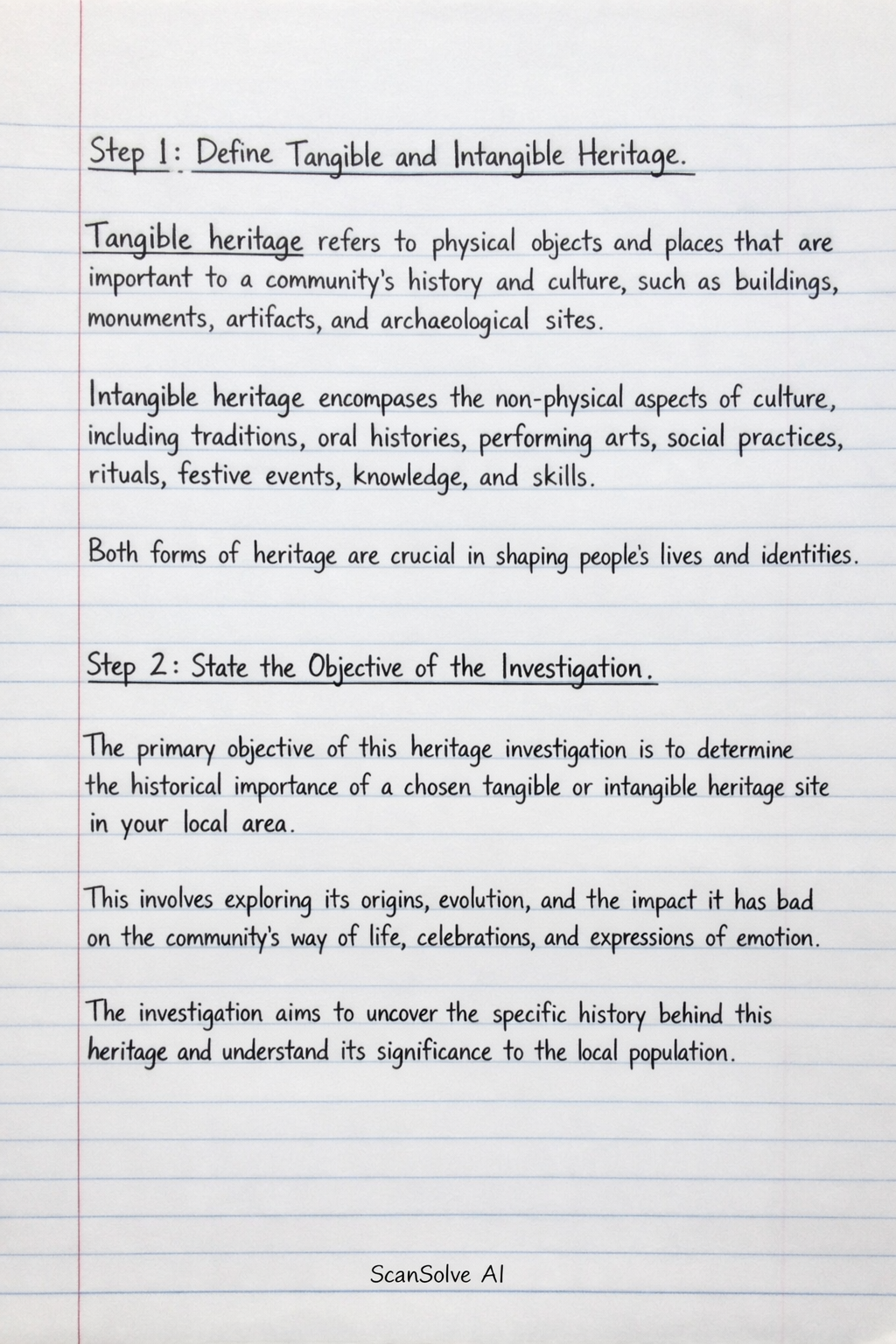
3 stepsDefine Tangible and Intangible Heritage.
Tangible heritage refers to physical objects and places that are important to a community's history and culture, such as buildings, monuments, artifacts, and archaeological sites. Intangible heritage encompasses the non-physical aspects of culture, including traditions, oral histories, performing arts, social practices, rituals, festive events, knowledge, and skills. Both forms of heritage are crucial in shaping people's lives and identities.
State the Objective of the Investigation.
The primary objective of this heritage investigation is to determine the historical importance of a chosen tangible or intangible heritage site in your local area. This involves exploring its origins, evolution, and the impact it has had on the community's way of life, celebrations, and expressions of emotion. The investigation aims to uncover the specific history behind this heritage and understand its significance to the local population.
Outline the Methodology for Data Collection and Analysis.
To conduct this investigation, data collection will involve various methods such as archival research (historical documents, maps, photographs), oral interviews with community elders or experts, and direct observation of the heritage site or practice. Once data is collected, it will be analyzed to identify patterns, themes, and historical narratives. This analysis will help in understanding the heritage's historical context, its cultural value, and how it has influenced the local community over time, directly addressing the key question of its historical importance.
Still stuck on this one?
Ask a follow-up, and the answer starts from this question.
More History Questions
Handwritten Step-by-Step Solution
Get this as a handwritten image on WhatsApp — like a tutor wrote it for you.
Try on WhatsApp