
We read your photo as:
The last major group of Bantu to enter East Africa is often considered to be the Ngoni, who migrated during the 19th-century Mfecane.
ScanSolve AI Answer
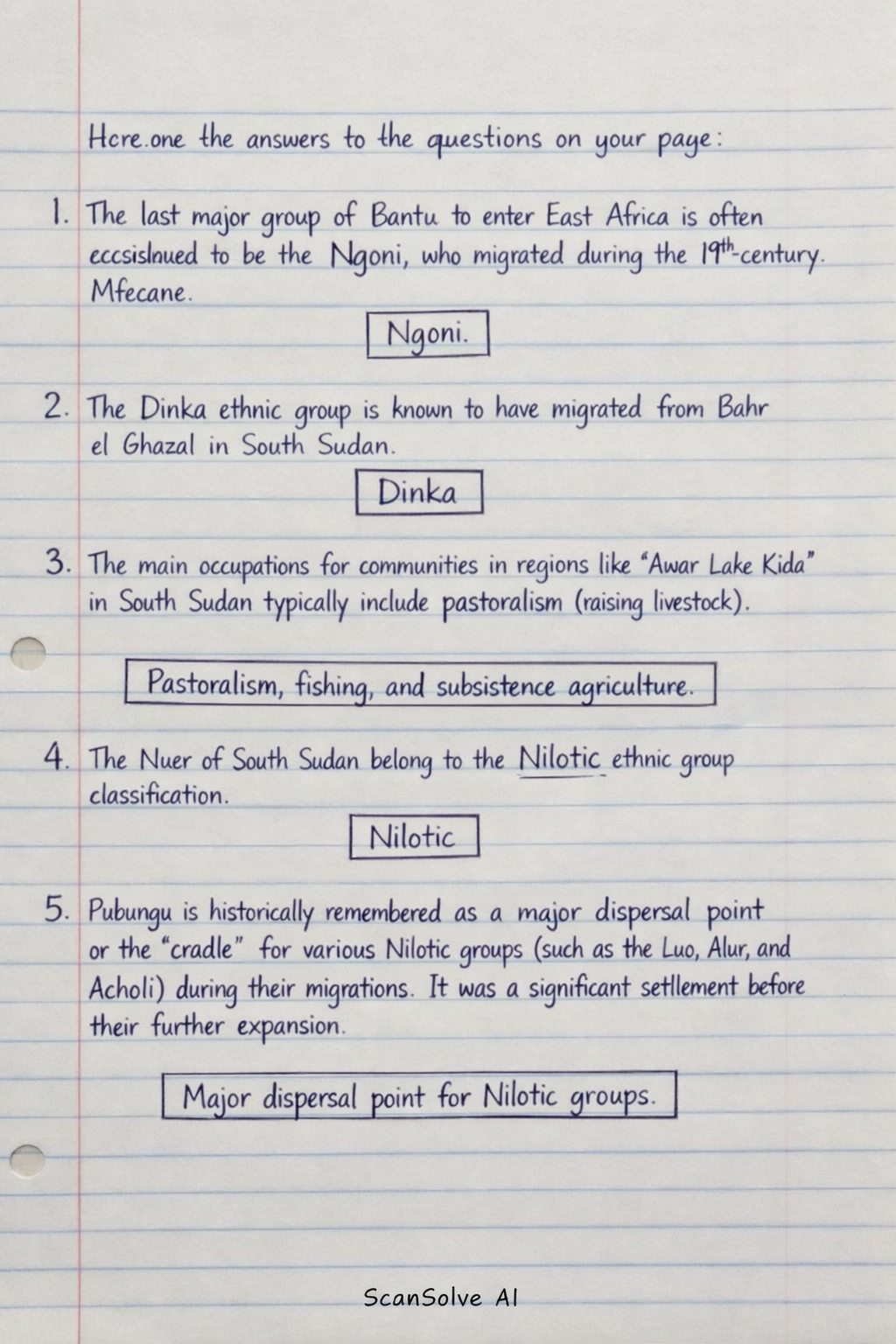
Here are the answers to the questions on your page:
-
The last major group of Bantu to enter East Africa is often considered to be the Ngoni, who migrated during the 19th-century Mfecane.
-
The Dinka ethnic group is known to have migrated from Bahr el Ghazal in South Sudan.
-
The main occupations for communities in regions like "Awar Lake Kida" in South Sudan typically include pastoralism (raising livestock), fishing, and subsistence agriculture.
-
The Nuer of South Sudan belong to the Nilotic ethnic group classification.
-
Pubungu is historically remembered as a major dispersal point or the cradle for various Nilotic groups (such as the Luo, Alur, and Acholi) during their migrations. It was a significant settlement before their further expansion.
-
Two countries in the Horn of Africa are Ethiopia and Somalia.
-
The Cushites preferred settling in the grasslands of Africa primarily because these areas provided abundant pasture for their livestock (cattle, sheep, and goats), which was central to their pastoralist way of life. Grasslands also offered suitable conditions for some agriculture and access to water sources.
Still stuck on this one?
Ask a follow-up, and the answer starts from this question.
More History Questions
Handwritten Step-by-Step Solution
Get this as a handwritten image on WhatsApp — like a tutor wrote it for you.
Try on WhatsApp