
We read your photo as:
What are the main themes of John's Gospel?
ScanSolve AI Answer
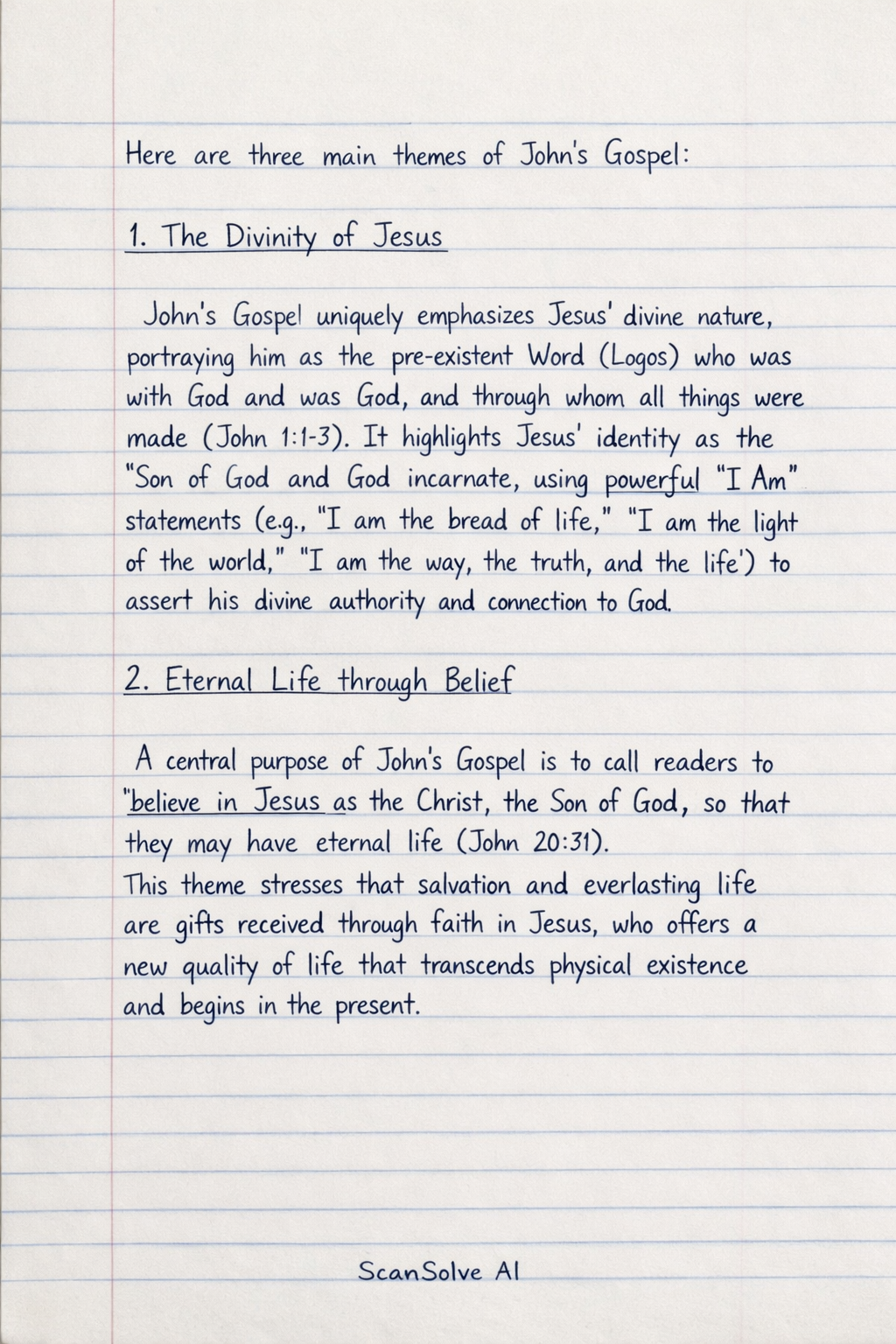
Here are three main themes of John's Gospel:
1. The Divinity of Jesus
John's Gospel uniquely emphasizes Jesus' divine nature, portraying him as the pre-existent Word (Logos) who was with God and was God, and through whom all things were made (John 1:1-3). It highlights Jesus' identity as the Son of God and God incarnate, using powerful "I Am" statements (e.g., "I am the bread of life," "I am the light of the world," "I am the way, the truth, and the life") to assert his divine authority and connection to God.
2. Eternal Life through Belief
A central purpose of John's Gospel is to call readers to believe in Jesus as the Christ, the Son of God, so that they may have eternal life (John 20:31). This theme stresses that salvation and everlasting life are gifts received through faith in Jesus, who offers a new quality of life that transcends physical existence and begins in the present.
3. Light versus Darkness
John frequently uses the dualistic imagery of light and darkness to describe the spiritual reality. Jesus is presented as the light of the world who illuminates truth and exposes sin (John 1:4-5, 8:12). Those who believe in him walk in the light, while those who reject him remain in spiritual darkness, preferring their deeds of evil. This theme highlights the stark choice humanity faces in responding to Jesus.
Still stuck on this one?
Ask a follow-up, and the answer starts from this question.
More History Questions
Handwritten Step-by-Step Solution
Get this as a handwritten image on WhatsApp — like a tutor wrote it for you.
Try on WhatsApp