
We read your photo as:
The role played by South African women in the resistance to Apartheid was indeed crucial and had a profound impact on its dismantling. Women faced a double oppression under Apartheid, experiencing b
ScanSolve AI Answer
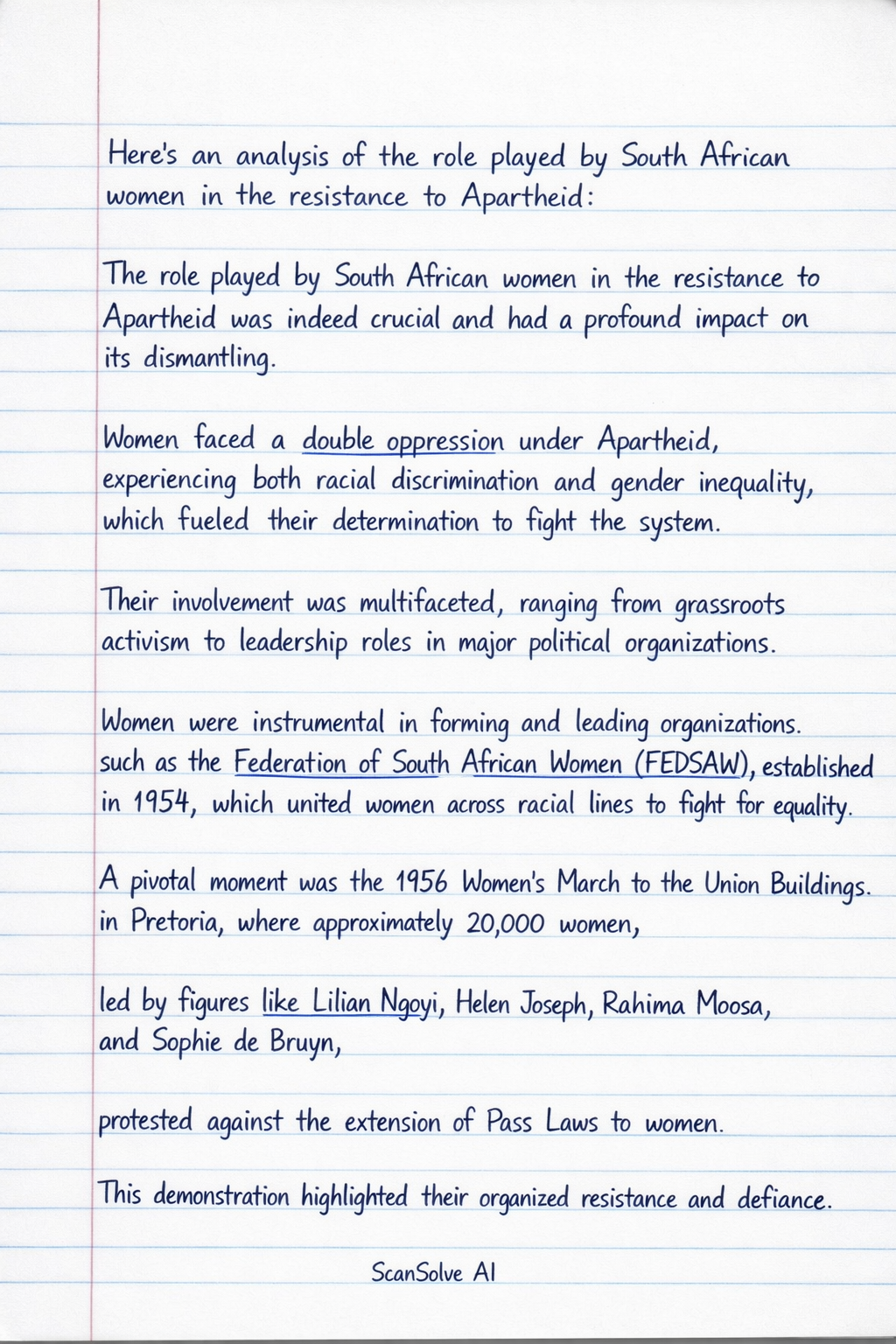
The role played by South African women in the resistance to Apartheid was indeed crucial and had a profound impact on its dismantling. Women faced a double oppression under Apartheid, experiencing both racial discrimination and gender inequality, which fueled their determination to fight the system.
Their involvement was multifaceted, ranging from grassroots activism to leadership roles in major political organizations. Women were instrumental in forming and leading organizations such as the Federation of South African Women (FEDSAW), established in 1954, which united women across racial lines to fight for equality. A pivotal moment was the 1956 Women's March to the Union Buildings in Pretoria, where approximately 20,000 women, led by figures like Lilian Ngoyi, Helen Joseph, Rahima Moosa, and Sophie de Bruyn, protested against the extension of Pass Laws to women. This demonstration highlighted their organized resistance and defiance.
Beyond large-scale protests, women engaged in sustained community activism, organizing consumer boycotts, establishing alternative education systems, and providing support networks for political prisoners and their families. They often bore the brunt of state repression, enduring arrests, detentions, and torture, yet continued their struggle. Individual women like Albertina Sisulu and Winnie Madikizela-Mandela became symbols of resistance, enduring banning orders, imprisonment, and harassment while continuing to inspire others. Their contributions, both visible and "unsung," were vital in sustaining the anti-Apartheid movement and ultimately contributed significantly to its downfall.
Still stuck on this one?
Ask a follow-up, and the answer starts from this question.
More History Questions
Handwritten Step-by-Step Solution
Get this as a handwritten image on WhatsApp — like a tutor wrote it for you.
Try on WhatsApp