
We read your photo as:
What were the reasons Jesus needed disciples and the social problems that led to the appointment of deacons in the early church?
ScanSolve AI Answer
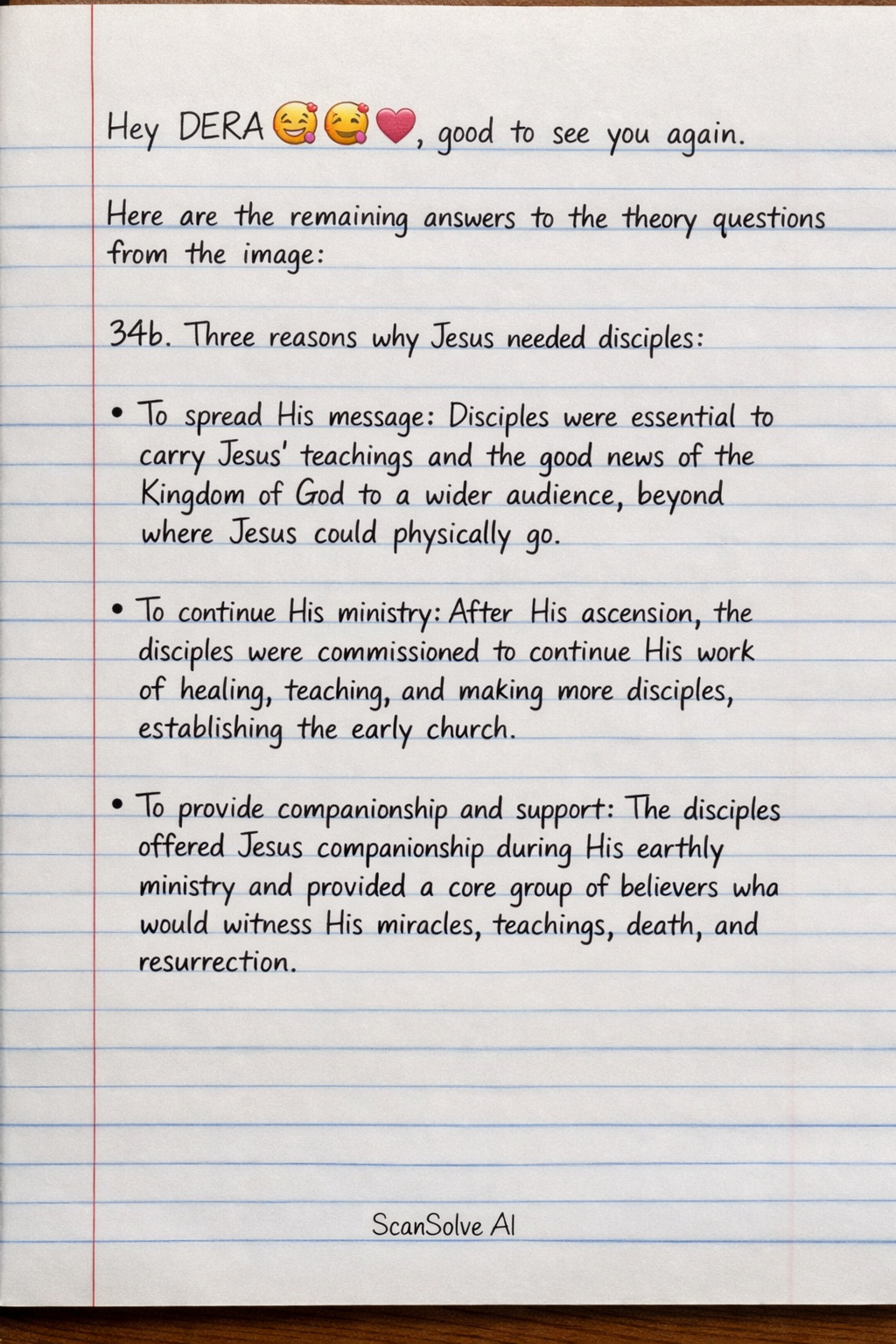
Here are the remaining answers to the theory questions from the image:
34b. Three reasons why Jesus needed disciples:
- To spread His message: Disciples were essential to carry Jesus' teachings and the good news of the Kingdom of God to a wider audience, beyond where Jesus could physically go.
- To continue His ministry: After His ascension, the disciples were commissioned to continue His work of healing, teaching, and making more disciples, establishing the early church.
- To provide companionship and support: The disciples offered Jesus companionship during His earthly ministry and provided a core group of believers who would witness His miracles, teachings, death, and resurrection.
35a. The social problems that led to the appointment of deacons in the early church were primarily related to discrimination and unequal distribution of food. Specifically, there was a complaint that the Hellenistic (Greek-speaking) Jewish widows were being overlooked in the daily distribution of food compared to the Hebraic (Aramaic-speaking) Jewish widows (Acts 6:1).
35b. The seven deacons appointed in the early church were:
- Stephen
- Philip
- Procorus
- Nicanor
- Timon
- Parmenas
- Nicolaus
35c. Three social problems facing the church today include:
- Materialism and consumerism: The church often struggles with members prioritizing worldly possessions and wealth over spiritual values, leading to a decline in commitment and generosity.
- Moral relativism and secularism: The increasing acceptance of subjective moral standards and the marginalization of religious influence in public life challenge the church's traditional teachings and authority.
- Disunity and denominationalism: Despite calls for unity, the church remains fragmented into numerous denominations and factions, often hindering its collective impact and witness.
36a. The event on the Day of Pentecost, as described in Acts 2, occurred fifty days after Passover. The disciples were gathered together in one place when suddenly a sound like a mighty rushing wind filled the house. Then, what appeared to be tongues of fire rested on each of them, and they were all filled with the Holy Spirit. They began to speak in other tongues (languages) as the Spirit enabled them. A crowd of devout Jews from every nation, who were in Jerusalem for the festival, heard the noise and gathered. They were astonished because each person heard the disciples speaking in their own native language, proclaiming the wonders of God. Peter then stood up and preached a powerful sermon, explaining that this event was the fulfillment of the prophet Joel's prophecy and proclaiming Jesus as Lord and Christ.
36b. Three ways in which the Holy Spirit still influences the life of Christians today:
- Empowerment for witness and service: The Holy Spirit empowers Christians to boldly share their faith and to serve others with spiritual gifts, enabling them to carry out God's mission in the world.
- Guidance and conviction: The Spirit guides believers into truth, helps them understand scripture, and convicts them of sin, leading to repentance and righteous living.
- Sanctification and spiritual growth: The Holy Spirit works within believers to transform their character, producing the "fruit of the Spirit" (love, joy, peace, patience, kindness, goodness, faithfulness, gentleness, self-control), making them more like Christ.
Still stuck on this one?
Ask a follow-up, and the answer starts from this question.
More History Questions
Handwritten Step-by-Step Solution
Get this as a handwritten image on WhatsApp — like a tutor wrote it for you.
Try on WhatsApp