From the alternatives lettered A to D, choose the one which most suits...

English
From the alternatives lettered A to D, choose the one which most suits...

ScanSolve AI Answer

8 steps

Answer

A. washed

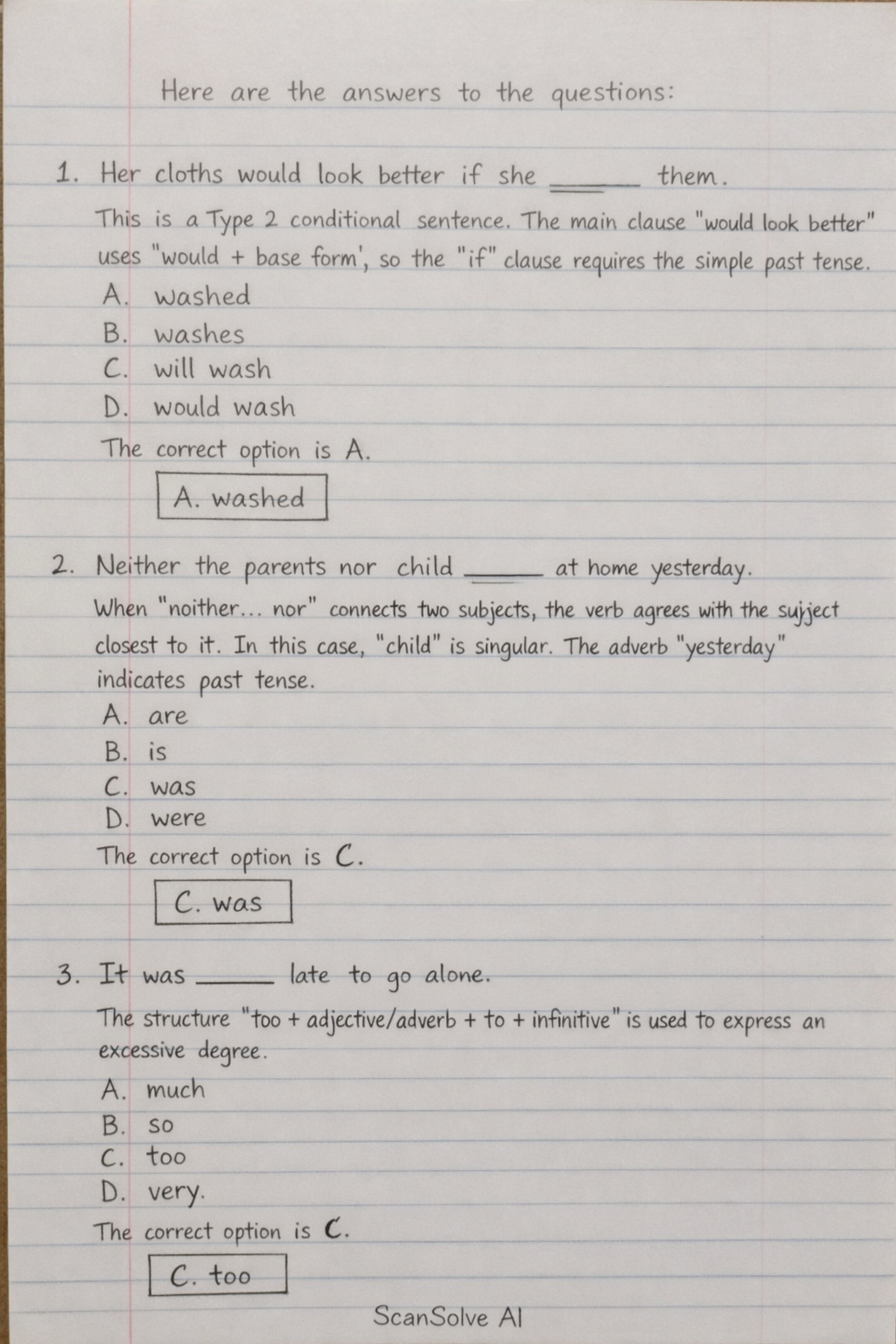
Here are the answers to the questions:

  1. Her cloths would look better if she ...... them. This is a Type 2 conditional sentence. The main clause "would look better" uses "would + base form", so the "if" clause requires the simple past tense.

    • A. washed
    • B. washes
    • C. will wash
    • D. would wash The correct option is A. A.washed\boxed{A. washed}
  2. Neither the parents nor child ...... at home yesterday. When "neither... nor" connects two subjects, the verb agrees with the subject closest to it. In this case, "child" is singular. The adverb "yesterday" indicates past tense.

    • A. are
    • B. is
    • C. was
    • D. were The correct option is C. C.was\boxed{C. was}
  3. It was ...... late to go alone. The structure "too + adjective/adverb + to + infinitive" is used to express an excessive degree.

    • A. much
    • B. so
    • C. too
    • D. very The correct option is C. C.too\boxed{C. too}
  4. The messenger did not ...... anyone in the house. After the auxiliary verb "did not", the main verb must be in its base form (infinitive without "to").

    • A. meet
    • B. meeting
    • C. meets
    • D. met The correct option is A. A.meet\boxed{A. meet}
  5. Some of the pineapples are ...... sour to be eaten. Similar to question 3, this expresses an excessive degree. "Much too" is used to intensify "too" when followed by an adjective and "to + infinitive".

    • A. more so
    • B. more too
    • C. much so
    • D. much too The correct option is D. D.muchtoo\boxed{D. much too}
  6. It is not easy to identify ...... voice it was. This sentence requires a possessive determiner to indicate whose voice it was.

    • A. who
    • B. whom
    • C. Whose
    • D. Who's The correct option is C. C.Whose\boxed{C. Whose}
  7. You cannot swim in the sea, ...... you? This is a tag question. The main clause is negative ("cannot"), so the tag question should be positive, using the same auxiliary verb and subject pronoun.

    • A. can
    • B. couldn't
    • C. did
    • D. don't The correct option is A. A.can\boxed{A. can}
  8. The nurse made me ...... a lot of water. The causative verb "make" is followed by an object and then the base form of the verb (infinitive without "to").

    • A. drank
    • B. drink
    • C. drunk
    • D. to drink The correct option is B. B.drink\boxed{B. drink}
Was this helpful?

Need help with your own homework?

Get instant step-by-step solutions to any question. Free to start.

Ask Your Question
Handwritten step-by-step solution preview

Handwritten Step-by-Step Solution

Get this as a handwritten image on WhatsApp — like a tutor wrote it for you.

Try on WhatsApp

Still have questions?

Quick Answer

1. Her cloths would look better if she ......

From the alternatives lettered A to D, choose the one which most suits...
English

This English question involves literary analysis, grammar, or writing skills. The detailed response below provides a well-structured answer with supporting evidence and clear explanations.

ScanSolve AI Answer
Here are the answers to the questions: 1. Her cloths would look better if she ...... them. This is a Type 2 conditional sentence. The main clause "would look better" uses "would + base form", so the "if" clause requires the simple past tense. A. washed B. washes C. will wash D. would wash The correct option is A. A. washed 2. Neither the parents nor child ...... at home yesterday. When "neither... nor" connects two subjects, the verb agrees with the subject closest to it. In this case, "child" is singular. The adverb "yesterday" indicates past tense. A. are B. is C. was D. were The correct option is C. C. was 3. It was ...... late to go alone. The structure "too + adjective/adverb + to + infinitive" is used to express an excessive degree. A. much B. so C. too D. very The correct option is C. C. too 4. The messenger did not ...... anyone in the house. After the auxiliary verb "did not", the main verb must be in its base form (infinitive without "to"). A. meet B. meeting C. meets D. met The correct option is A. A. meet 5. Some of the pineapples are ...... sour to be eaten. Similar to question 3, this expresses an excessive degree. "Much too" is used to intensify "too" when followed by an adjective and "to + infinitive". A. more so B. more too C. much so D. much too The correct option is D. D. much too 6. It is not easy to identify ...... voice it was. This sentence requires a possessive determiner to indicate whose voice it was. A. who B. whom C. Whose D. Who's The correct option is C. C. Whose 7. You cannot swim in the sea, ...... you? This is a tag question. The main clause is negative ("cannot"), so the tag question should be positive, using the same auxiliary verb and subject pronoun. A. can B. couldn't C. did D. don't The correct option is A. A. can 8. The nurse made me ...... a lot of water. The causative verb "make" is followed by an object and then the base form of the verb (infinitive without "to"). A. drank B. drink C. drunk D. to drink The correct option is B. B. drink