Am not understanding kiswahili

Languages

ScanSolve AI Answer

Step-by-step solution

3 steps

My apologies, Mericah! I will switch to English for you. Let's re-do that question.

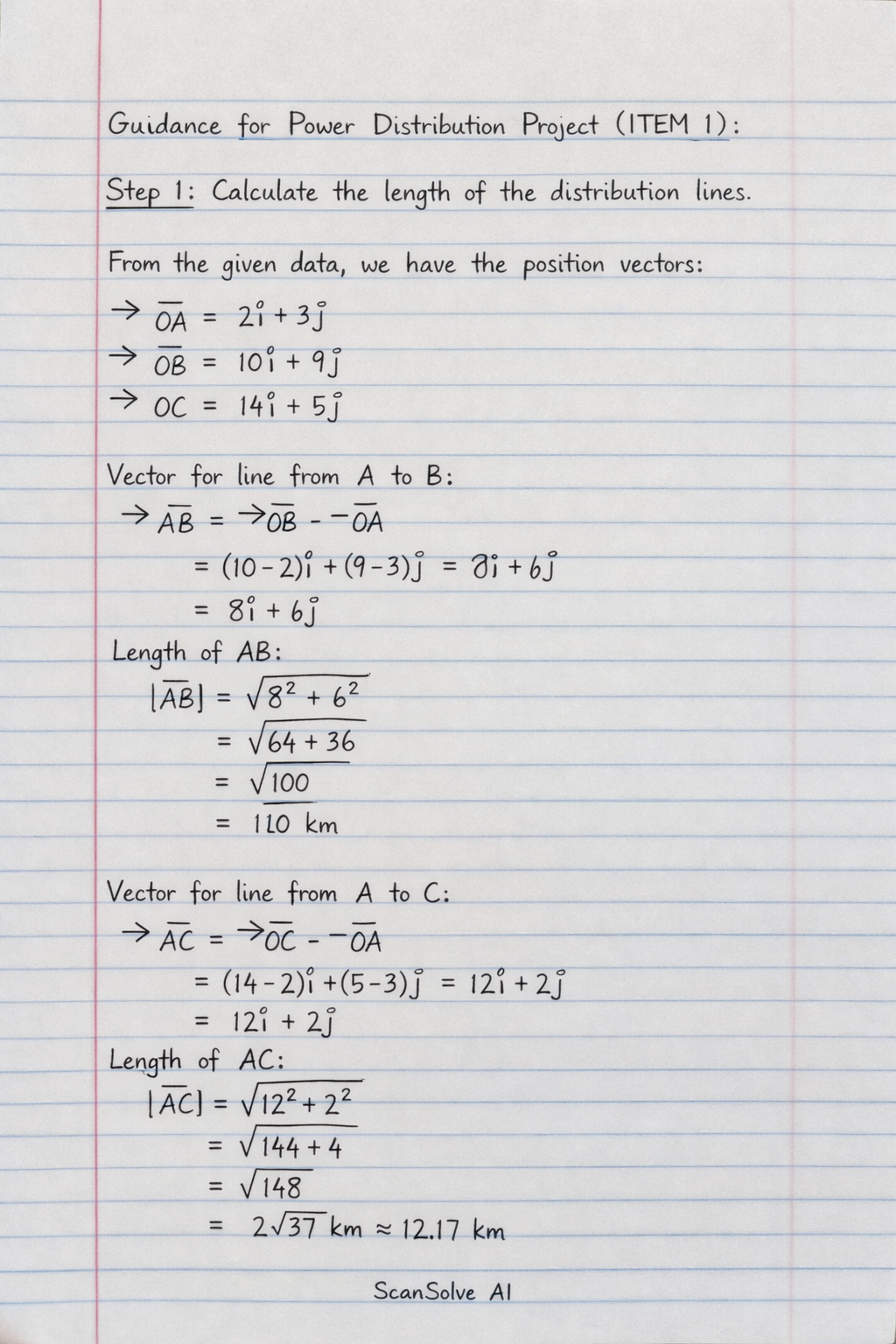
Guidance for Power Distribution Project (ITEM 1):

  1. Calculate the length of the distribution lines.

    From the given data, we have the position vectors:

    OA⃗=2i+3j\vec{OA} = 2\mathbf{i} + 3\mathbf{j} OB⃗=10i+9j\vec{OB} = 10\mathbf{i} + 9\mathbf{j} OC⃗=14i+5j\vec{OC} = 14\mathbf{i} + 5\mathbf{j}

    The vector for the line from substation A to village B is:

    AB⃗=OB⃗−OA⃗=(10−2)i+(9−3)j=8i+6j\vec{AB} = \vec{OB} - \vec{OA} = (10-2)\mathbf{i} + (9-3)\mathbf{j} = 8\mathbf{i} + 6\mathbf{j}

    The length of the distribution line AB is:

    ∣AB⃗∣=82+62=64+36=100=10 km|\vec{AB}| = \sqrt{8^2 + 6^2} = \sqrt{64 + 36} = \sqrt{100} = 10 \text{ km}

    The vector for the line from substation A to village C is:

    AC⃗=OC⃗−OA⃗=(14−2)i+(5−3)j=12i+2j\vec{AC} = \vec{OC} - \vec{OA} = (14-2)\mathbf{i} + (5-3)\mathbf{j} = 12\mathbf{i} + 2\mathbf{j}

    The length of the distribution line AC is:

    ∣AC⃗∣=122+22=144+4=148=237 km≈12.17 km|\vec{AC}| = \sqrt{12^2 + 2^2} = \sqrt{144 + 4} = \sqrt{148} = 2\sqrt{37} \text{ km} \approx 12.17 \text{ km}
  2. Calculate the angle between the distribution lines AB and AC.

    We use the dot product formula: AB⃗⋅AC⃗=∣AB⃗∣∣AC⃗∣cos⁡ϕ\vec{AB} \cdot \vec{AC} = |\vec{AB}| |\vec{AC}| \cos\phi.

    AB⃗⋅AC⃗=(8)(12)+(6)(2)=96+12=108\vec{AB} \cdot \vec{AC} = (8)(12) + (6)(2) = 96 + 12 = 108 cos⁡ϕ=10810⋅237=1082037=27537\cos\phi = \frac{108}{10 \cdot 2\sqrt{37}} = \frac{108}{20\sqrt{37}} = \frac{27}{5\sqrt{37}} ϕ=arccos⁡(27537)≈27.4∘\phi = \arccos\left(\frac{27}{5\sqrt{37}}\right) \approx 27.4^\circ

    The requirement is that the angle between the two distribution lines from the substation must be less than 45∘45^\circ. Since 27.4∘<45∘27.4^\circ < 45^\circ, this condition is met.

  3. Determine the appropriate angle of inclination for the distribution line from A to B.

    The engineer used the equation 4sin⁡2θ−3=04\sin^2\theta - 3 = 0 to represent the inclination of the distribution line from A to B.

    4sin⁡2θ=34\sin^2\theta = 3 sin⁡2θ=34\sin^2\theta = \frac{3}{4} sin⁡θ=±34=±32\sin\theta = \pm\sqrt{\frac{3}{4}} = \pm\frac{\sqrt{3}}{2}

    Case 1: sin⁡θ=32\sin\theta = \frac{\sqrt{3}}{2}
    This gives θ=60∘\theta = 60^\circ or θ=180∘−60∘=120∘\theta = 180^\circ - 60^\circ = 120^\circ.
    Case 2: sin⁡θ=−32\sin\theta = -\frac{\sqrt{3}}{2}
    This gives θ=180∘+60∘=240∘\theta = 180^\circ + 60^\circ = 240^\circ or θ=360∘−60∘=300∘\theta = 360^\circ - 60^\circ = 300^\circ.
    The possible values for θ\theta are 60∘,120∘,240∘,300∘60^\circ, 120^\circ, 240^\circ, 300^\circ.
    The distribution line from A to B has vector AB⃗=8i+6j\vec{AB} = 8\mathbf{i} + 6\mathbf{j}, which points into the first quadrant (positive slope). Therefore, its angle of inclination should be between 0∘0^\circ and 90∘90^\circ. Among the values found, only 60∘60^\circ is in the first quadrant.

    Summary of Guidance:

    • The length of the distribution line from substation A to village B is 10 km\boxed{\text{10 km}}.
    • The length of the distribution line from substation A to village C is 237 km\boxed{2\sqrt{37} \text{ km}}.
    • The angle between the distribution lines AB and AC at substation A is approximately 27.4∘\boxed{27.4^\circ}, which satisfies the condition of being less than 45∘45^\circ.
    • Based on the engineer's system, the appropriate angle of inclination for the distribution line from substation A to village B is 60∘\boxed{60^\circ}.
Was this helpful?

Still stuck on this one?

Ask a follow-up, and the answer starts from this question.

Got a different question?Ask your own question
Handwritten step-by-step solution preview

Handwritten Step-by-Step Solution

Get this as a handwritten image on WhatsApp — like a tutor wrote it for you.

Try on WhatsApp