
Differentiate between language and dialectat least four points each
Languages
ScanSolve AI Answer
Here are four points differentiating between language and dialect:
- Scope and System: A language is a comprehensive, independent system of communication with its own distinct grammar, vocabulary, and phonology. A dialect is a specific variety or sub-form of a language, sharing many core features with other dialects of the same language but having distinct regional or social variations.
- Mutual Intelligibility: Speakers of different dialects of the same language can generally understand each other, although there might be some differences in pronunciation or vocabulary. Speakers of different languages, however, typically cannot understand each other without having learned the other language.
- Standardization and Prestige: A language often has a standardized written form, established grammar rules, and is typically associated with national identity and institutional use (education, government). Dialects, especially non-standard ones, are primarily spoken, may lack a standardized written form, and can sometimes carry less social prestige.
- Political and Social Factors: The distinction between a language and a dialect is not always purely linguistic; it can be heavily influenced by political, social, and cultural factors. Often, a "language" is a dialect with an army and a navy, meaning it has gained political recognition and status, while "dialects" are varieties that have not.
Was this helpful?
Still stuck on this one?
Ask a follow-up, and the answer starts from this question.
Got a different question?Ask your own question
More Languages Questions
QWhat are the four main language skills and their classifications?QAs an Early grade educator, present four (4) determinants of a child's first language acquisition…QGive the difference between sign language vs cultural competence, interlingua vs intralingua…QArgue for or against the adoption of multilingualism in teaching, learning, and assessment in…QPlease answer the following Hindi grammar questions: 1. Define language, grammar, script, and…
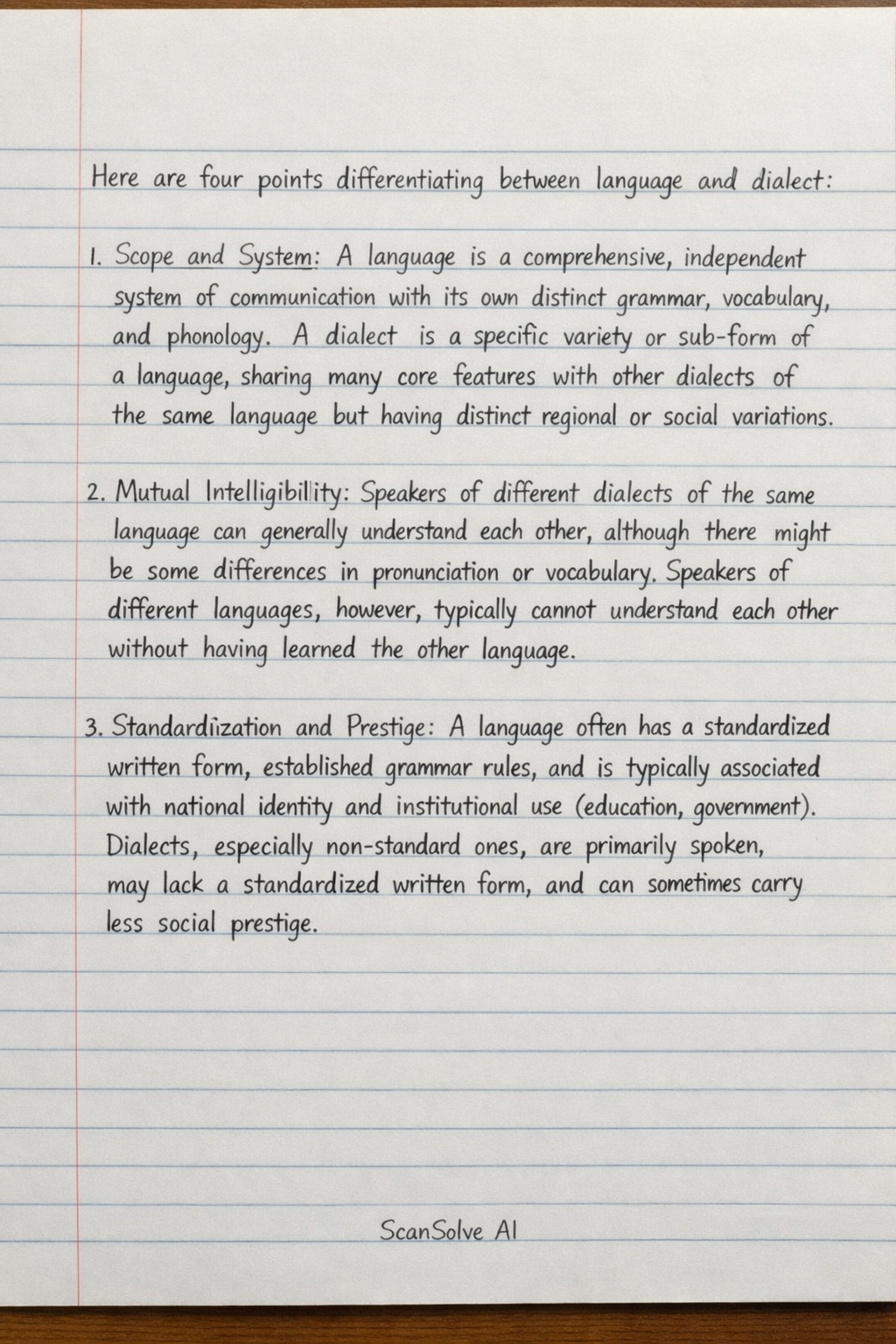
Handwritten Step-by-Step Solution
Get this as a handwritten image on WhatsApp — like a tutor wrote it for you.
Try on WhatsApp