
We read your photo as:
Feleletsa mafoko a gore a tsamaelane le setshwantsho. Dirisa ng. Kgotsa kh. Re go direetse ya ntlha.
ScanSolve AI Answer
Step-by-step solution
2 stepsHere are the completed words and their correct matches based on the images and the Setswana instructions. The task is to complete the words using "ng" or "kh" to match the pictures.
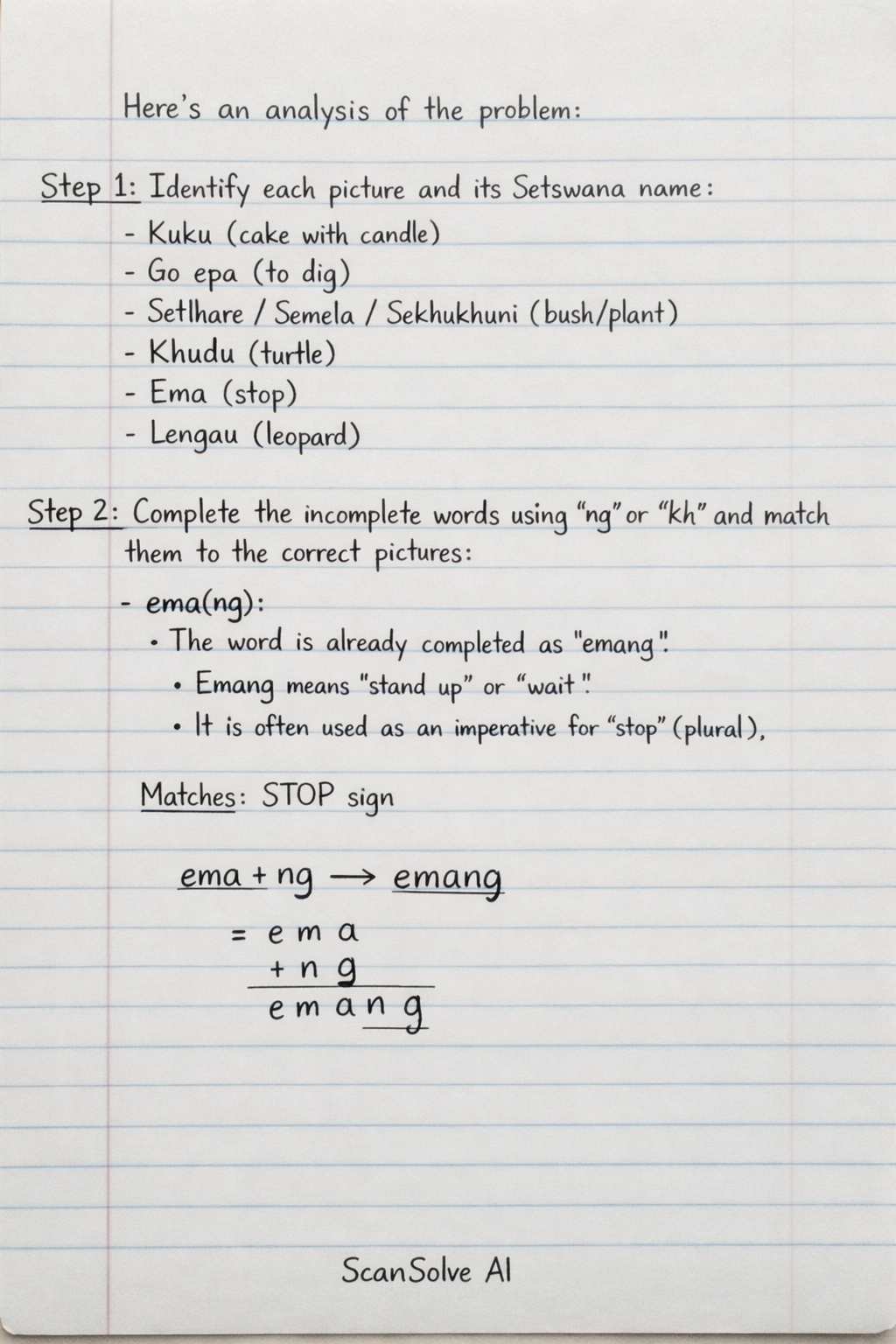
Identify each picture and its Setswana name.
- Cake with candle: Kuku (not directly formable from the given incomplete words, but "emang" is provided as an example match).
- Two people digging: Go epa (to dig).
- Bush/plant: Setlhare, semela, sekhukhuni.
- Turtle: Khudu.
- Stop sign: Ema (stop).
- Leopard/cheetah: Lengau.
Complete the incomplete words using "ng" or "kh" and match them to the correct pictures.
-
ema(ng): This word is already completed as "emang". "Emang" means "stand up" or "wait". It is often used as an imperative for "stop" (plural).
- Matches: STOP sign (The line in the image goes from "emang" to the cake, which is incorrect. It should match the STOP sign).
-
rema_:
- Adding "ng" gives "remang". "Remang" means to cut or chop (e.g., wood, or clearing ground).
- Adding "kh" gives "remakh" (not a Setswana word).
- Matches: Two people digging (The line in the image correctly goes from "remang" to the people digging).
-
le_au:
- Adding "ng" gives "lengau". "Lengau" means leopard or cheetah.
- Adding "kh" gives "lekhau" (not a Setswana word).
- Matches: Leopard/cheetah (The line in the image goes from "lehg au" to the stop sign, which is incorrect. It should match the leopard).
-
Khudu: This word is already completed as "Khudu". "Khudu" means turtle.
- Matches: Turtle (The line in the image correctly goes from "Khudu" to the turtle).
-
se_i: This is the most challenging one. Given the options "ng" or "kh", neither "sengi" nor "sekhi" forms a common Setswana word for "bush" or "plant". However, if we consider the possibility of a common word that might be partially represented or a less common word, it's difficult to definitively complete with just "ng" or "kh" to match the bush.
- Let's re-examine the image. The word is "se i". It's possible it's a different word or a misprint.
- Given the context of simple words, and the picture of a bush, there isn't a direct fit with "se_i" and "ng" or "kh".
- However, if we assume there's a word that fits, and the line goes to the bush, we'll leave it as "se_i" as it cannot be completed with the given options to form a known word for a bush.
-
e_e:
- Adding "ng" gives "enge" (not a common word for a picture).
- Adding "kh" gives "ekhe" (an exclamation, not a noun).
- This word is also problematic with the given options. The line from "e e" goes to the leopard, but "lengau" is the correct word for leopard.
Given the inconsistencies in the provided lines and the example "emang" for cake, I will provide the correct matches for the words that can be completed with "ng" or "kh" to match a picture.
Here are the completed words and their correct matches:
-
emang (from "ema(ng)")
- Meaning: Stand up / Wait / Stop (plural imperative)
- Matches: STOP sign
-
remang (from "rema_")
- Meaning: Cut / Chop
- Matches: Two people digging
-
lengau (from "le_au")
- Meaning: Leopard / Cheetah
- Matches: Leopard/cheetah
-
Khudu (already complete)
- Meaning: Turtle
- Matches: Turtle
The words "se_i" and "e_e" cannot be completed with "ng" or "kh" to form a clear Setswana word that matches the remaining pictures (cake, bush).
Here are the final matches:
- emang STOP sign
- remang Two people digging
- lengau Leopard/cheetah
- Khudu Turtle
-
Still stuck on this one?
Ask a follow-up, and the answer starts from this question.
More Languages Questions
Handwritten Step-by-Step Solution
Get this as a handwritten image on WhatsApp — like a tutor wrote it for you.
Try on WhatsApp