
We read your photo as:
Ntsalisa gabedi a dirisa molopolo. O diretse sakao sa ntlha.
ScanSolve AI Answer
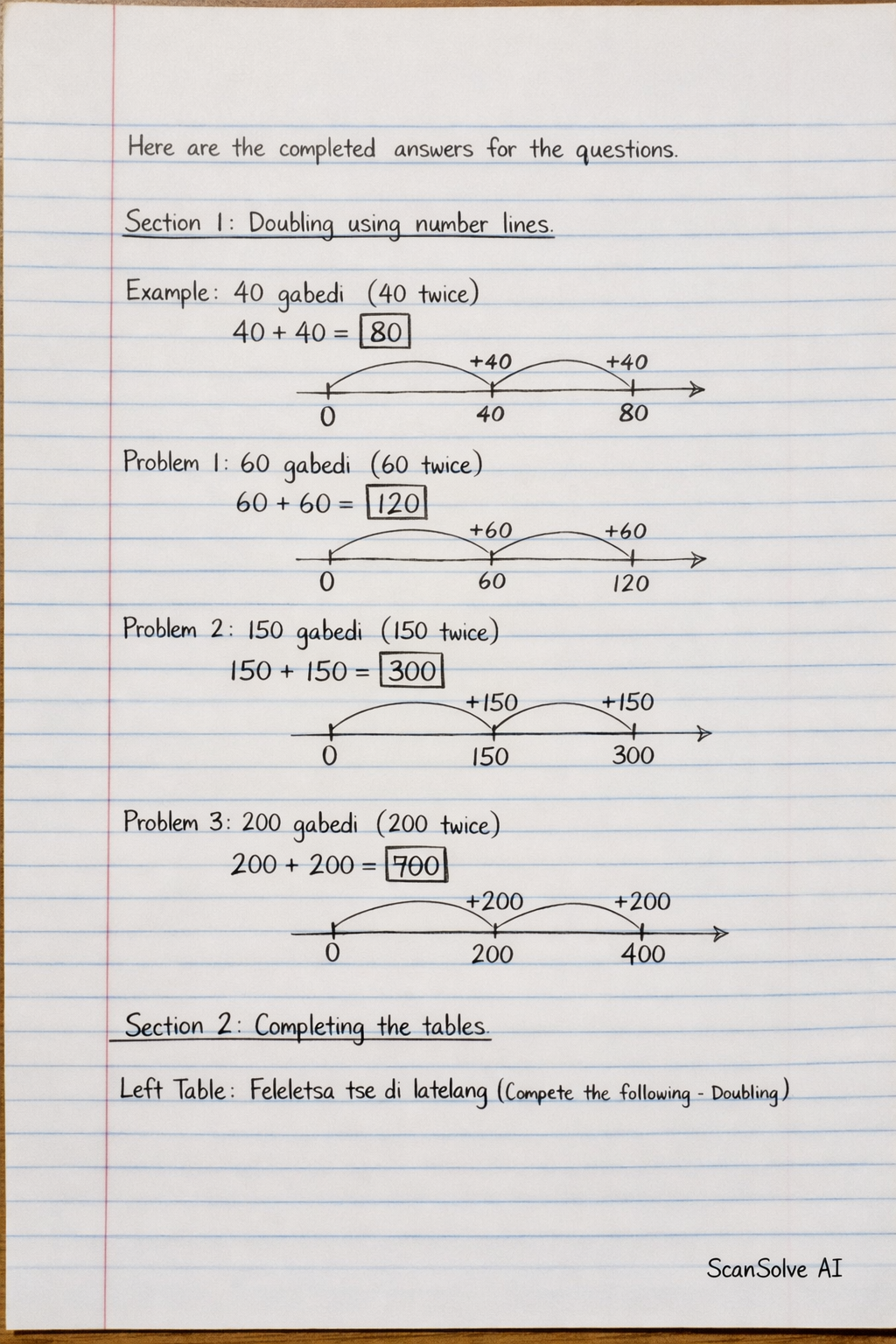
Here are the completed answers for the questions.
Section 1: Doubling using number lines
The instruction is to double the given number using addition and show it on the number line.
-
Example: 40 gabedi (40 twice)
(The number line shows a jump from 0 to 40, then another jump of 40 to 80.)
-
: 60 gabedi (60 twice)
(The number line should show a jump from 0 to 60, then another jump of 60 to 120.)
-
: 150 gabedi (150 twice)
(The number line should show a jump from 0 to 150, then another jump of 150 to 300.)
-
: 200 gabedi (200 twice)
(The number line should show a jump from 0 to 200, then another jump of 200 to 400.)
Section 2: Completing the tables
Left Table: Feleletsa tse di latelang (Complete the following - Doubling)
- a. 100 gabedi:
- b. 150 gabedi:
- c. 120 gabedi:
- d. 200 gabedi:
- e. 170 gabedi:
Right Table: Feleletsa tse di latelang (Complete the following - Halving)
- a. Hafola 220:
- b. Hafola 180:
- c. Hafola 260:
- d. Hafola 60:
- e. Hafola 320:
Still stuck on this one?
Ask a follow-up, and the answer starts from this question.
More Mathematics Questions
Handwritten Step-by-Step Solution
Get this as a handwritten image on WhatsApp — like a tutor wrote it for you.
Try on WhatsApp