ScanSolve logoScanSolve
Toggle sidebar
  • Homework
  • Tutor
  • Humanizer
  • AI Detector
  • Questions
  • Blog
  • History
  • Mobile App

  • Homework
  • Tutor
  • Humanizer
  • AI Detector

  • Questions
  • Math homework helpMath
    Physics homework helpPhysics
    Chemistry homework helpChemistry
    Biology homework helpBiology
    Computer Science homework helpComputer Science
    History homework helpHistory
    More homework helpMore
  • Blog
  • History

  • Mobile App
ScanSolvePLUS
  • Unlimited answers
  • ScanSolve AI Pro
Start Free Trial →
Try on WhatsApp
Home > Languages Homework Help > Solution

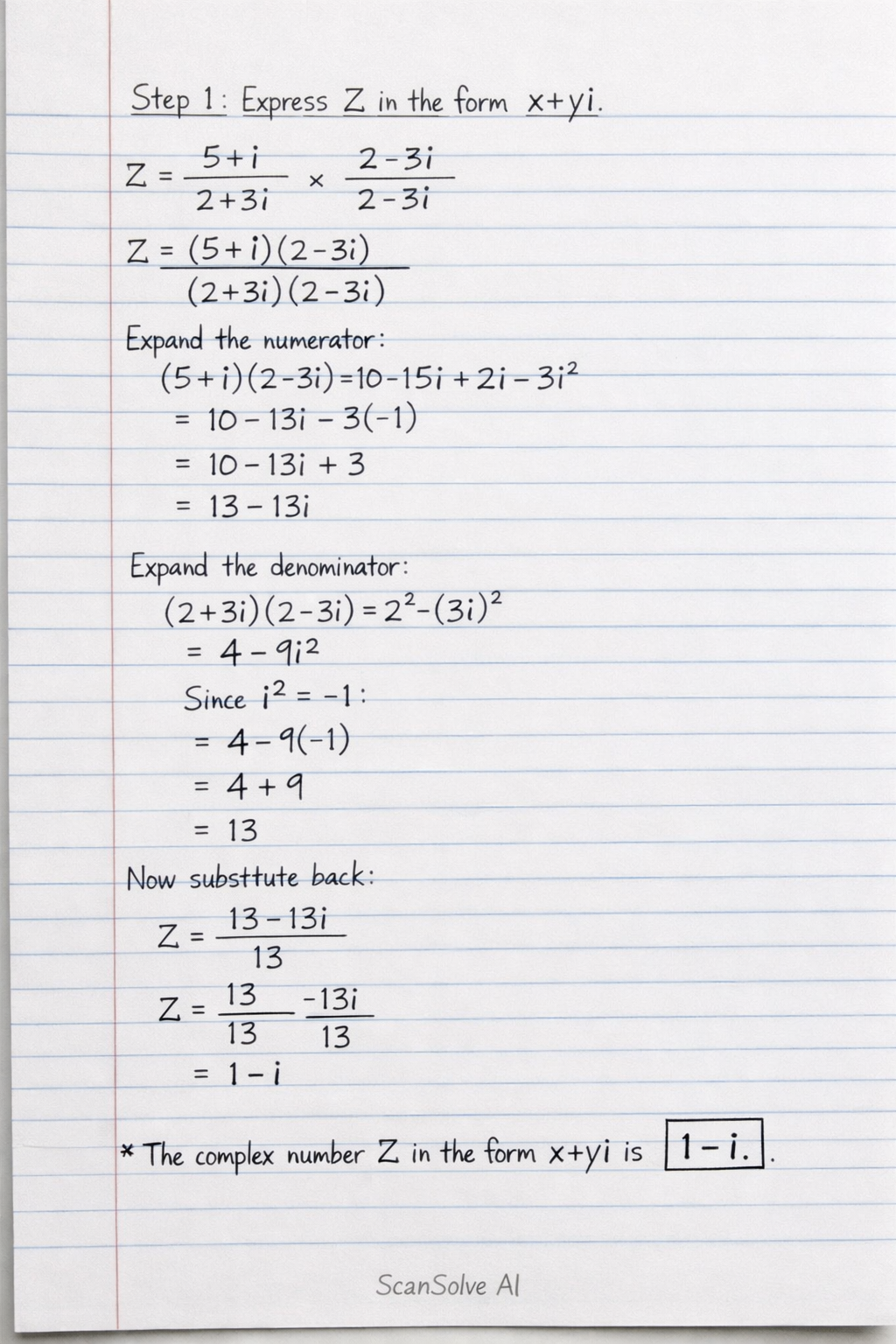
Given Z = (5+i)/(2+3i). To express this in the form x+yi, multiply the numerator and denominator by the conjugate of the denominator. The conjugate of 2+3i is 2-3i.

Asked on March 27, 2026|Languages

This languages problem is solved step by step below, with detailed explanations to help you understand the method and arrive at the correct answer.

ScanSolve AI AnswerAnswered on March 27, 2026
Step 1: Express $Z$ in the form $x+yi$. Given $Z = \frac{5+i}{2+3i}$. To express this in the form $x+yi$, multiply the numerator and denominator by the conjugate of the denominator. The conjugate of $2+3i$ is $2-3i$. $$Z = \frac{5+i}{2+3i} \times \frac{2-3i}{2-3i}$$ $$Z = \frac{(5+i)(2-3i)}{(2+3i)(2-3i)}$$ Expand the numerator: $$(5+i)(2-3i) = 5(2) + 5(-3i) + i(2) + i(-3i)$$ $$= 10 - 15i + 2i - 3i^2$$ Since $i^2 = -1$: $$= 10 - 13i - 3(-1)$$ $$= 10 - 13i + 3$$ $$= 13 - 13i$$ Expand the denominator using the difference of squares formula $(a+b)(a-b) = a^2-b^2$: $$(2+3i)(2-3i) = 2^2 - (3i)^2$$ $$= 4 - 9i^2$$ Since $i^2 = -1$: $$= 4 - 9(-1)$$ $$= 4 + 9$$ $$= 13$$ Now substitute the expanded numerator and denominator back into the expression for $Z$: $$Z = \frac{13 - 13i}{13}$$ $$Z = \frac{13}{13} - \frac{13i}{13}$$ $$Z = 1 - i$$ a) The complex number $Z$ in the form $x+yi$ is $\boxed{1-i}$. Step 2: Show that $Z = \sqrt{2}\left(\cos\frac{\pi}{4} - i\sin\frac{\pi}{4}\right)$. From part (a), we have $Z = 1 - i$. To express a complex number $x+yi$ in polar form $r(\cos\theta + i\sin\theta)$, we find the modulus $r = \sqrt{x^2+y^2}$ and the argument $\theta = \arctan\left(\frac{y}{x}\right)$ (adjusted for quadrant). For $Z = 1 - i$, we have $x=1$ and $y=-1$. Calculate the modulus $r$: $$r = \sqrt{1^2 + (-1)^2}$$ $$r = \sqrt{1+1}$$ $$r = \sqrt{2}$$ Calculate the argument $\theta$: Since $x=1$ (positive) and $y=-1$ (negative), $Z$ lies in the fourth quadrant. The reference angle $\alpha$ is given by $\tan\alpha = \left|\frac{y}{x}\right| = \left|\frac{-1}{1}\right| = 1$. So, $\alpha = \frac{\pi}{4}$. For a complex number in the fourth quadrant, $\theta = -\alpha$. $$\theta = -\frac{\pi}{4}$$ Now substitute $r$ and $\theta$ into the polar form $r(\cos\theta + i\sin\theta)$: $$Z = \sqrt{2}\left(\cos\left(-\frac{\pi}{4}\right) + i\sin\left(-\frac{\pi}{4}\right)\right)$$ Using the trigonometric identities $\cos(-\theta) = \cos\theta$ and $\sin(-\theta) = -\sin\theta$: $$Z = \sqrt{2}\left(\cos\frac{\pi}{4} - i\sin\frac{\pi}{4}\right)$$ b) We have shown that $Z = \sqrt{2}\left(\cos\frac{\pi}{4} - i\sin\frac{\pi}{4}\right)$. Step 3: By equating the form in (a) to that in (b), show that $\cos\frac{\pi}{4} = \frac{1}{\sqrt{2}}$. From part (a), $Z = 1 - i$. From part (b), $Z = \sqrt{2}\left(\cos\frac{\pi}{4} - i\sin\frac{\pi}{4}\right)$. Equate the two expressions for $Z$: $$1 - i = \sqrt{2}\left(\cos\frac{\pi}{4} - i\sin\frac{\pi}{4}\right)$$ $$1 - i = \sqrt{2}\cos\frac{\pi}{4} - i\sqrt{2}\sin\frac{\pi}{4}$$ For two complex numbers to be equal, their real parts must be equal and their imaginary parts must be equal. Equating the real parts: $$1 = \sqrt{2}\cos\frac{\pi}{4}$$ Divide by $\sqrt{2}$: $$\cos\frac{\pi}{4} = \frac{1}{\sqrt{2}}$$ c) We have shown that $\boxed{\cos\frac{\pi}{4} = \frac{1}{\sqrt{2}}}$.

Related Languages Questions

  • a) Discuss the process of sign language acquisition, focusing on production and reception skills.
  • The text in the image is in Shona and translates as follows:
  • The following are descriptions of factors of L2 acquisition EXCEPT
  • Tengeneza sentensi zenye miundo ifuatayo: KN(Ø)+KT(T+N+V), KN(N+U+N)+KT(T+N+S).
  • Ambia ngeli za maneno yafuatayo: i) manusura... ii) bahari... f) Ainisha maneno yaliyopigiwa mstari katika sentensi ifua...
  • Identify the grammatical structure (verb tense) of the underlined words in the following sentences: a) Majani ya mpera h...
See all Languages questions

This step-by-step solution was generated by ScanSolve AI. Need help with more languages problems? Browse Languages solutions or ask your own question.

Home›Languages Homework Help›Given Z = (5+i)/(2+3i). To express this in the form x+yi, mu…
Q

Given Z = (5+i)/(2+3i). To express this in the form x+yi, multiply the numerator and denominator by the conjugate of the denominator. The conjugate of 2+3i is 2-3i.

March 27, 2026|Languages
Given Z = (5+i)/(2+3i). To express this in the form x+yi, multiply the numerator and denominator by the conjugate of the denominator. The conjugate of 2+3i is 2-3i.

Given Z = (5+i)/(2+3i). To express this in the form x+yi, multiply the numerator and denominator by the conjugate of the denominator. The conjugate of 2+3i is 2-3i.

ScanSolve AI

ScanSolve AI Answer

Answered on March 27, 2026

Step 1: Express ZZZ in the form x+yix+yix+yi. Given Z=5+i2+3iZ = \frac{5+i}{2+3i}Z=2+3i5+i​. To express this in the form x+yix+yix+yi, multiply the numerator and denominator by the conjugate of the denominator. The conjugate of 2+3i2+3i2+3i is 2−3i2-3i2−3i.

Z=5+i2+3i×2−3i2−3iZ = \frac{5+i}{2+3i} \times \frac{2-3i}{2-3i}Z=2+3i5+i​×2−3i2−3i​ Z=(5+i)(2−3i)(2+3i)(2−3i)Z = \frac{(5+i)(2-3i)}{(2+3i)(2-3i)}Z=(2+3i)(2−3i)(5+i)(2−3i)​ Expand the numerator: (5+i)(2−3i)=5(2)+5(−3i)+i(2)+i(−3i)(5+i)(2-3i) = 5(2) + 5(-3i) + i(2) + i(-3i)(5+i)(2−3i)=5(2)+5(−3i)+i(2)+i(−3i) =10−15i+2i−3i2= 10 - 15i + 2i - 3i^2=10−15i+2i−3i2 Since i2=−1i^2 = -1i2=−1: =10−13i−3(−1)= 10 - 13i - 3(-1)=10−13i−3(−1) =10−13i+3= 10 - 13i + 3=10−13i+3 =13−13i= 13 - 13i=13−13i Expand the denominator using the difference of squares formula (a+b)(a−b)=a2−b2(a+b)(a-b) = a^2-b^2(a+b)(a−b)=a2−b2: (2+3i)(2−3i)=22−(3i)2(2+3i)(2-3i) = 2^2 - (3i)^2(2+3i)(2−3i)=22−(3i)2 =4−9i2= 4 - 9i^2=4−9i2 Since i2=−1i^2 = -1i2=−1: =4−9(−1)= 4 - 9(-1)=4−9(−1) =4+9= 4 + 9=4+9 =13= 13=13 Now substitute the expanded numerator and denominator back into the expression for ZZZ: Z=13−13i13Z = \frac{13 - 13i}{13}Z=1313−13i​ Z=1313−13i13Z = \frac{13}{13} - \frac{13i}{13}Z=1313​−1313i​ Z=1−iZ = 1 - iZ=1−i a) The complex number ZZZ in the form x+yix+yix+yi is 1−i\boxed{1-i}1−i​.

Step 2: Show that Z=2(cos⁡π4−isin⁡π4)Z = \sqrt{2}\left(\cos\frac{\pi}{4} - i\sin\frac{\pi}{4}\right)Z=2​(cos4π​−isin4π​). From part (a), we have Z=1−iZ = 1 - iZ=1−i. To express a complex number x+yix+yix+yi in polar form r(cos⁡θ+isin⁡θ)r(\cos\theta + i\sin\theta)r(cosθ+isinθ), we find the modulus r=x2+y2r = \sqrt{x^2+y^2}r=x2+y2​ and the argument θ=arctan⁡(yx)\theta = \arctan\left(\frac{y}{x}\right)θ=arctan(xy​) (adjusted for quadrant). For Z=1−iZ = 1 - iZ=1−i, we have x=1x=1x=1 and y=−1y=-1y=−1. Calculate the modulus rrr: r=12+(−1)2r = \sqrt{1^2 + (-1)^2}r=12+(−1)2​ r=1+1r = \sqrt{1+1}r=1+1​ r=2r = \sqrt{2}r=2​ Calculate the argument θ\thetaθ: Since x=1x=1x=1 (positive) and y=−1y=-1y=−1 (negative), ZZZ lies in the fourth quadrant. The reference angle α\alphaα is given by tan⁡α=∣yx∣=∣−11∣=1\tan\alpha = \left|\frac{y}{x}\right| = \left|\frac{-1}{1}\right| = 1tanα=​xy​​=​1−1​​=1. So, α=π4\alpha = \frac{\pi}{4}α=4π​. For a complex number in the fourth quadrant, θ=−α\theta = -\alphaθ=−α. θ=−π4\theta = -\frac{\pi}{4}θ=−4π​ Now substitute rrr and θ\thetaθ into the polar form r(cos⁡θ+isin⁡θ)r(\cos\theta + i\sin\theta)r(cosθ+isinθ): Z=2(cos⁡(−π4)+isin⁡(−π4))Z = \sqrt{2}\left(\cos\left(-\frac{\pi}{4}\right) + i\sin\left(-\frac{\pi}{4}\right)\right)Z=2​(cos(−4π​)+isin(−4π​)) Using the trigonometric identities cos⁡(−θ)=cos⁡θ\cos(-\theta) = \cos\thetacos(−θ)=cosθ and sin⁡(−θ)=−sin⁡θ\sin(-\theta) = -\sin\thetasin(−θ)=−sinθ: Z=2(cos⁡π4−isin⁡π4)Z = \sqrt{2}\left(\cos\frac{\pi}{4} - i\sin\frac{\pi}{4}\right)Z=2​(cos4π​−isin4π​) b) We have shown that Z=2(cos⁡π4−isin⁡π4)Z = \sqrt{2}\left(\cos\frac{\pi}{4} - i\sin\frac{\pi}{4}\right)Z=2​(cos4π​−isin4π​).

Step 3: By equating the form in (a) to that in (b), show that cos⁡π4=12\cos\frac{\pi}{4} = \frac{1}{\sqrt{2}}cos4π​=2​1​. From part (a), Z=1−iZ = 1 - iZ=1−i. From part (b), Z=2(cos⁡π4−isin⁡π4)Z = \sqrt{2}\left(\cos\frac{\pi}{4} - i\sin\frac{\pi}{4}\right)Z=2​(cos4π​−isin4π​). Equate the two expressions for ZZZ: 1−i=2(cos⁡π4−isin⁡π4)1 - i = \sqrt{2}\left(\cos\frac{\pi}{4} - i\sin\frac{\pi}{4}\right)1−i=2​(cos4π​−isin4π​) 1−i=2cos⁡π4−i2sin⁡π41 - i = \sqrt{2}\cos\frac{\pi}{4} - i\sqrt{2}\sin\frac{\pi}{4}1−i=2​cos4π​−i2​sin4π​ For two complex numbers to be equal, their real parts must be equal and their imaginary parts must be equal. Equating the real parts: 1=2cos⁡π41 = \sqrt{2}\cos\frac{\pi}{4}1=2​cos4π​ Divide by 2\sqrt{2}2​: cos⁡π4=12\cos\frac{\pi}{4} = \frac{1}{\sqrt{2}}cos4π​=2​1​ c) We have shown that cos⁡π4=12\boxed{\cos\frac{\pi}{4} = \frac{1}{\sqrt{2}}}cos4π​=2​1​​.

Need help with your own homework?

Get instant step-by-step solutions to any question. Free to start.

Ask Your Question
Handwritten step-by-step solution

Handwritten Step-by-Step Solution

Get this solution as a handwritten image on WhatsApp — just like a tutor wrote it for you.

Try on WhatsApp

More Languages Questions

a) Discuss the process of sign language acquisition, focusing on production and reception skills.The text in the image is in Shona and translates as follows:The following are descriptions of factors of L2 acquisition EXCEPTTengeneza sentensi zenye miundo ifuatayo: KN(Ø)+KT(T+N+V), KN(N+U+N)+KT(T+N+S).Ambia ngeli za maneno yafuatayo: i) manusura... ii) bahari... f) Ainisha maneno yaliyopigiwa mstari…Identify the grammatical structure (verb tense) of the underlined words in the following sentences:…
See all Languagesquestions →
Languages: Given Z = (5+i)/(2+3i). To express this in the form x+yi, multiply the numerator... — Step-by-Step Solution | ScanSolve