
I don't understand french, translate all this to English
ScanSolve AI Answer
Step-by-step solution
4 stepsHere are the solutions to your questions, translated into English:
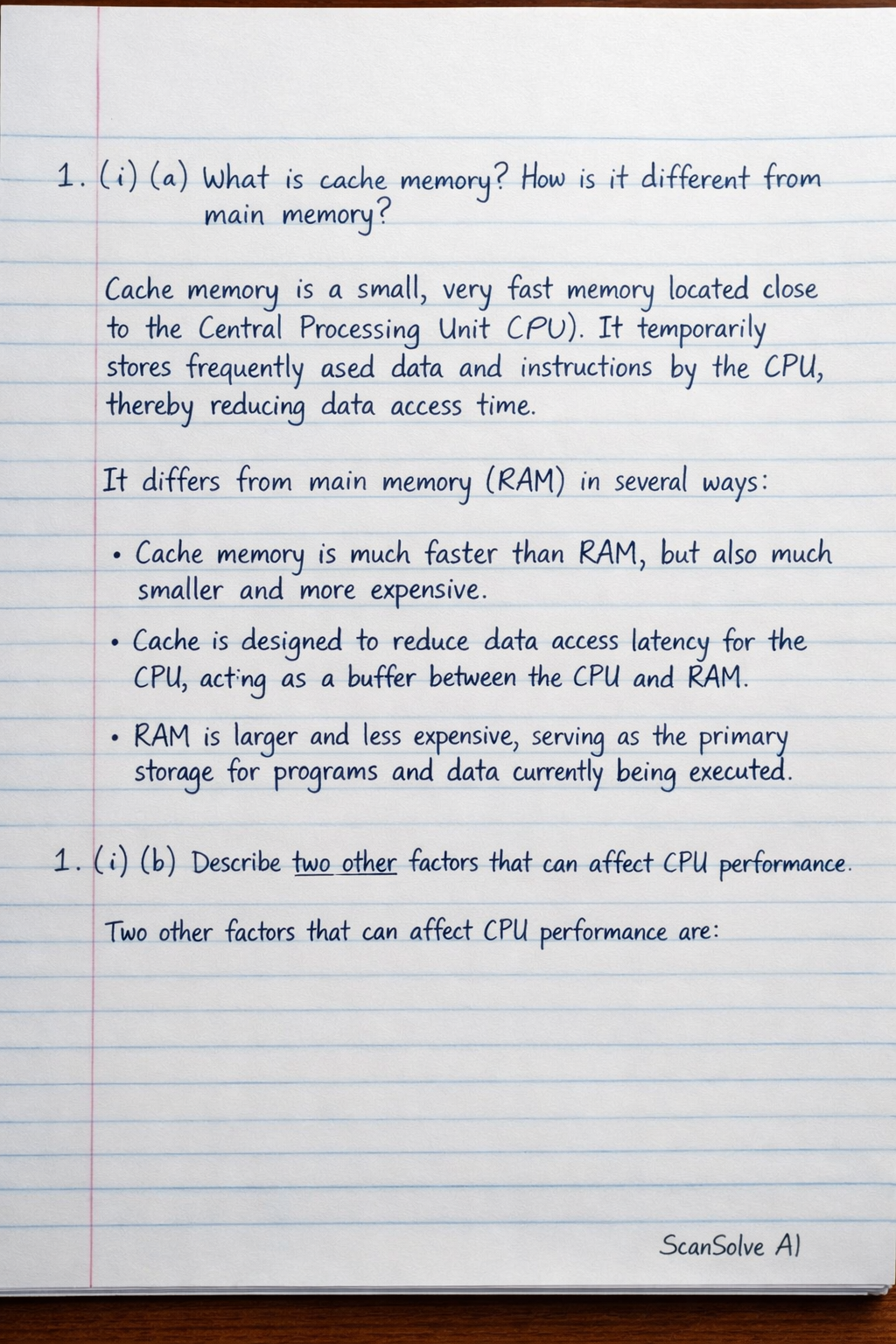
1. (i) (a) What is cache memory? How is it different from main memory?
Cache memory is a small, very fast memory located close to the Central Processing Unit (CPU). It temporarily stores frequently used data and instructions by the CPU, thereby reducing data access time.
It differs from main memory (RAM) in several ways:
- Cache memory is much faster than RAM, but also much smaller and more expensive.
- Cache is designed to reduce data access latency for the CPU, acting as a buffer between the CPU and RAM.
- RAM is larger and less expensive, serving as the primary storage for programs and data currently being executed.
1. (i) (b) Describe two other factors that can affect CPU performance.
Two other factors that can affect CPU performance are:
- Clock speed (or clock rate): Measured in gigahertz (GHz), it determines the number of cycles the CPU can execute per second. A higher clock speed means the CPU can process more instructions per second, thus improving performance.
- Number of cores: A multi-core CPU contains several independent processing units (cores). Each core can execute different tasks simultaneously, allowing the CPU to handle multiple processes or threads in parallel, significantly improving performance for multi-threaded applications.
1. (ii) (a) From the truth table, determine the sum of products form for output Q. Then, show that Q = A ⊕ B ⊕ C.
The truth table is as follows:
| A | B | C | Q |
|---|---|---|---|
| 0 | 0 | 0 | 0 |
| 0 | 0 | 1 | 1 |
| 0 | 1 | 0 | 1 |
| 0 | 1 | 1 | 0 |
| 1 | 0 | 0 | 1 |
| 1 | 0 | 1 | 0 |
| 1 | 1 | 0 | 0 |
| 1 | 1 | 1 | 1 |
Determine the sum of products (SOP) form.
The output Q is '1' for the following minterms:
- A=0, B=0, C=1
- A=0, B=1, C=0
- A=1, B=0, C=0
- A=1, B=1, C=1
The sum of products form for Q is:
Show that .
The XOR (⊕) operator is defined as .
For three variables, .
First, let's calculate :
Now, let's calculate :
Let . Then .
We know that .
So, .
Using De Morgan's theorem, :
Now, substitute and into :
Comparing this expression with the sum of products form obtained in Step 1, we see that they are identical.
We have shown that .
1. (ii) (b) Ignoring production cost, state two advantages of designing the digital circuit using the expression Q = A ⊕ B ⊕ C rather than the sum of products form obtained in ii(a) above.
Two advantages of using the expression are:
- Circuit simplicity: The expression can be implemented with fewer logic gates (e.g., two two-input XOR gates or a single three-input XOR gate) compared to the sum of products form (), which would require NOT, AND, and OR gates. A simpler circuit is easier to design and debug.
- Reduced propagation delay: A circuit with fewer logic gates and fewer gate levels will generally have a shorter propagation delay. This means that the output signal Q will be available more quickly after a change in inputs A, B, or C, which improves the operating speed of the circuit.
1. (ii) (c) Draw a logic circuit diagram for the Boolean expression F = A'B + (A ⊕ B ⊕ C).
Identify the components.
The expression consists of two parts combined by an OR gate:
- The first part is .
- The second part is .
Draw the circuit.
- For : A NOT gate for (giving ), then an AND gate with and .
- For : Two two-input XOR gates in cascade (one for , then another for ).
- Finally, an OR gate combines the output of the AND gate and the output of the last XOR gate.
Here is a textual representation of the circuit diagram:
- Inputs: A, B, C
- Part A'B:
- A goes through a NOT gate to become A'.
- A' and B are the inputs to an AND gate. The output is .
- Part A ⊕ B ⊕ C:
- A and B are the inputs to a first XOR gate. The output is .
- The output and C are the inputs to a second XOR gate. The output is .
- Final Part F:
- The output of the AND gate () and the output of the second XOR gate () are the inputs to an OR gate. The output is .
Still stuck on this one?
Ask a follow-up, and the answer starts from this question.
More Languages Questions
Handwritten Step-by-Step Solution
Get this as a handwritten image on WhatsApp — like a tutor wrote it for you.
Try on WhatsApp