solve in English I don't understand french

Languages
solve in English I don't understand french

ScanSolve AI Answer

Answer

0.5 Nm

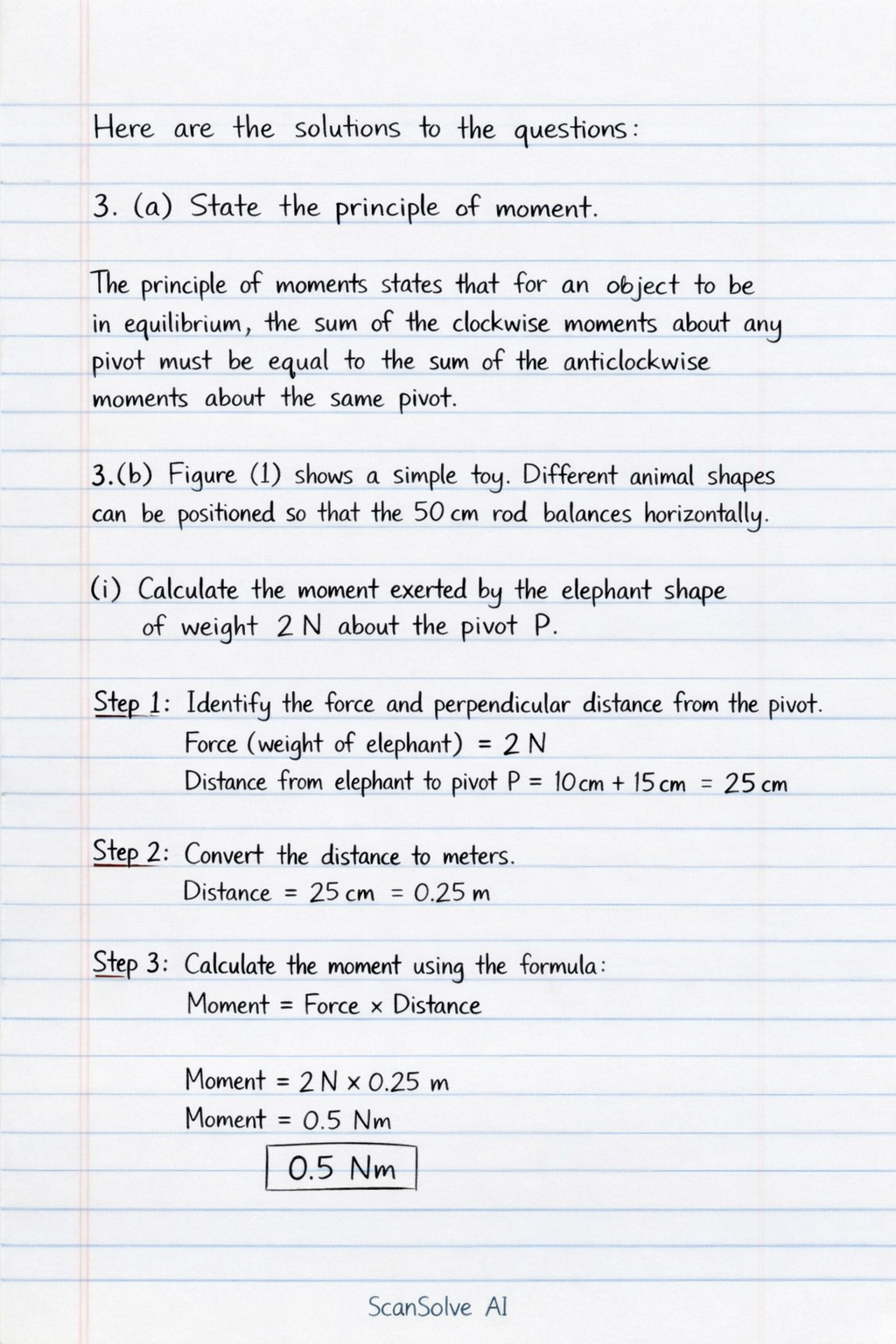
Here are the solutions to the questions:

3. (a) State the principle of moment. The principle of moments states that for an object to be in equilibrium, the sum of the clockwise moments about any pivot must be equal to the sum of the anticlockwise moments about the same pivot.

3. (b) Figure (1) shows a simple toy. Different animal shapes can be positioned so that the 50 cm rod balances horizontally.

  • (i) Calculate the moment exerted by the elephant shape of weight 2 N about the pivot P. Step 1: Identify the force and perpendicular distance from the pivot. Force (weight of elephant) = 2 N2 \text{ N} Distance from elephant to pivot P = 10cm+15cm=25 cm10 cm + 15 cm = 25 \text{ cm} Step 2: Convert the distance to meters. Distance = 25cm=0.25 m25 cm = 0.25 \text{ m} Step 3: Calculate the moment using the formula: Moment = Force ×\times Distance. Moment=2N×0.25mMoment = 2 N \times 0.25 m Moment=0.5 NmMoment = 0.5 \text{ Nm}

  • (ii) Calculate the weight of the monkey shape. Step 1: Apply the principle of moments: Clockwise moment = Anticlockwise moment. The moment due to the elephant (anticlockwise) is 0.5 Nm0.5 \text{ Nm}. Step 2: Identify the distance of the monkey from the pivot. Distance from monkey to pivot P = 20cm+5cm=25cm=0.25 m20 cm + 5 cm = 25 cm = 0.25 \text{ m} Step 3: Let WMW_M be the weight of the monkey. Set the moments equal. Moment(elephant)=Moment(monkey)Moment (elephant) = Moment (monkey) 0.5Nm=WM×0.25m0.5 Nm = W_M \times 0.25 m Step 4: Solve for WMW_M. WM=0.5Nm0.25mW_M = \frac{0.5 Nm}{0.25 m} WM=2 NW_M = 2 \text{ N}

3. (c) Name one everyday situation where moment is used.

  • Using a spanner to tighten or loosen a nut.

4. (a) Define the term e.m.f. as used in current electricity. Electromotive force (e.m.f.) is the work done per unit charge by a source of energy (like a battery) in moving a unit positive charge around a complete circuit. It is the potential difference across the terminals of the source when no current is flowing.

4. (b) A source of e.m.f. of 20 V and negligible internal resistance is connected to resistors of 2Ω2 \Omega, 2Ω2 \Omega and 3Ω3 \Omega as shown in the figure below.

  • (i) Find the ammeter reading when switch K is Open. Step 1: When switch K is open, the 2Ω2 \Omega resistor in parallel with K is disconnected. Step 2: The 3Ω3 \Omega resistor and the other 2Ω2 \Omega resistor are in series. Calculate the total resistance (RTR_T). RT=3Ω+2Ω=5ΩR_T = 3 \Omega + 2 \Omega = 5 \Omega Step 3: Use Ohm's Law (I=e.m.f.RTI = \frac{e.m.f.}{R_T}) to find the current. I=20V5ΩI = \frac{20 V}{5 \Omega} I=4 AI = 4 \text{ A}

  • (ii) Find the ammeter reading when switch K is Closed. Step 1: When switch K is closed, the two 2Ω2 \Omega resistors are in parallel. Calculate their equivalent resistance (RPR_P). 1RP=12Ω+12Ω\frac{1}{R_P} = \frac{1}{2 \Omega} + \frac{1}{2 \Omega} 1RP=22Ω=11Ω\frac{1}{R_P} = \frac{2}{2 \Omega} = \frac{1}{1 \Omega} RP=1ΩR_P = 1 \Omega Step 2: The 3Ω3 \Omega resistor is in series with this parallel combination. Calculate the total resistance (RTR_T). RT=3Ω+RP=3Ω+1Ω=4ΩR_T = 3 \Omega + R_P = 3 \Omega + 1 \Omega = 4 \Omega Step 3: Use Ohm's Law (I=e.m.f.RTI = \frac{e.m.f.}{R_T}) to find the current. I=20V4ΩI = \frac{20 V}{4 \Omega} I=5 AI = 5 \text{ A}

4. (c) What is meant by short circuit as applied to electricity? A short circuit is an unintended low-resistance connection between two points in an electrical circuit that are meant to be at different potentials, leading to an excessive and potentially damaging flow of current.

Got more? Send 'em.

Was this helpful?

Need help with your own homework?

Get instant step-by-step solutions to any question. Free to start.

Ask Your Question
Handwritten step-by-step solution preview

Handwritten Step-by-Step Solution

Get this as a handwritten image on WhatsApp — like a tutor wrote it for you.

Try on WhatsApp

Still have questions?

solve in English I don't understand french
Languages

This languages problem is solved step by step below, with detailed explanations to help you understand the method and arrive at the correct answer.

ScanSolve AI Answer
Here are the solutions to the questions: 3. (a) State the principle of moment. The principle of moments states that for an object to be in equilibrium, the sum of the clockwise moments about any pivot must be equal to the sum of the anticlockwise moments about the same pivot. 3. (b) Figure (1) shows a simple toy. Different animal shapes can be positioned so that the 50 cm rod balances horizontally. (i) Calculate the moment exerted by the elephant shape of weight 2 N about the pivot P. Step 1: Identify the force and perpendicular distance from the pivot. Force (weight of elephant) = 2 N Distance from elephant to pivot P = 10 cm + 15 cm = 25 cm Step 2: Convert the distance to meters. Distance = 25 cm = 0.25 m Step 3: Calculate the moment using the formula: Moment = Force × Distance. Moment = 2 N × 0.25 m Moment = 0.5 Nm (ii) Calculate the weight of the monkey shape. Step 1: Apply the principle of moments: Clockwise moment = Anticlockwise moment. The moment due to the elephant (anticlockwise) is 0.5 Nm. Step 2: Identify the distance of the monkey from the pivot. Distance from monkey to pivot P = 20 cm + 5 cm = 25 cm = 0.25 m Step 3: Let W_M be the weight of the monkey. Set the moments equal. Moment (elephant) = Moment (monkey) 0.5 Nm = W_M × 0.25 m Step 4: Solve for W_M. W_M = 0.5 Nm0.25 m W_M = 2 N 3. (c) Name one everyday situation where moment is used. Using a spanner* to tighten or loosen a nut. 4. (a) Define the term e.m.f. as used in current electricity. Electromotive force (e.m.f.) is the work done per unit charge by a source of energy (like a battery) in moving a unit positive charge around a complete circuit. It is the potential difference across the terminals of the source when no current is flowing. 4. (b) A source of e.m.f. of 20 V and negligible internal resistance is connected to resistors of 2 , 2 and 3 as shown in the figure below. (i) Find the ammeter reading when switch K is Open. Step 1: When switch K is open, the 2 resistor in parallel with K is disconnected. Step 2: The 3 resistor and the other 2 resistor are in series. Calculate the total resistance (R_T). R_T = 3 + 2 = 5 Step 3: Use Ohm's Law (I = e.m.f.R_T) to find the current. I = 20 V5 I = 4 A (ii) Find the ammeter reading when switch K is Closed. Step 1: When switch K is closed, the two 2 resistors are in parallel. Calculate their equivalent resistance (R_P). (1)/(R_P) = (1)/(2 ) + (1)/(2 ) (1)/(R_P) = (2)/(2 ) = (1)/(1 ) R_P = 1 Step 2: The 3 resistor is in series with this parallel combination. Calculate the total resistance (R_T). R_T = 3 + R_P = 3 + 1 = 4 Step 3: Use Ohm's Law (I = e.m.f.R_T) to find the current. I = 20 V4 I = 5 A 4. (c) What is meant by short circuit as applied to electricity? A short circuit is an unintended low-resistance connection between two points in an electrical circuit that are meant to be at different potentials, leading to an excessive and potentially damaging flow of current. Got more? Send 'em.