
Solve in English not French
ScanSolve AI Answer
Answer
Step-by-step solution
4 stepsHere is the solution to the next question.
Part 4
Part b
To determine the speed of sound in air, we need to find the time it takes for the sound to travel from the speaker to the microphone and the distance between them.
Determine the time difference () between the two waves from the oscilloscope display.
The oscilloscope shows two waves. Channel 1 (speaker) represents the sound emitted, and Channel 2 (microphone) represents the sound received.
The time base is given as 0.5 ms/div.
By observing the graph, the peak of the wave from Channel 1 aligns with a major grid line. The corresponding peak for Channel 2 is 2 divisions to the right of the Channel 1 peak.
So, the time difference is:Convert the time difference to seconds.
Use the distance between the speaker and the microphone and the calculated time difference to find the speed of sound ().
The distance is given as 0.85 m.
The formula for speed is:Substitute the values and calculate the speed.
The speed of sound in air is .
Try one yourself
A new problem that tests the same skill.
Still stuck on this one?
Ask a follow-up, and the answer starts from this question.
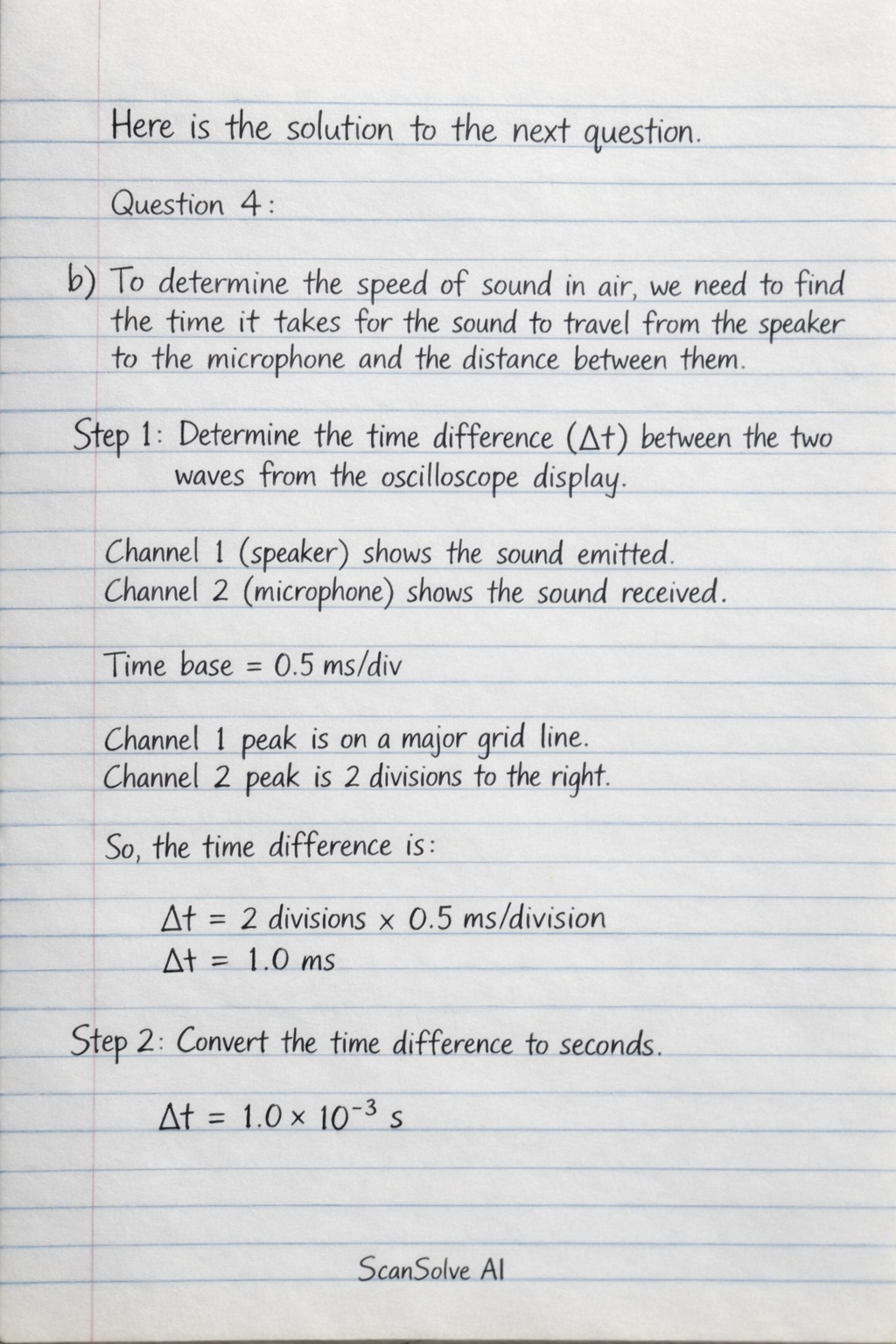
Handwritten Step-by-Step Solution
Get this as a handwritten image on WhatsApp — like a tutor wrote it for you.
Try on WhatsApp