

This history question requires analysis of historical events, causes, and consequences. The detailed answer below provides context, evidence, and a well-structured explanation.
ScanSolve AI Answer
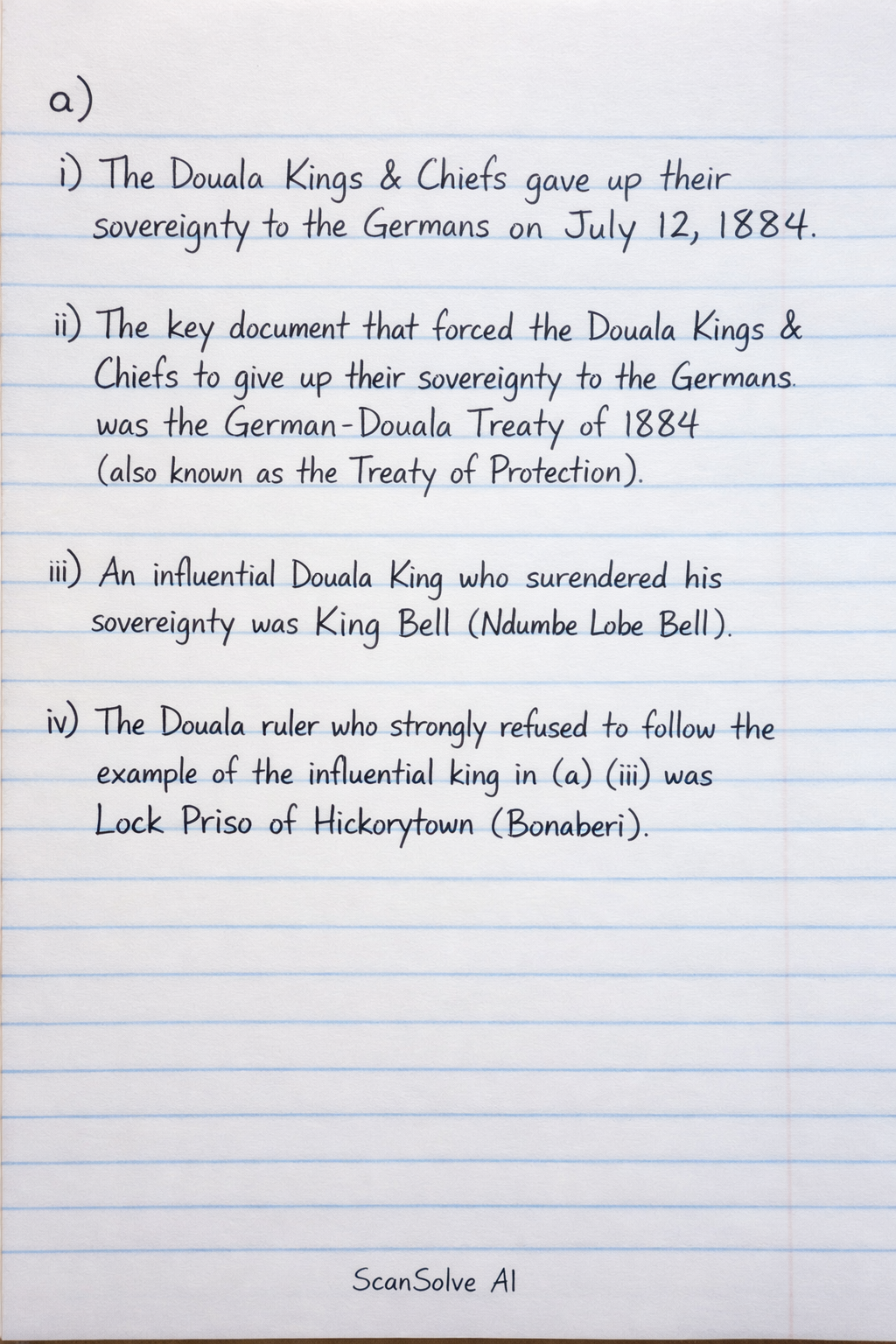
a) i) The exact date in which the Douala Kings and Chiefs decided to give up their sovereignty to the Germans in the 1880s was July 12, 1884. ii) The important document that compelled the Douala Kings and Chiefs to give up their sovereignty to the Germans in the 1880s was the German-Douala Treaty of 1884 (also known as the Treaty of Protection). iii) One influential Douala King who gave up his sovereignty was King Bell (Ndumbe Lobe Bell). iv) The Douala traditional ruler who vehemently refused to emulate the example of the influential king mentioned in (a)(iii) above was Lock Priso of Hickorytown (Bonaberi). b) Two economic reasons why the Germans were determined to penetrate into the interior of Cameroon after the annexation of the territory were: • To bypass the Douala middlemen who controlled coastal trade and made access to interior resources "elusive," thereby gaining direct access to the interior's wealth. • To control and redirect trade routes (e.g., those through Banyo and Bangwa) that were diverting goods towards British Nigeria, ensuring that interior resources and trade benefited Germany. c) i) Two political problems which the Germans encountered in the course of penetration into the interior of Cameroon were: • Resistance from local people in the interior, which continued in various forms until the First World War. • Confrontations with the Douala Kings and Chiefs as German actions led to inevitable clashes over control and influence. ii) One traditional ruler who collaborated with the Germans as they penetrated into the interior of Cameroon was Sultan Njoya of Bamum. d) i) Apart from those mentioned in the extract, two other ethnic groups that fiercely opposed German penetration into the interior of Cameroon in the 1880s were the Bakweri and the Bassa. ii) Two social reasons that influenced most of the ethnic groups to resist the German penetration into the interior of Cameroon were: • The desire to preserve their traditional sovereignty and independence, as German rule threatened their existing political and social structures. • The disruption of their traditional way of life, customs, and social order by the imposition of German colonial laws, administration, and cultural norms. e) i) The town where the Germans built their first military inland station as they made efforts to discover overland inland routes leading into the interior of Cameroon was Yaoundé. ii) Dr. Eugen Zintgraff arrived in the Bamenda grass field in 1889. iii) The main provisions of the Friendship Treaty he signed with the traditional ruler of Bali in 1891 were: • An agreement for mutual friendship and alliance between the Germans and the Bali people. • Permission for the Germans to establish a station within Bali territory.