
We read your photo as:
Is it accurate to say that language assessment should measure distinct reading sub-skills rather than treating reading as a single ability?
ScanSolve AI Answer
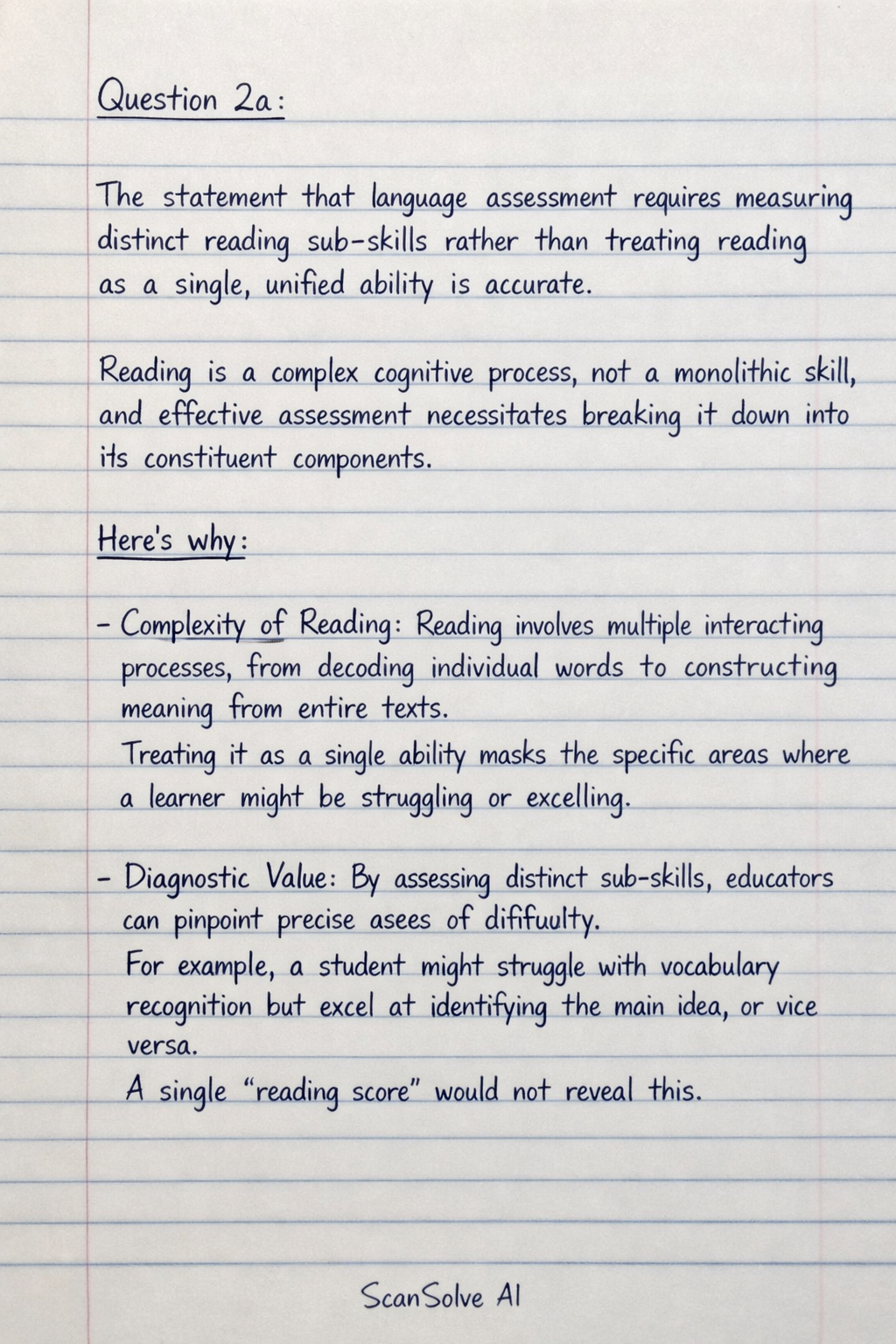
The statement that language assessment requires measuring distinct reading sub-skills rather than treating reading as a single, unified ability is accurate. Reading is a complex cognitive process, not a monolithic skill, and effective assessment necessitates breaking it down into its constituent components.
Here's why:
- Complexity of Reading: Reading involves multiple interacting processes, from decoding individual words to constructing meaning from entire texts. Treating it as a single ability masks the specific areas where a learner might be struggling or excelling.
- Diagnostic Value: By assessing distinct sub-skills, educators can pinpoint precise areas of difficulty. For example, a student might struggle with vocabulary recognition but excel at identifying the main idea, or vice versa. A single "reading score" would not reveal this.
- Targeted Instruction: Understanding specific weaknesses allows for highly targeted and effective instructional interventions. If a student has difficulty with inferencing, instruction can focus specifically on that skill, rather than general reading practice.
- Examples of Sub-skills: Key reading sub-skills include:
- Decoding and phonological awareness: Recognizing letters and sounds.
- Vocabulary knowledge: Understanding word meanings.
- Sentence comprehension: Grasping the meaning of individual sentences.
- Main idea identification: Determining the central theme of a text.
- Identifying specific details: Locating explicit information.
- Inferencing: Drawing conclusions based on implicit information.
- Understanding text structure: Recognizing how a text is organized (e.g., cause/effect, comparison).
- Critical evaluation: Analyzing the author's purpose, bias, or argument.
- Comprehensive Feedback: Assessing sub-skills provides learners with specific, actionable feedback on their strengths and weaknesses, empowering them to focus their efforts on particular areas for improvement.
Therefore, a robust language assessment system must disaggregate reading into its component sub-skills to provide meaningful diagnostic information, guide instruction, and ultimately foster more effective reading development.
Still stuck on this one?
Ask a follow-up, and the answer starts from this question.
More Languages Questions
Handwritten Step-by-Step Solution
Get this as a handwritten image on WhatsApp — like a tutor wrote it for you.
Try on WhatsApp