
We read your photo as:
Explain the differences between proficiency, achievement, and diagnostic tests in language education, focusing on their purpose, design, and alignment.
ScanSolve AI Answer
Question 1bA:
In language education, distinguishing between different types of tests is crucial for effective assessment.
-
Proficiency Tests: These tests measure a learner's overall language ability independent of specific instruction, assessing their capacity to use language in real-world contexts. Their primary purpose is to determine general competence for external purposes like university admission or job placement. Design involves a broad scope, often covering all four skills with authentic materials. Construct validity is paramount, ensuring the test accurately measures the underlying language construct. Alignment is with external standards and real-world language demands, not a specific curriculum.
-
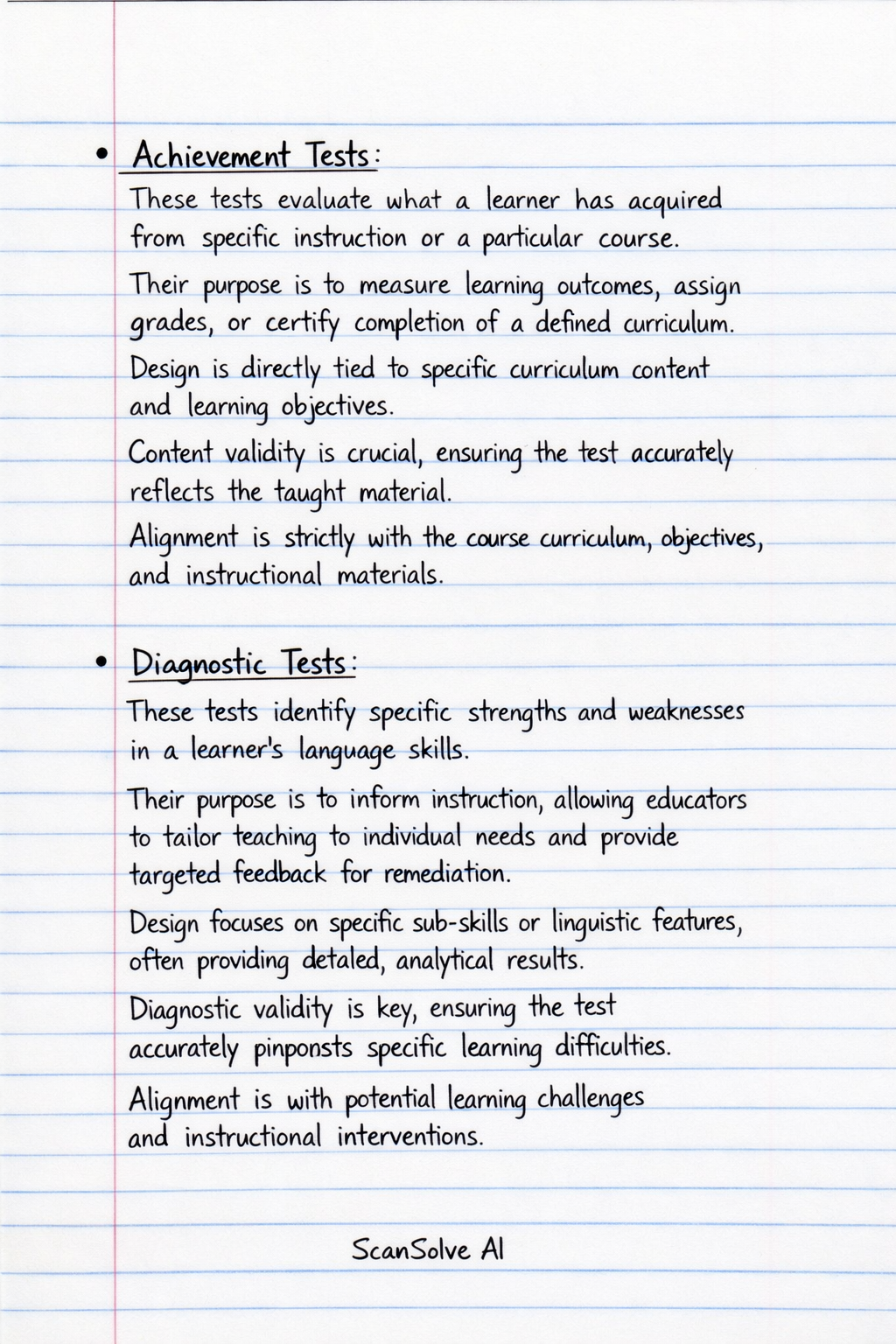
Achievement Tests: These tests evaluate what a learner has acquired from specific instruction or a particular course. Their purpose is to measure learning outcomes, assign grades, or certify completion of a defined curriculum. Design is directly tied to specific curriculum content and learning objectives. Content validity is crucial, ensuring the test accurately reflects the taught material. Alignment is strictly with the course curriculum, objectives, and instructional materials.
-
Diagnostic Tests: These tests identify specific strengths and weaknesses in a learner's language skills. Their purpose is to inform instruction, allowing educators to tailor teaching to individual needs and provide targeted feedback for remediation. Design focuses on specific sub-skills or linguistic features, often providing detailed, analytical results. Diagnostic validity is key, ensuring the test accurately pinpoints specific learning difficulties. Alignment is with potential learning challenges and instructional interventions.
-
Placement Tests: These tests assign learners to appropriate levels or courses within a language program. Their purpose is to ensure students are placed in classes where the challenge level is optimal for their learning. Design covers a range of language levels, often combining elements of proficiency and achievement to differentiate learners. Predictive validity is essential, as the test must accurately forecast a student's success in a given level. Alignment is with the program's curriculum and level descriptions.
Understanding these distinctions, along with their specific design, validity, and alignment considerations, is fundamental for developing and using assessments that are fair, accurate, and supportive of language learning goals.
Still stuck on this one?
Ask a follow-up, and the answer starts from this question.
More Languages Questions
Handwritten Step-by-Step Solution
Get this as a handwritten image on WhatsApp — like a tutor wrote it for you.
Try on WhatsApp